

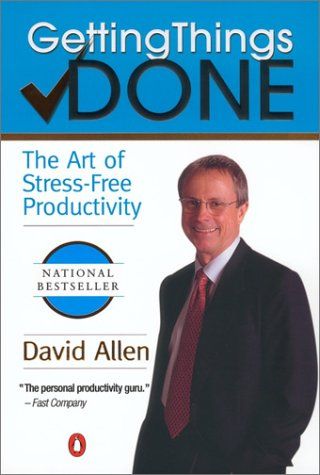
Getting Things Done
The Art of Stress-Free Productivity
Introduction
Nova: Have you ever had that feeling where your brain feels like a browser with fifty tabs open, and you can hear the fan spinning but nothing is actually loading?
Atlas: Every single Tuesday morning, Nova. Honestly, every morning. It feels like my head is just a giant bucket with a hole in the bottom, and I am desperately trying to refill it with to-do lists while everything leaks out.
Nova: That is the perfect metaphor for why we are here today. We are diving into a book that changed the productivity world forever when it first came out in 2001, and it is still the gold standard today. We are talking about Getting Things Done by David Allen.
Atlas: I have heard the name GTD everywhere. It is like a cult. People swear by it like it is a religion. But let’s be real, is this just another way to write a to-do list, or is there actually some magic here for people like me who are drowning in emails?
Nova: It is definitely not just a to-do list. David Allen’s core philosophy is actually quite radical. He says that your brain is for having ideas, not for holding them. He wants us to get to a state he calls Mind Like Water.
Atlas: Mind Like Water? That sounds a bit too Zen for someone who has three meetings starting at the same time and a car that needs an oil change.
Nova: Think about it this way: if you throw a pebble into a still pond, the water reacts with exactly the right amount of force. It doesn’t overreact, it doesn’t underreact, and then it goes back to being still. Most of us are overreacting to small emails and underreacting to big life goals because our brains are so cluttered. Today, we are going to break down how to actually build that still pond and empty the bucket once and for all.
Key Insight 1
The Five-Step Engine
Nova: To get to that Mind Like Water state, David Allen outlines a five-step workflow that he calls the engine of the system. It is Capture, Clarify, Organize, Reflect, and Engage.
Atlas: Five steps? That already sounds like work. Why can’t I just write down what I need to do and do it?
Nova: Because your brain is a terrible filing cabinet. The first step, Capture, is about getting every single thing out of your head and into a trusted system. Not just work stuff. Everything. The fact that you need to buy milk, that idea for a screenplay, the weird noise your fridge is making.
Atlas: So I just carry a notebook and write down every random thought? That sounds like I am going to end up with a three-hundred-page list of nonsense.
Nova: That is where step two comes in: Clarify. This is where most people fail. They look at their list and see things like Mom. What does Mom mean? Is it her birthday? Do you need to call her? Do you need to buy her a gift? David Allen says if it takes more than one step, it is not a task, it is a project.
Atlas: Wait, a project? Calling my mom is a project?
Nova: If you have to find her new address first, then yes. Clarifying means deciding exactly what the very next physical action is. If you cannot do it in one move, you haven't clarified it yet.
Atlas: Okay, so I capture the mess, I clarify what the mess actually means. What about Organize?
Nova: Organizing is just putting those clarified actions into categories that make sense. But instead of organizing by priority, like A-B-C, Allen suggests organizing by context.
Atlas: Context? Like, where I am?
Nova: Exactly. If you are at the grocery store, you don't need to see your list of things to do at the computer. You only want to see the Grocery list. If you are exhausted at the end of the day, you want to see your Low Energy list. It prevents that paralysis of looking at a hundred items and not knowing where to start.
Atlas: That actually makes sense. I often find myself staring at my work computer thinking about the laundry I need to fold. If I only see what I can actually do right now, I might actually do it.
Key Insight 2
The Power of the Two-Minute Rule
Nova: There is one specific rule in the Clarify step that has become legendary in productivity circles. It is the Two-Minute Rule.
Atlas: I have heard this one! If it takes less than two minutes, just do it now, right?
Nova: Exactly. If you are processing your inbox or your notes and you see a task that takes less than two minutes, the time it takes to write it down, track it, and look at it later is actually longer than just doing the thing.
Atlas: I see the logic, but isn't there a danger of getting stuck in a loop of two-minute tasks and never getting to the big, deep work? I could spend my whole day answering two-minute emails and never finish my actual projects.
Nova: That is a great point, Atlas. The two-minute rule isn't for when you are in the middle of deep work. It is for when you are in the processing phase. It is about clearing the deck so that when you sit down for that big project, there are no tiny gnats buzzing around your head saying, remind Sarah about the meeting or pay that five-dollar bill.
Atlas: So it is like a mental windshield wiper. Clear the rain so you can see the road.
Nova: I love that analogy. And it ties into the concept of the Next Action. David Allen tells a story about a consultant who had a project on his list for weeks: Get car fixed. He never did it.
Atlas: Because it is a huge, annoying task. I get that.
Nova: But it wasn't because it was huge. It was because it wasn't an action. The next action was actually Call the mechanic for an estimate. As soon as he changed the wording from Get car fixed to Call mechanic, he did it in thirty seconds.
Atlas: It is a psychological trick. Our brains see a big, vague blob like Car and they go into freeze mode. But our brains know how to Call mechanic.
Nova: Precisely. You have to lower the barrier to entry for your own brain. If the task is so small it is almost impossible not to do it, you win. David Allen found that the more successful someone is, the more they struggle with this, because their brains are already moving so fast they skip the granular details, and those details become the friction that slows them down.
Key Insight 3
The Engine Room: The Weekly Review
Nova: Now we have to talk about the part of the book that most people skip, and it is the reason why their systems eventually fall apart. The Weekly Review.
Atlas: Is this where we look back at all the things we didn't do and feel bad about ourselves? Because I am already an expert at that.
Nova: No! It is the opposite. The Weekly Review is your time to get back to empty. You clear your head again, you look at your projects, you look at your calendar for the next few weeks, and you ask, is there anything I am missing?
Atlas: It sounds like a lot of maintenance. If I am spending two hours every Friday reviewing my lists, that is two hours I could be, you know, actually getting things done.
Nova: David Allen would argue that those two hours save you ten hours of stress and lost time during the week. Without the review, your brain stops trusting the system. It starts thinking, wait, did I forget that dental appointment? or did I ever hear back from that client?
Atlas: And as soon as the brain stops trusting the system, it takes the job back. The bucket starts filling up again.
Nova: Exactly. You lose the Mind Like Water. The Weekly Review is what keeps the system external. It is about checking in on your Horizons of Focus. Allen doesn't just care about your daily tasks. He looks at things from different altitudes.
Atlas: Altitudes? Like a flight path?
Nova: Yes. Runway is your daily tasks. Ten thousand feet is your current projects. Twenty thousand feet is your areas of responsibility, like your health or your finances. All the way up to fifty thousand feet, which is your life purpose.
Atlas: That is deep. So the Weekly Review isn't just about milk and emails; it is about making sure the milk and emails are actually serving your fifty-thousand-foot purpose?
Nova: Ideally, yes. Most productivity systems only focus on the runway. GTD tries to connect the runway to the vision. If you know that your next action on the runway is aligned with your twenty-thousand-foot goal of being a better parent, you are going to feel a lot more motivated to do it.
Case Study
GTD in the Digital Age
Nova: When this book was written, people were using Palm Pilots and paper planners. Today, we have Notion, Todoist, Obsidian, and a thousand other apps. A lot of people wonder if GTD is still relevant when we are being hit by a firehose of digital information.
Atlas: That is my big question. My problem isn't that I don't have a list; it is that I have five lists in five different apps and three thousand unread emails. Does David Allen have a solution for the Slack notifications and the TikTok rabbit holes?
Nova: The core principles actually become more important in the digital age. The biggest mistake people make today is what experts call productivity porn.
Atlas: Productivity porn? I am almost afraid to ask.
Nova: It is the act of spending hours setting up the perfect digital system, color-coding your tags in Notion, and automating your calendar, but never actually doing any work.
Atlas: Oh, I am a gold medalist in that. I will spend all day finding the perfect to-do list app and then be too tired to actually write the to-do list.
Nova: David Allen says the tool doesn't matter. You can do GTD with a shoebox and some index cards. The digital age has made the Capture step much harder because the information is coming at us from everywhere. The modern GTD practitioner has to be even more disciplined about having one primary inbox.
Atlas: So I shouldn't have tasks in my email, tasks in my Slack, and tasks in my head?
Nova: No. That creates a cognitive load that is exhausting. You need one place where everything lands before it is clarified. Even for big companies, this has been a game-changer. There are stories of CEOs of Fortune 500 companies who took a week off just to do a giant mind-sweep and set up their GTD system, and they claim it was the most productive week of their lives because it finally stopped the noise.
Atlas: It sounds like it is about reclaiming your attention. If you aren't managing your system, the system is managing you.
Deep Dive
The Natural Planning Model
Nova: Before we wrap up, I want to touch on one more concept from the book that people often miss: The Natural Planning Model. Have you ever been in a meeting that felt like a total waste of time because nobody knew why they were there?
Atlas: Every single Wednesday at 2:00 PM. We just sit there and look at each other until someone suggests a follow-up meeting.
Nova: That is because most people plan unnaturally. They start with the How. They say, let's schedule a meeting. David Allen says our brains naturally plan in a specific order: Purpose, Vision, Brainstorming, Organizing, and then Next Actions.
Atlas: So we skip to the end without knowing why we are doing it.
Nova: Exactly. If you start with the Purpose, why are we doing this? and the Vision, what does success look like?, the brainstorming and organizing become easy.
Atlas: It is like trying to build a Lego set without the picture on the box. You have all the pieces, but you are just guessing where they go.
Nova: And then you end up with a mess. Allen argues that if you apply this model to everything, even something as simple as a dinner party, you eliminate the stress. You know the purpose is to connect with friends. The vision is a relaxed evening with good food. Once you have that, the next actions, like buy wine or clean the kitchen, feel purposeful instead of like chores.
Atlas: I like that. It moves the focus from the grind to the outcome. It makes productivity feel less like a machine and more like a creative process.
Conclusion
Nova: We have covered a lot today, from the five steps of the GTD engine to the altitudes of focus and the two-minute rule. The big takeaway from Getting Things Done is that your mind is a workspace, not a storage space.
Atlas: It is a lot to take in, but I think I am ready to try a mind-sweep. Just getting all those browser tabs in my brain onto a piece of paper sounds like a massive relief. Even if I don't get to the fifty-thousand-foot life purpose today, I can at least find the next action for my car oil change.
Nova: That is the best way to start. Don't try to build the perfect system in a day. Just start capturing. Buy a notebook or open a simple app and just start writing down every open loop that is tugging at your attention.
Atlas: And then clarify it. Don't just write Mom, write Call Mom about Sunday dinner.
Nova: You have got it. Once you clear the deck, you will be amazed at how much creative energy suddenly floods back in. When you aren't using your brain to remember to buy milk, you can use it to solve actual problems or come up with that next big idea.
Atlas: I am actually feeling a little more Mind Like Water already. Still a bit more like Mind Like Puddle, but I am getting there.
Nova: One next action at a time, Atlas. One next action at a time. This is Aibrary. Congratulations on your growth!