

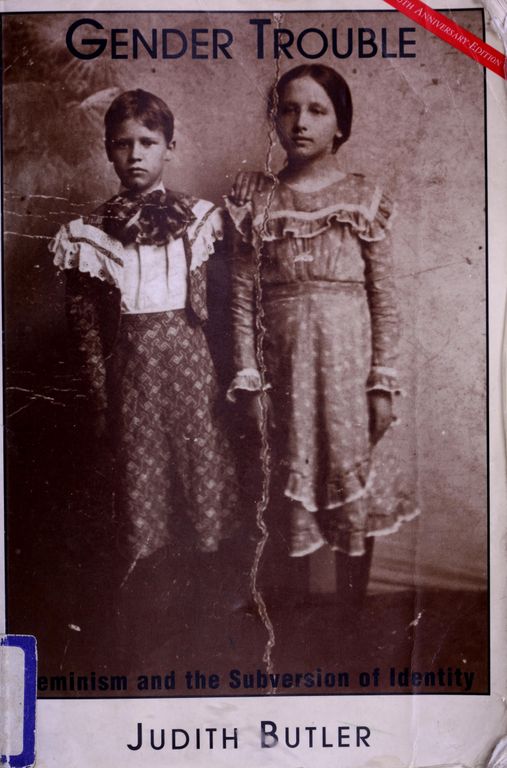
Gender Trouble
Feminism and the Subversion of Identity
Introduction: The Earthquake Under Identity
Introduction: The Earthquake Under Identity
Nova: Welcome back to The Idea Engine. Today, we are tackling a book that didn't just shift the tectonic plates of feminist theory; it caused a full-blown seismic event. We're talking about Judith Butler's 1990 masterpiece, Gender Trouble: Feminism and the Subversion of Identity.
Nova: : That title alone sounds like a declaration of war on established norms. When I first heard about it, the common summary was that Butler said gender is just performance. But I suspect it's far more complex, and frankly, far more unsettling than that simple soundbite suggests.
Nova: Unsettling is the perfect word. Imagine this: For decades, a major goal in feminism was to separate 'sex'—the biological body—from 'gender'—the cultural roles we impose on it. Butler walks in and says, 'Hold on, that separation is the very thing keeping us trapped.' It’s a radical move that forces us to question what we even mean by 'woman' or 'man' in the first place.
Nova: : So, this isn't just about how we dress or act. This is about the very foundation of identity being built on sand? What was the political urgency behind this book in 1990? Why did feminism need this kind of trouble?
Nova: The urgency was political paralysis. If feminism was organizing around 'women' as a stable, pre-existing category, Butler asked: Who is this 'woman' we are fighting for? If that category is already constructed by the very patriarchal system we are fighting against, then organizing around it is like trying to build a house on a foundation you haven't inspected. We need to look at the blueprints, and Butler hands us a wrecking ball.
Nova: : A wrecking ball aimed squarely at essentialism. I’m ready to see how she wields it. Let's start with the most controversial target: the body itself.
Nova: Exactly. Let's dive into the first major rupture Butler creates.
Key Insight 1: The Critique of the Sex/Gender Distinction
Dismantling the Binary: Sex is Not a Fact
Nova: The traditional feminist argument, which was incredibly useful for decades, relied on the sex/gender distinction. Sex is biology—male/female. Gender is culture—masculine/feminine. Butler argues this distinction is fundamentally flawed because 'sex' is never just a brute, pre-cultural fact.
Nova: : That’s a tough pill to swallow for many. If sex isn't real, what are we talking about when we talk about bodies? Are we saying biology doesn't exist?
Nova: Not at all. Butler is saying that the of biological sex is entirely dependent on a gendered framework. The moment we look at a body and label it 'sexed,' we are already applying a cultural grid. Think about medical discourse. Even the way doctors interpret chromosomes or anatomy is filtered through the compulsory heterosexual matrix.
Nova: : So, the very language we use to describe the 'natural' body is already saturated with gendered assumptions. It’s like trying to see a clear glass of water, but the glass itself is tinted blue. You can't see the water without the tint.
Nova: Precisely! And Butler points out that this distinction creates a hierarchy. Sex is positioned as the 'real,' the material ground, while gender is the flimsy cultural overlay. This makes it impossible to fully dismantle patriarchy because you keep appealing to a 'natural' origin point that isn't actually natural.
Nova: : If sex is already gendered, then what is the 'material' that gender is supposed to be constructed upon? It seems like a recursive loop where gender is always already there, shaping what we perceive as sex.
Nova: It is. Butler suggests that the notion of a stable, pre-social sex is a necessary fiction that allows the gender system to appear natural and inevitable. It’s the bedrock we we need for political action, but it’s actually the cage.
Nova: : This is where the term 'compulsory heterosexuality' comes in, right? The system demands that sex, gender, and desire align perfectly: male body equals masculine gender equals desire for the feminine.
Nova: That's the compulsory order she targets. If you can't find a stable 'sex' that exists outside of this ordering, then the entire structure—the idea that there are only two fixed, opposite genders—begins to look like an arbitrary enforcement, not a natural law.
Nova: : So, the goal isn't to say sex doesn't exist, but to show that the of sex is entirely contingent on gender norms. That’s a huge intellectual leap. What happens when we accept that premise? Where does the action move to?
Nova: The action moves from trying to fix the 'real' body to disrupting the that makes the body seem real. That brings us directly to the heart of the book: performativity.
Key Insight 2: Gender as Doing, Not Being
Performativity: The Verb of Gender
Nova: This is the concept everyone quotes, and often misunderstands. Performativity is NOT performance. If I put on a costume for a play, that’s performance. I know I’m acting. Performativity is different; it’s the unconscious, compulsory way we gender every single day.
Nova: : Right, the common mistake is thinking, 'Oh, I’m not performing gender, I’m just being myself.' Butler suggests that 'being myself' is already the result of countless, often invisible, repetitions of learned gender norms.
Nova: Exactly. Butler says gender is maintained, created, or perpetuated by 'iterative repetitions when speaking and interacting.' It’s the constant citation of norms. Every time you walk, talk, or gesture in a way coded as 'masculine' or 'feminine,' you are citing the law of gender, and in citing it, you are momentarily reinforcing it.
Nova: : So, the identity—the 'I am a woman'—isn't an internal essence that then gets expressed externally. The identity the effect of the external repetition. It’s a verb, not a noun. Gender is something you, not something you.
Nova: That’s the core insight! And here’s a surprising detail from the research: Butler notes that this repetition is never perfect. There are always slippages, hesitations, and failures in the citation process. If gender were perfectly performed, it would be completely invisible and totally stable. But it’s not stable, is it?
Nova: : No, it’s constantly being policed. We see the instability when someone steps outside the lines—the immediate social correction, the judgment, the violence directed at those who fail the repetition.
Nova: That policing proves the compulsory nature of the repetition. The system needs constant maintenance because the 'self' is never fully solidified. Think about how much energy we expend just trying to 'pass' or fit into a binary expectation. That energy is the cost of maintaining the illusion of an inner core.
Nova: : It’s almost exhausting to think about. If I’m constantly citing norms just to exist as a recognizable person, how can I ever break free? If I stop citing them, do I cease to exist socially?
Nova: That’s the central dilemma, and it leads us to the concept of agency. Butler doesn't advocate for stopping all repetition—that would mean ceasing to speak or act entirely. The agency lies in we repeat. This is where we move from the theoretical critique to the political possibility, which often involves drag.
Key Insight 3: Agency Through Stylized Iteration
Subversive Repetition: The Power of Drag
Nova: If gender is an effect of repetition, then the way to challenge it isn't to invent a new, authentic self, but to repeat the norms in a way that exposes their artificiality. This is where drag becomes Butler's prime example of subversive agency.
Nova: : Drag isn't just about men dressing as women for comedy; it’s a philosophical tool. It takes the established codes of femininity—the makeup, the walk, the voice—and exaggerates them to the point of parody.
Nova: Exactly. Drag reveals that the original, 'natural' gender presentation is an imitation. It shows that there is no original to imitate. The drag queen is a copy of a copy, which exposes the entire chain of imitation as arbitrary.
Nova: : It’s like holding up a funhouse mirror to society's gender expectations. The exaggeration makes the underlying structure visible, making us realize, 'Wait, why do we take this specific way of standing so seriously?'
Nova: And Butler argues that this exposure creates 'gender trouble'—a moment where the compulsory order falters. It’s not about becoming a 'better' gender; it’s about showing that the category itself is unstable enough to be played with.
Nova: : I read that Butler suggests this subversive repetition can lead to the 'deconstruction' of the gender norms themselves, not just the individual’s identity. Is that right?
Nova: Yes. By repeating the norms in a way that highlights their artificiality, you create a space where new, non-normative configurations of the body and desire can emerge. It’s a critical genealogy of gender categories in action. It's about showing that the boundaries are porous.
Nova: : But what about the criticism that this focus on drag and discourse ignores the very real, material violence faced by trans people or gender non-conforming individuals who aren't performing in a way that's easily readable as 'subversive'? Some critics argue Butler prioritizes intellectual play over material survival.
Nova: That is a major and persistent critique, often coming from materialist feminists who argue that ignoring the stability of 'sex' makes it harder to fight for material rights based on shared female experience. Butler acknowledges this tension. The book is a theoretical intervention, aiming to destabilize the that grounds the violence, even while recognizing that the violence itself is brutally material.
Nova: : So, the theory aims to undermine the for the violence, even if it doesn't stop the violent act itself in the moment. It’s a long game of undermining the cultural bedrock that allows the policing to happen.
Nova: It is. The ultimate goal is to make the compulsory alignment of sex, gender, and desire so visible as a construct that it loses its power to compel. It’s about opening up the possibility of a life lived outside the binary's rigid demands.
Conclusion: The Ongoing Trouble
Conclusion: The Ongoing Trouble
Nova: We’ve covered a lot of dense ground today, moving from the critique of the sex/gender distinction to the verb of performativity, and finally to the subversive potential of iteration.
Nova: : If I had to boil down the impact of Gender Trouble into one takeaway for our listeners, it would be this: Stop looking for the 'real' you underneath the clothes and the mannerisms. The 'real you' is the ongoing, messy, and sometimes failed attempt to repeat the norms you’ve inherited.
Nova: I agree. The key is recognizing that the 'trouble' Butler names isn't a problem to be solved, but a condition to be embraced. The instability of gender is not a failure; it is the very condition that makes political and personal transformation possible.
Nova: : It shifts the political project from demanding recognition a stable category, to demanding the right to exist of stable categories altogether. It’s a profound shift in focus.
Nova: And that's why this book remains essential twenty-five years later. It forces us to be self-aware about the very language we use to define ourselves and others. Every time you hear someone say, 'That's just how men/women are,' remember Butler's challenge: That 'just' is doing a lot of heavy lifting, and it’s built on repetition, not nature.
Nova: : It’s a constant invitation to look closer at the citation process. To ask, 'Who wrote this script I’m reading from, and can I improvise a line or two?'
Nova: A perfect way to put it. The work isn't to stop repeating, but to become conscious of we repeat, and to find the gaps where new possibilities can bloom. Thank you for joining us on this deep dive into the theory that keeps giving us trouble.
Nova: : Always a pleasure to wrestle with the giants of thought, Nova.
Nova: This is Aibrary. Congratulations on your growth!