

Forecasting Tomorrow: Adapting to Future Tech Landscapes
Golden Hook & Introduction
SECTION
Nova: Think about your smartphone for a second. Just five years ago, it was already a marvel. Now, it's a supercomputer in your pocket, capable of things we couldn't even dream of back then. And it’s getting faster, smarter, more integrated, every single day. That relentless, accelerating pace… it’s a mind-bending thing, isn't it?
Atlas: Oh man, it’s not just mind-bending, it's mind-breaking sometimes! I feel like I just figured out the last big tech leap, and suddenly, three more have already happened. It’s like trying to drink from a firehose that’s also accelerating.
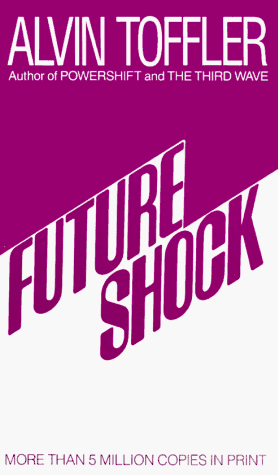
Nova: Exactly! That feeling, that sense of being overwhelmed by the sheer speed of change, is precisely what we're tackling today. We're diving into the brilliant, almost prophetic work of Alvin Toffler and his groundbreaking book,. Toffler, a futurist and author whose ideas profoundly shaped how we understand societal change, introduced this concept back in 1970, long before the internet, long before smartphones. He saw this coming with incredible clarity.
Atlas: Wow, 1970? That’s wild. He must have seemed like he was talking about science fiction to people back then. But it feels incredibly relevant now. So, what was he getting at with "future shock"? What did he predict that we’re living through today?
The Psychological Impact of Rapid Change: 'Future Shock'
SECTION
Nova: He argued that future shock isn't just about technological change itself, but the of that change. It’s a psychological state of distress and disorientation when individuals and entire societies are confronted with too much change in too short a period. Think of it as a personal and societal nervous breakdown caused by overstimulation from novelty.
Atlas: So you’re saying it’s not just about, "oh no, a new iPhone update," but a deeper, almost existential discomfort with how fast everything around us is evolving? For our listeners who are leaders, trying to keep their organizations agile, this must feel incredibly real.
Nova: Absolutely. Toffler broke it down into several facets. One key aspect was the of things – relationships, organizations, even products. He observed that we're constantly forming and breaking ties, switching jobs, upgrading tech, discarding the old. This lack of permanence, he argued, chips away at our sense of stability. It’s like living in a world of ever-shifting sands.
Atlas: That makes me wonder about the impact on things like company culture. If everything is transient, how do you build a lasting, resilient team? How do you foster loyalty when the tools, the methods, even the entire industry can shift overnight?
Nova: Precisely. Toffler also talked about – the constant bombardment of new ideas, products, and choices. Every day brings something new to learn, adapt to, or simply filter out. It creates a kind of cognitive overload. He saw this leading to what he called "information overload" long before the term became commonplace, predicting the very challenges we face daily with digital feeds and endless notifications.
Atlas: That sounds like my Monday mornings. I totally know that feeling of just being swamped, not by bad news necessarily, but just by sheer of newness. So, if we’re all experiencing this "future shock," how does it manifest? What are the symptoms, so to speak, in an organizational context?
Nova: In organizations, it can look like decision paralysis, high employee turnover, a constant chasing of the latest trend without deep integration, or a general sense of burnout and apathy. Toffler used vivid examples, even in his time, of people feeling alienated by the fast-paced, disposable nature of modern life. He spoke of people literally needing to 'unplug' or seek refuge in simpler, more stable environments to cope.
Atlas: That’s actually really inspiring that someone saw this coming so clearly, even without the internet to point to. But it also sounds quite bleak. Is there a way to inoculate ourselves, or our teams, against this shock? Or are we just doomed to be perpetually overwhelmed?
Mapping the Inevitable: Understanding Core Technological Forces
SECTION
Nova: That’s where we pivot to our second brilliant mind of the day, Kevin Kelly, and his book. Kelly, a co-founder of Wired magazine, isn't just predicting the future; he's identifying the fundamental, long-term trends – what he calls 'inevitables' – that are driving technology forward.
Atlas: Oh, I love that. "Inevitable." It sounds so much more empowering than "future shock." Like, okay, these things are coming, so let’s get smart about them. What are some of these "inevitable" forces that Kelly identifies?
Nova: He identifies twelve, but let’s focus on a couple that really resonate with our current experience. He talks about – the idea that everything is in a state of continuous upgrade and flux. Nothing is ever truly finished; it's always in beta. This directly counters our human desire for permanence, but also provides endless opportunities for improvement.
Atlas: So, it's not just that things, but that change. That’s a subtle but powerful reframing. It means we can't just react to change; we have to build systems and mindsets that and even constant evolution. For strategic architects, that’s a game-changer.
Nova: Exactly. Another crucial one is – the pervasive spread of artificial intelligence into every single object and process. From our cars to our toasters, everything is getting smarter. It’s not just about powerful AI mainframes; it’s about distributed, embedded intelligence making things more efficient, more personalized, more… cognitive.
Atlas: That makes me wonder about the psychological implications of that. If everything is 'cognifying,' are we, as humans, going to feel less cognitive, less essential? Or does it free us up for higher-order thinking?
Nova: Kelly suggests the latter. He sees AI not as a replacement for human intelligence, but as a new utility, much like electricity. It elevates our capabilities, allowing us to focus on what humans do best: creativity, empathy, complex problem-solving that requires nuanced understanding. The challenge, of course, is adapting our skills and our educational systems to leverage this.
Atlas: That’s a much more hopeful view than just being swamped by future shock. So, Kelly’s framework gives us a way to categorize and understand these overwhelming changes. It turns the firehose into a neatly labeled set of spigots, almost.
Nova: Precisely. He also talks about – the shift from static products to continuous streams and subscriptions, and – the move from ownership to subscription and access. These aren't just business models; they're fundamental shifts in how we interact with the world and what we value.
Atlas: Right, like we don't buy CDs anymore; we subscribe to music services. We don't buy software boxes; we subscribe to cloud services. It’s a complete paradigm shift that affects everything from manufacturing to individual consumption habits. It’s like the user profile of a strategic architect who values sustainable ecosystems – these 'inevitables' are creating entirely new ecosystems.
Nova: And that brings us right back to Toffler’s 'future shock.' If everything is 'becoming,' 'cognifying,' 'flowing,' and 'accessing,' then the rate of change is inherently high. Kelly’s work provides the map to navigate the landscape that Toffler warned us about. It’s about understanding the deep currents so we can build better ships, rather than just being tossed about by the waves.
Atlas: So, if Toffler gave us the diagnosis – the 'shock' – Kelly offers the prognosis and a framework for understanding the underlying mechanics. It’s about moving from a reactive state of being overwhelmed to a proactive state of informed adaptation.
Synthesis & Takeaways
SECTION
Nova: That’s it exactly. The synthesis here is profound. Toffler’s serves as a powerful warning, highlighting the human cost of unchecked technological acceleration. It’s a reminder that we are biological beings with limits to how much novelty and transience we can absorb. Kelly’s, on the other hand, provides us with a lens. It doesn’t just predict what’s coming; it helps us understand the driving it.
Atlas: It’s like knowing the tide patterns before you sail. You can either get swept away, or you can use the currents to your advantage. For our future-focused leaders and ethical innovators, the insight here is that you can’t stop the inevitable, but you can certainly prepare for it, and even shape how it impacts your organization and your life.
Nova: And the key takeaway, I think, is that building organizational resilience isn't just about implementing new tech. It's about cultivating a mindset that embraces constant evolution, while simultaneously safeguarding against the psychological burnout of 'future shock.' It’s about designing systems, and cultures, that are inherently adaptable and provide psychological anchors amidst the flux.
Atlas: So, rather than just reacting to every new innovation, we should be looking for these deeper, inevitable trends. And then, we should be asking: How can we build an environment where our teams can not only cope but actually thrive, finding opportunity in what might otherwise be overwhelming? That’s a powerful challenge.
Nova: It truly is. The goal isn't to avoid the future, but to understand its underlying rhythm and design our lives and our organizations to dance with it, rather than fight against it.
Atlas: That’s such a hopeful way to look at it. It turns the daunting into the doable.
Nova: This is Aibrary. Congratulations on your growth!