

Beyond the Hype: Mastering the Art of Strategic Foresight
Golden Hook & Introduction
SECTION
Nova: Everyone talks about predicting the future, right? We want to know what's going to happen. But what if that's exactly the wrong question to ask? What if trying to predict the future actually makes us less prepared?
Atlas: Whoa, that's a bold claim, Nova. My whole strategic planning department just collectively gasped. Are you saying my five-year plan is… a trap?
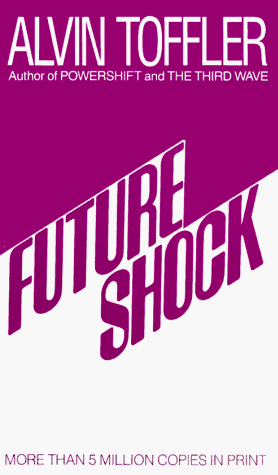
Nova: In some ways, yes! Today, we're tearing down that predictive fallacy as we dive into the core ideas of "Beyond the Hype: Mastering the Art of Strategic Foresight." And we're going to lean heavily on two titans in this field: Alvin Toffler, whose monumental book "Future Shock" became a global phenomenon, even sparking a massive hit song decades ago, and Peter Schwartz with "The Art of the Long View," which literally changed how governments and corporations around the world approach uncertainty.
Atlas: So, we're not just looking at theories, we're looking at frameworks that have shaped how the powerful plan for tomorrow. That sounds like something any architect or strategist needs to hear to build something lasting.
Nova: Absolutely. And to understand why these frameworks are so crucial, we first need to confront what the book calls "The Blind Spot."
The Blind Spot: Why We Miss the Future
SECTION
Atlas: The blind spot. I like that. It immediately makes me think of merging lanes on the highway, where you just there's something there, but you can't quite see it.
Nova: Exactly! It’s that inherent human tendency to focus on the immediate, the urgent, the short-term reaction, while completely overlooking the deep, slow-moving trends that truly shape the future. It’s like driving a car and only looking at the immediate road ahead, never checking your rearview, never glancing at the distant horizon, and certainly never considering the long-term weather patterns that might be rolling in.
Atlas: But isn't that just good business? Reacting quickly to market shifts, addressing immediate customer needs? For those of us building solutions, isn't agility about rapid response?
Nova: Rapid response is vital, but it’s different from strategic foresight. Rapid response lives the current paradigm. Foresight challenges and expands that paradigm. Think about it: if you're only reacting, you're always playing catch-up. You're adapting to a future that's already arrived.
Atlas: I can see how that would be a problem. Give me a vivid example, Nova. Where did this short-term thinking lead to a catastrophic miss?
Nova: The classic example is Blockbuster versus Netflix. Everyone knows the story, but the nuances are crucial. Blockbuster, at its peak, was a behemoth. Their entire business model was built around immediate gratification – late fees, the in-store experience, new releases. They were incredibly efficient at.
Atlas: And they had a chance to buy Netflix, right? I remember hearing that.
Nova: They did! Back in 2000, Netflix offered to sell for $50 million. Blockbuster, focused on its massive physical footprint and those lucrative late fees, dismissed it. Their CEO reportedly scoffed at the idea, calling it a "niche business." They saw Netflix as a minor threat, a side-show. They couldn't see the slow, undeniable trend of digital distribution, the increasing desire for convenience without leaving your couch, and the eventual ubiquity of internet streaming.
Atlas: That's a classic. But it feels almost… inevitable in hindsight. How do we spot our Blockbuster moment before it's too late, especially when we're focused on building something impactful, something that lasts?
Nova: That’s the core challenge. The trends that kill you often aren't sudden shocks; they're the slow, almost imperceptible shifts that accumulate over years. Blockbuster’s leadership was suffering from a profound psychological bias—they had confirmation bias, seeing only what supported their existing successful model. They were incentivized by short-term profits from late fees, and the status quo was incredibly comfortable. They couldn't imagine a world where their physical stores, their entire empire, became obsolete.
Atlas: I totally know that feeling. It's hard to challenge your own success, to look for the cracks in the foundation when it feels so solid. So, if predicting the future is a trap, and our blind spots make us miss the slow-moving threats, what's the alternative? How do we move beyond reacting and actually shape our response?
The Shift: From Reacting to Shaping with Strategic Foresight
SECTION
Nova: It's precisely because of those biases and the inherent unpredictability of the future that simply trying to predict it is so dangerous. Instead, we need to prepare for multiple plausible futures. And that's where Alvin Toffler and Peter Schwartz come in, creating a powerful one-two punch for strategic foresight.
Atlas: Future shock – that resonates deeply. It’s like trying to build a web architecture that's obsolete before it even launches because the underlying tech keeps shifting. Toffler diagnoses the problem of overwhelming change. Where does Schwartz take us?
Nova: Toffler, with "Future Shock," published in 1970, was a prophet. He didn't just talk about change; he talked about the of change and the psychological and social disorientation it would cause. He argued that understanding the of change was key to avoiding being paralyzed by it. His book became a cultural touchstone, making people aware that the future wasn't just coming; it was rushing at them at an unprecedented speed. It was a wake-up call that simply reacting wouldn't cut it anymore.
Atlas: So, Toffler identifies the overwhelming problem. And then Schwartz gives us a tool to deal with it?
Nova: Precisely. Peter Schwartz, through his seminal work "The Art of the Long View," introduces scenario planning. And this is crucial: it's not about predicting future. It's about building several of different futures. You create, say, three to five distinct scenarios – perhaps an optimistic one, a pessimistic one, a wildly disruptive one – and then you ask: "How would our organization, our strategy, our long-term plans fare in of these futures?"
Atlas: That makes sense. It’s like an architect drawing up multiple blueprints for a building, not just for perfect weather, but also for earthquakes, floods, or even a sudden shift in building codes.
Nova: Exactly! A famous example is Shell Oil in the 1970s. During a period of relative stability, Shell's strategic planners, influenced by early forms of scenario planning, developed scenarios that included potential oil supply disruptions and price spikes. They didn't the 1973 OPEC oil embargo, but because they had explored that, they were mentally and strategically prepared for it.
Atlas: Wow. So, when the crisis hit, they weren't caught flat-footed.
Nova: Not at all. While other oil companies were scrambling, Shell was able to adapt much faster, shifting their sourcing, refining, and distribution strategies because they had already thought through the implications of such a scenario. Schwartz’s work essentially codified this approach, moving it from an intuitive practice to a rigorous discipline. It showed that foresight isn't about having a crystal ball; it's about building a robust set of blueprints for different weather conditions, as you put it.
Atlas: That's a powerful contrast. Shell didn't the crisis was coming, but they'd about it. So, for someone trying to make a lasting contribution, is it about having a crystal ball, or building a robust set of blueprints for different weather conditions? How does scenario planning differ from just simple "contingency planning"?
Nova: That’s a great distinction to make. Contingency planning is generally about preparing for known risks, things you can identify and put a probability on. Like, 'if this specific machine breaks down, we have this backup plan.' Scenario planning goes much deeper. It explores. It pushes you beyond obvious threats to consider wild cards, paradigm shifts, and forces you to expand your imagination about what happen, not just what's likely. It’s about building mental flexibility.
Synthesis & Takeaways
SECTION
Nova: So, to synthesize this: the goal isn't to predict, but to understand the fundamental forces of change, as Toffler urged, and then to build mental models for how those forces could play out in multiple plausible futures, as Schwartz taught us. This allows us to actively shape our response, not just react to what hits us.
Atlas: So, it's about developing 'peripheral vision' for the future, right? Not just seeing what's directly in front of you, but understanding the entire landscape, the potential storms brewing on the horizon, and the shifting tectonic plates beneath your feet. For an 'Architect' or 'Strategist', it's about building resilient systems, not just stable ones. It's about designing for adaptation.
Nova: Exactly. And the profound question posed by the book that we want to leave our listeners with is: "What is one future scenario you haven't fully considered, and how might it impact your long-term plans?" It’s a challenge to expand that peripheral vision.
Atlas: That’s a fantastic call to action. We'd love to hear what scenarios you're starting to consider. Head over to our community page and share your reflections. It's how we all grow, by sharing our wisdom and helping each other see beyond our individual blind spots.
Nova: Because embracing uncertainty isn't about fear; it's about empowerment.
Nova: This is Aibrary. Congratulations on your growth!