

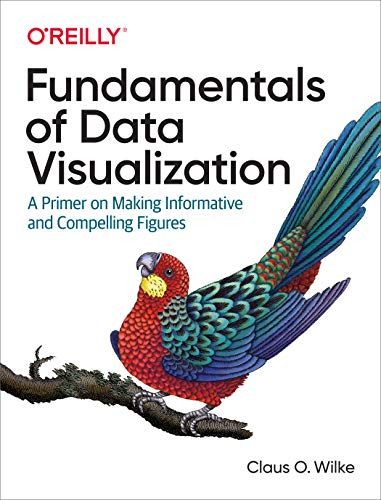
Fundamentals of Data Visualization
Introduction
Nova: Have you ever looked at a chart in a news article or a business report and felt like your brain was just... short-circuiting? Like, the numbers are there, the colors are bright, but you have absolutely no idea what you are supposed to be looking at?
Atlas: All the time. Usually, I just assume I am not a math person or that I missed a meeting. I figured some charts are just meant to look complicated to make the person who made them look smart.
Nova: Well, according to Claus O. Wilke, it is usually not you. It is the chart. Wilke is the author of Fundamentals of Data Visualization, and he argues that most of the bad data we see out there is not just a lack of artistic talent. It is a failure of fundamental principles.
Atlas: So there is actually a science to not making people feel stupid when they look at a graph?
Nova: Exactly. Wilke is a professor at the University of Texas at Austin, and he wrote this book because he saw a gap. We have plenty of books on how to code charts and plenty of books on high-level design theory, but very few that explain the actual logic of why one chart works and another one fails.
Atlas: I like that. It sounds like a field guide for the rest of us. Because let is be honest, most of us are not graphic designers, but we are all being asked to visualize data these days.
Nova: That is the beauty of it. He treats data visualization as a language. And today, we are going to break down his grammar rules. We are talking about the difference between a chart that is just ugly and one that is actually lying to you, the secret math of proportional ink, and why your choice of color might be making your data invisible to ten percent of your audience.
Atlas: I am ready. Let is see if we can figure out how to stop the brain short-circuits.
Key Insight 1
The Ugly, The Bad, and The Wrong
Nova: One of the most famous parts of Wilke's book is how he categorizes bad visualizations. He uses three specific labels: Ugly, Bad, and Wrong. It is a bit like a data version of The Good, the Bad and the Ugly.
Atlas: Okay, I can guess what Wrong means. That is when the math is just broken, right? Like a pie chart that adds up to one hundred and ten percent?
Nova: Precisely. A Wrong figure has objective, mathematical errors. It is distorting the data in a way that is factually incorrect. If you have a bar that represents fifty and another that represents one hundred, but the fifty bar is somehow taller, that is Wrong. It is a technical failure.
Atlas: That seems like the easiest one to fix. Just check your math. But what about Ugly versus Bad? Is not that just subjective?
Nova: That is where it gets interesting. Wilke defines an Ugly figure as one that is technically correct and clear, but it is just... unpleasant to look at. Maybe the fonts are clashing, the colors are garish, or there is too much clutter. It does not necessarily mislead you, but it makes you want to look away.
Atlas: So it is like a house that is structurally sound but painted neon pink with lime green shutters. You can live in it, but you probably do not want to.
Nova: Great analogy. And while Ugly is a shame, it is not the end of the world. The real danger is the Bad figure. Wilke says a Bad figure is one that is technically correct—the math is right—but it is functionally useless because it is confusing or misleading.
Atlas: Wait, how can it be mathematically right but still misleading?
Nova: Think about a chart with way too many overlapping lines, or a 3D bar chart where the perspective makes it impossible to tell where the top of the bar actually hits the axis. The data is there, but the design choices are obscuring it. You are making the reader work way too hard to find the point.
Atlas: I see. So Ugly is a matter of taste, Wrong is a matter of truth, but Bad is a matter of communication.
Nova: Exactly. And Wilke's goal is to get everyone to at least the level of Good. A Good figure is clear, accurate, and professional. It does not have to be a work of art, but it has to be an effective bridge between the data and the human brain.
Atlas: It sounds like he is trying to move us away from the idea that data viz is just about making things pretty. It is about making things functional.
Nova: Precisely. He often says that if a visualization requires a long paragraph of text to explain how to read it, the visualization has failed. It should be intuitive.
Atlas: I have definitely seen those. The ones where you spend five minutes looking for the legend just to figure out what the x-axis even represents.
Nova: And that is a Bad figure. It is a waste of the reader's cognitive load. Wilke wants us to spend our brainpower on the insights, not on decoding the chart itself.
Key Insight 2
The Principle of Proportional Ink
Atlas: Okay, so we want to avoid being Bad or Wrong. But is there a specific rule I can follow? Like, a golden rule for not accidentally lying with my charts?
Nova: There is, and Wilke calls it the Principle of Proportional Ink. It sounds fancy, but the core idea is incredibly simple: the sizes of shaded areas in a visualization must be proportional to the data values they represent.
Atlas: Proportional ink. So, if the number is twice as big, the amount of ink on the page should be twice as big?
Nova: Exactly. This is most obvious with bar charts. If you have a bar chart and you do not start the y-axis at zero, you are violating this principle.
Atlas: Oh, I see this all the time in political ads! They show a tiny increase in something, but because the bar starts at, say, ninety instead of zero, the second bar looks four times as tall as the first one.
Nova: Right! Even if the labels are technically correct, your eyes see the area of the bar first. Your brain registers that one bar is four times the size of the other before you ever read the numbers on the side. That is a violation of proportional ink because the ink used for the second bar is not four times the value of the first.
Atlas: So, is it a hard rule? Do all charts have to start at zero?
Nova: Not all of them, and that is a common misconception. Wilke clarifies that this rule specifically applies when you use shaded areas to represent magnitude—like bars or areas in a pie chart. But for line graphs, it is different.
Atlas: Why is it different for lines? A line is still ink, right?
Nova: True, but in a line graph, you are usually looking at the position and the slope, not the area under the line. If you are tracking someone's body temperature, you do not need to start the chart at zero degrees. If you did, the line would just look like a flat horizontal strip at the top, and you would miss all the important fluctuations.
Atlas: That makes sense. You are looking for the change, not the total volume of temperature.
Nova: Exactly. But if you fill the area under that line—making it an area chart—then you are back to the proportional ink rule. You have to start at zero because now the viewer's eye is judging the total shaded volume.
Atlas: It is funny how our brains are so easily tricked by just a little bit of extra shading. It is like we are hardwired to trust the visual weight more than the actual digits.
Nova: We absolutely are. Visual perception happens in milliseconds, long before the analytical part of our brain kicks in. Wilke's point is that as a creator, you have a responsibility not to exploit that biological shortcut.
Atlas: It is almost like a code of ethics for data. If you use the ink, you have to earn the ink.
Nova: I love that. If you use the ink, you have to earn the ink. It is about honesty in design. When you violate proportional ink, you are essentially shouting a lie while whispering the truth in the fine print.
Key Insight 3
The Color Revolution and Accessibility
Atlas: Let is talk about color. I love a good colorful chart, but sometimes I feel like people just pick colors because they look cool. Does Wilke have a system for this?
Nova: He does, and it is one of the most practical parts of the book. He breaks color use into three main categories: qualitative, sequential, and diverging.
Atlas: Okay, break those down for me. What is qualitative?
Nova: Qualitative scales are for when you have categories that do not have a specific order. Think of a map showing different types of land use—forest, urban, water. You want colors that are distinct so you can tell them apart, but none of them should look more important than the others.
Atlas: So you would not use light red and dark red, because dark red might look like it is more intense.
Nova: Exactly. You would use blue, green, and brown. Now, sequential scales are the opposite. That is for when you are representing a range of values, like population density. You go from a light color to a dark color of the same hue. The darker the color, the higher the value.
Atlas: And diverging? Is that for when things go in two different directions?
Nova: Spot on. Think of a map showing temperature anomalies—where it is hotter or colder than average. You have a neutral middle color, like white or grey, and then it branches out into two different hues, like blue for cold and red for hot.
Atlas: That seems logical. But I have seen charts that use the whole rainbow for everything. Is that a bad idea?
Nova: Wilke is very much against the default rainbow scale, often called the jet scale. It is actually quite dangerous in scientific data. The problem is that the human eye does not perceive the transitions between rainbow colors as equal. The jump from yellow to green looks much sharper than the jump from green to blue, even if the data change is the same.
Atlas: So the rainbow creates fake boundaries in the data where they do not actually exist?
Nova: Exactly. It creates artifacts. But there is an even bigger reason to be careful with color: accessibility. Wilke points out that roughly eight percent of men and zero point five percent of women have some form of color-vision deficiency.
Atlas: That is a huge chunk of the population. If I use red and green to show pass/fail, a lot of people literally cannot see the difference.
Nova: Right. To them, those two colors might just look like the same shade of muddy brown. Wilke advocates for color-blind friendly palettes. He suggests using blue and orange instead of red and green, or using redundant coding.
Atlas: Redundant coding? What is that?
Nova: It means you do not rely on color alone. You use color plus something else—like different shapes for points on a scatter plot, or different line styles like dashed versus solid. That way, even if the color is stripped away, the message remains.
Atlas: It is like having subtitles on a movie. It makes it better for everyone, not just the people who need it.
Nova: Precisely. And Wilke actually includes simulations in the book showing what his charts look like to people with different types of color blindness. It is a real eye-opener for designers who have never had to think about it.
Key Insight 4
The Directory of Visualizations
Atlas: One thing I struggle with is just knowing which chart to pick in the first place. I usually just default to a bar chart or a line graph because they are easy. Does Wilke help with the selection process?
Nova: He actually provides what he calls a Directory of Visualizations. It is like a menu where he groups charts by what you are trying to achieve. Are you showing amounts? Distributions? Proportions? Or x-y relationships?
Atlas: I usually just think, I have some numbers, let is put them in a pie chart. But I have heard people say pie charts are the devil. Where does Wilke stand on that?
Nova: He is more nuanced than most. He does not say never use them, but he points out their limitations. The problem with pie charts is that humans are not very good at judging angles or areas. We are much better at judging lengths.
Atlas: So a bar chart is almost always easier to read than a pie chart?
Nova: Usually, yes. If you have five categories that are all around twenty percent, a pie chart looks like five equal slices. But in a bar chart, you might clearly see that one is twenty-two percent and another is eighteen. However, Wilke says pie charts are okay if you only have two or three categories and you really want to emphasize the part-to-whole relationship.
Atlas: What about the more exotic stuff? I have seen those ridgeline plots that look like the cover of a Joy Division album. Are those just for show?
Nova: Ridgeline plots are actually great for showing how distributions change over time or across categories. Wilke is a big fan of showing the raw data whenever possible. Instead of just showing a bar with an average, he suggests things like violin plots or sina plots.
Atlas: A violin plot? Does it actually look like a violin?
Nova: It does! It shows the density of the data. It tells you if all the points are bunched up in the middle or if there are two different clusters. A simple bar chart with an error bar hides all that detail. It just gives you one number, whereas a violin plot gives you the whole story.
Atlas: It sounds like he is pushing for more transparency. Like, do not just give me the summary, show me the texture of the data.
Nova: That is a core theme of the book. He also talks about visualizing uncertainty. Most people hate showing error bars because they think it makes their data look weak or messy. But Wilke argues that uncertainty is part of the data. If you hide the margin of error, you are actually being less accurate.
Atlas: That is a tough pill to swallow in a business setting where everyone wants a single, certain number.
Nova: It is, but Wilke provides ways to do it elegantly. He shows how to use things like confidence strips or graded error bars that fade out, so the uncertainty is visible but not distracting. It is about being a professional who respects the complexity of the information.
Conclusion
Nova: We have covered a lot of ground today, from the ethics of proportional ink to the psychology of the rainbow. If there is one thing to take away from Claus Wilke's work, it is that data visualization is not an afterthought. It is not just the gift wrapping you put on your data once the analysis is done.
Atlas: It is the analysis. Or at least, it is the final, most important step of the analysis. If you can not communicate what you found, did you really find it?
Nova: Exactly. Wilke's book reminds us that every choice we make—the width of a bar, the shade of a blue, the decision to start an axis at zero—is a choice about how we are telling the story. And those choices have rules that we can learn.
Atlas: I feel a lot better about my next presentation. I am definitely going to be checking my proportional ink and maybe swapping out my red-green scales for something more inclusive.
Nova: That is the spirit. Data visualization is a superpower, but like any power, it requires a bit of discipline to use correctly. If you want to dive deeper, the entire book is actually available for free on Wilke's website, which is a testament to his commitment to making this knowledge accessible to everyone.
Atlas: Free? Now that is a data point I can get behind.
Nova: It really is a masterclass in the field. Thank you for joining us on this deep dive into the fundamentals of seeing.
Atlas: And for helping me stop those brain short-circuits.
Nova: This is Aibrary. Congratulations on your growth!