

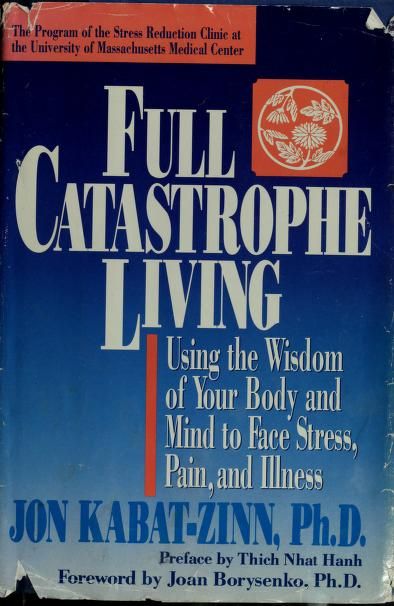
Full catastrophe living
using the wisdom of your body and mind to face stress, pain, and illness
Introduction
Nova: Imagine you are sitting in a movie theater in 1964, watching Zorba the Greek. There is this scene where Zorba is asked if he has ever been married. He looks at the guy and says, Wife, children, house, everything. The full catastrophe. Most people hear that and think of a disaster, right? But Jon Kabat-Zinn heard that line and saw a philosophy for living.
Nova: That is exactly the misconception Kabat-Zinn wanted to shatter. Full Catastrophe Living is not about escaping the chaos. It is about leaning into it. It is the foundational text for Mindfulness-Based Stress Reduction, or MBSR, which basically took meditation out of the monastery and put it into the hospital basement to see if it could actually help people in physical and emotional agony.
Nova: Exactly. Chronic pain, terminal illness, crippling anxiety. Today, we are diving into how Kabat-Zinn proved that by changing how we relate to the catastrophe, we can actually change our biology and our lives.
Key Insight 1
The Basement Revolution
Nova: To understand this book, you have to go back to 1979. Jon Kabat-Zinn was a molecular biologist at the University of Massachusetts Medical School. He was also a long-time meditator. He looked around the hospital and saw patients who were falling through the cracks of modern medicine. People with chronic pain or heart disease whose doctors basically told them, We have done all we can, you just have to live with it.
Nova: Kabat-Zinn saw it as a beginning. He asked the doctors to send those patients to him in the hospital basement. He started an eight-week program called Mindfulness-Based Stress Reduction. He did not promise to cure their physical diseases. He promised to teach them how to live with them.
Nova: It was revolutionary. He had to strip away the religious language and the incense to make it accessible. He focused on the science of stress. He showed that while we might not be able to change the physical sensation of pain, we can change the way the brain processes it.
Nova: It is the most studied mindfulness program in history. In his first major study in 1982, he took patients with chronic pain who had not improved with traditional medicine. After eight weeks of MBSR, sixty-five percent of them showed a significant reduction in their pain ratings. But even more interestingly, their psychological distress dropped even more than their physical pain.
Key Insight 2
The Seven Pillars of Mindfulness
Nova: To get those kinds of results, Kabat-Zinn argues you need a specific mental framework. He outlines seven attitudinal pillars in the book. These are not just nice ideas; they are the actual tools you use to face the catastrophe.
Nova: The first is non-judging. We spend our whole lives labeling things as good, bad, or neutral. If you have a backache, you judge it as bad. That judgment actually creates a second layer of stress. Mindfulness is about just observing the sensation without the label.
Nova: There is patience, which is understanding that things must unfold in their own time. Then there is beginner's mind, which is seeing things as if for the first time, so you do not get stuck in your expectations. But the one that usually trips people up is non-striving.
Nova: It is a total paradox. Kabat-Zinn says that in mindfulness, the best way to get somewhere is to stop trying to get anywhere. If you sit down to meditate thinking, I am going to fix my anxiety, you are just creating more tension. You are essentially saying, I am not okay as I am. Non-striving is about being fully present with how you are right now, even if you are anxious.
Nova: Trust, which is trusting your own intuition and your body. Acceptance, which is seeing things as they actually are in the present. And finally, letting go. Not forcing things to leave, but just giving them permission to pass through you.
Key Insight 3
The Raisin and the Body Scan
Nova: Now, you do not just think about these pillars. You practice them. One of the most famous exercises in the book is the raisin exercise. Have you heard of this?
Nova: It feels ridiculous until you do it. You look at the raisin like you have never seen one before. You feel its texture, you smell it, you hear it crinkle. When you finally eat it, you experience the explosion of flavor and the mechanics of swallowing.
Nova: Because most of us live our lives on autopilot. We eat while watching TV, we drive while thinking about work. We are rarely actually where our bodies are. The raisin exercise is a training ground for being present. If you can be present for a raisin, you can eventually be present for a difficult conversation or a moment of physical pain.
Nova: The body scan is the heart of the early weeks of the program. You lie down and systematically move your attention from your toes all the way up to your head. You are not trying to change anything; you are just checking in.
Nova: Kabat-Zinn says falling asleep is fine, it just means you needed the sleep. But the goal is falling awake. It teaches you to stay present with sensations that might be uncomfortable. Instead of pulling away from a pain in your knee, you breathe into it. You explore its boundaries. You realize the pain is not a solid block; it is a shifting sea of sensations.
Key Insight 4
Reaction vs. Response
Nova: That space you just mentioned is the key to the whole book. Kabat-Zinn makes a huge distinction between a stress reaction and a stress response.
Nova: Exactly. That is the fight-or-flight system. Your heart rate spikes, your cortisol levels go up, and your prefrontal cortex, the thinking part of your brain, basically goes offline. If you live in a state of constant reaction, it wreaks havoc on your immune system and your heart.
Nova: Yes. A response is conscious. You feel the surge of anger or the spike in heart rate, but because you have been practicing mindfulness, you recognize it. You take a breath. In that moment, you have a choice. You are no longer a slave to your biological conditioning.
Nova: Precisely. Kabat-Zinn uses the science of the eighties and nineties to show that this is not just a psychological trick. It actually changes your nervous system. By choosing the response over the reaction, you are moving from the sympathetic nervous system, which is stress, to the parasympathetic nervous system, which is rest and digest.
Nova: Right. He talks about how we can actually use the energy of the stressor to heal. It is like aikido for the mind. You take the force of the catastrophe and you redirect it so it does not crush you.
Conclusion
Nova: As we wrap up, it is worth remembering that Full Catastrophe Living is not a book you just read once. It is a manual for a lifelong practice. Jon Kabat-Zinn showed the world that mindfulness is not an escape from reality, but a way to meet it with dignity and wisdom.
Nova: That is the ultimate takeaway. The catastrophe is just the weather of human life. You cannot control the weather, but you can learn how to sail. Kabat-Zinn reminds us that as long as you are breathing, there is more right with you than wrong with you, no matter what you are facing.
Nova: That is all it takes. One breath, one moment, one raisin at a time. This is Aibrary. Congratulations on your growth!