

Reinventing Our Schools
Content
Content
Narrator: Introduction
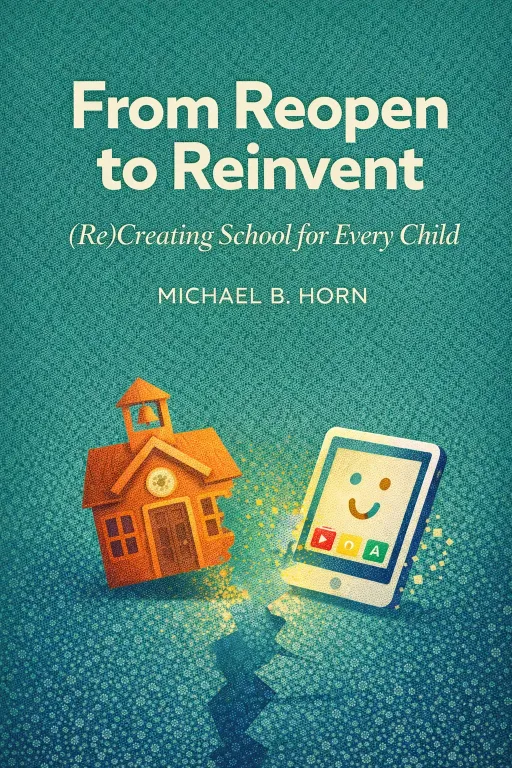
Imagine two students, Jeremy and Julia, both attending the same elementary school. Jeremy is a bright kid who quickly grasps concepts and often finishes his work early, leaving him bored and disengaged. Julia, on the other hand, struggles with reading and needs more time and support, but the class keeps moving forward, leaving her feeling lost and perpetually behind. The school, with its one-size-fits-all structure, is failing both of them. It’s not optimized for the advanced student or the one who needs help. In fact, it’s not optimized for anyone—not the students, not the teachers, and not the parents. This is the stark reality that the COVID-19 pandemic laid bare, exposing the deep cracks in a system designed for a different era. In his book, "From Reopen to Reinvent," author Michael B. Horn argues that the goal shouldn't be to simply go back to the way things were. Instead, he provides a compelling blueprint for a complete reinvention of school itself.
Key Insights
Key Insight 1: From Threat to Opportunity
When the pandemic hit, school systems across the globe were faced with an unprecedented threat. Their response, as Horn explains, was a classic case of "threat rigidity." This is a psychological phenomenon where organizations, when under pressure, don't innovate; they double down on what they already know. They become more rigid, centralize control, and focus on preserving existing routines. Schools tried to replicate the physical classroom online, clinging to familiar schedules and practices, even when they were no longer effective.
Horn argues that this is precisely the wrong approach. Instead of viewing crises as threats, visionary organizations see them as opportunities. He points to the story of the Toyota Prius. In the face of rising fuel costs and environmental concerns—a major threat to the auto industry—Toyota didn’t just make its gasoline engines slightly more efficient. It empowered an autonomous team to create something entirely new: the hybrid car. This move transformed a threat into a market-defining opportunity.
A similar story unfolded at Southern New Hampshire University (SNHU). Facing declining enrollment and the threat of irrelevance, SNHU didn’t just tweak its campus programs. It embraced innovation, moving aggressively into online and competency-based education. By granting its new division the autonomy to operate differently, SNHU reinvented itself and became a global leader in higher education. The lesson for K-12 schools is clear: to truly evolve, they must overcome threat rigidity by empowering autonomous teams to build new models from the ground up, turning today's challenges into tomorrow's breakthroughs.
Key Insight 2: Begin with the End
Before a single new program is designed or a new technology is purchased, Horn insists that every school community must answer one fundamental question: What is the purpose of schooling? Without a clear and shared answer, any effort to reinvent will be directionless. Trying to improve a system without defining its ultimate goal is like trying to build a house without a blueprint.
The book provides a brief history of American education to show that this purpose has never been static. It has shifted over the decades, from creating virtuous citizens, to assimilating immigrants, to preparing a workforce for the industrial age. The problem today is that schools are trying to do everything at once, resulting in a system that does nothing particularly well. This lack of a clear, modern purpose is the source of much of the system's incoherence.
Horn advocates for a "begin with the end" approach. He urges communities—including educators, parents, and students—to engage in a deliberate conversation to define what they want their schools to achieve. Should the primary goal be to prepare students for college and careers? To cultivate lifelong learners and critical thinkers? To foster social and emotional well-being? Only after a community agrees on its "why" can it begin to effectively design the "how." This foundational step ensures that all subsequent decisions—about curriculum, technology, and school structure—are aligned with a unified and meaningful vision.
Key Insight 3: The Student Experience: Guarantee Mastery
For too long, the primary measure of progress in school has been time. Students sit in a class for a set number of weeks, and when the calendar says it's time, they move on, regardless of whether they truly understood the material. Horn argues for a radical shift in this paradigm, moving from a time-based system to one of "guaranteed mastery."
He once again uses Toyota as a powerful analogy. On a Toyota assembly line, if a defect is found in a part, the entire line stops until the problem is fixed. The company would never knowingly ship a car with a faulty engine. Yet, in education, we do this every day. We pass students from grade to grade with significant gaps in their foundational knowledge, knowing these gaps will only widen over time. This is the root cause of what is often mislabeled as "learning loss."
A mastery-based system flips the model. Here, learning is the constant and time is the variable. Students progress to the next concept only after they have demonstrated true proficiency in the current one. This approach builds a learning cycle based on success, not failure. It ensures every student has a solid foundation, which increases confidence and engagement. Horn emphasizes that this is about more than just changing grading systems; it requires a fundamental redesign of instruction, assessment, and scheduling. It also means creating an environment where students can have fun and build relationships, because learning is an inherently social and emotional process.
Key Insight 4: The Unbundled School
The traditional model of schooling places an impossible burden on a single teacher. They are expected to be an expert lecturer, a small-group facilitator, a curriculum designer, an assessment specialist, a behavior manager, and an emotional support counselor—all at the same time. Horn argues that this "one-teacher, one-classroom" model is a relic of the past and a primary driver of teacher burnout.
The solution he proposes is to "unbundle" the role of the teacher. In a team-based model, a group of educators would share responsibility for a cohort of students, with each member specializing in what they do best. One teacher might excel at delivering dynamic, engaging lessons to a large group. Another might be a master of Socratic dialogue and project-based coaching in smaller settings. A third might focus on data analysis and personalized intervention. This approach not only leverages the unique strengths of each educator but also makes the profession more sustainable and effective.
This concept of unbundling also extends to the parent experience. Using frameworks like the Kano model, which categorizes needs into basic, performance, and excitement factors, schools can better understand what parents are truly looking for. For many, the rigidity of the school day is a major source of stress. By offering more flexible and unbundled options—from hybrid schedules to a la carte support services—schools can reduce this burden and move from a transactional relationship with parents to a true partnership focused on the child's progress.
Key Insight 5: The Engine of Change
Great ideas are not enough to reinvent a system as entrenched as education. Implementation is everything. Horn identifies two foundational pillars that must be in place to drive successful change: culture and technology. He defines culture as "the way we do things around here" and argues it is the single most powerful factor in a school's success. A strong, positive culture must be intentionally built through shared values, clear priorities, and consistent rituals. Without it, even the best-laid plans will fail. Technology, meanwhile, is not a solution in itself, but a necessary utility. Ensuring every student has adequate and equitable access to devices and connectivity is the baseline requirement for any modern learning environment.
With these foundations in place, Horn introduces a practical method for managing innovation: "discovery-driven planning." Instead of creating a rigid, five-year plan based on unproven assumptions, leaders should identify their most critical hypotheses and design small, low-cost experiments to test them. This iterative process of testing, learning, and adapting dramatically reduces the risk of large-scale failure. It allows schools to innovate intelligently, even when faced with uncertainty and disagreement among stakeholders. This approach provides a clear pathway for leaders to navigate the complex human dynamics of change and build momentum toward a truly reinvented school.
Conclusion
The most critical takeaway from "From Reopen to Reinvent" is that the future of education cannot be a slightly improved version of the past. Incremental tweaks to a broken system will not suffice. True transformation requires a courageous reinvention built on three core principles: a clearly defined purpose, a commitment to guaranteed mastery for every student, and a flexible, unbundled structure that empowers teams of educators and respects the needs of families.
The book leaves us with a profound challenge. For over a century, our education system has been defined by rigidity. Now, in the wake of a global disruption, we have a choice. We can succumb to the instinct to rebuild what we lost, or we can seize this rare opportunity to build what we have always needed. The real work begins when we stop asking how to get back to normal and start asking what a better normal could look like.