

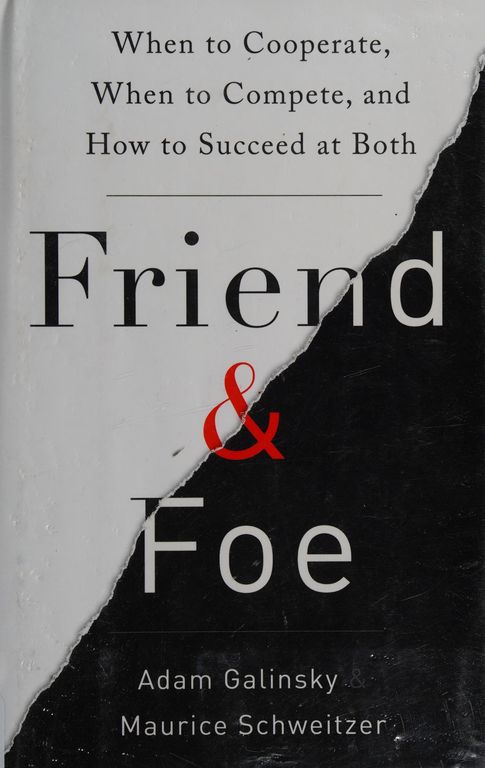
Friend and Foe
When to Cooperate, When to Compete, and How to Succeed at Both
Introduction: The Tension That Defines Us
Introduction: The Tension That Defines Us
Nova: Welcome to the show. Today, we are diving into a book that tackles the most fundamental tension in human interaction: cooperation versus competition. Forget the idea that we are either inherently good collaborators or ruthless rivals. The reality, as Adam D. Galinsky and Maurice Schweitzer argue in "Friend and Foe," is far more nuanced, and frankly, more useful.
Nova: : That tension is everywhere, isn't it? I think about my own work life. You need your team to cooperate to hit the quarterly goal, but you're also competing against another team for the budget next year. It feels like a constant, exhausting tightrope walk.
Nova: Exactly. And that tightrope walk is the key. The authors suggest that the debate—are humans hardwired to cooperate or compete—misses the mark entirely. They found that success in modern life, whether in business, politics, or even dating, hinges on our ability to master roles. They call it succeeding at both friend and foe.
Nova: : So, this isn't just a book about being nice or being cutthroat. It’s about strategy. What's the most surprising thing you uncovered about why we even have these two opposing drives?
Nova: The surprise is how deeply ingrained and adaptive both are. We evolved to cooperate for survival—building tribes, sharing resources. But we also evolved to compete for status, mates, and scarce resources. Galinsky and Schweitzer frame it not as a moral failing, but as a necessary dual operating system. The real question isn't which one to choose, but how to switch between them seamlessly.
Nova: : I'm ready to learn the switch. Let's break down the science behind this dual nature. Where do we start?
Key Insight 1: How We Size Up the World
The Social Comparison Engine: Identifying Friend or Foe
Nova: Chapter one in understanding this dynamic is realizing that our first step in any new interaction is assessment. We are constantly sizing people up to determine if they are a potential collaborator or a potential threat. The book highlights the power of social comparison in this process.
Nova: : Social comparison—that’s when we look at someone else to gauge our own standing, right? Like checking your neighbor's lawn to see if yours is good enough.
Nova: Precisely. But Galinsky and Schweitzer show how this comparison dictates our immediate move toward cooperation or competition. If we compare ourselves to someone we perceive as significantly in a relevant domain, we might be motivated to cooperate to learn from them, or we might become intensely competitive to close that gap.
Nova: : That makes sense in a performance review, but what about everyday life? Are we doing this subconsciously all the time?
Nova: Constantly. They point to fascinating research on how this plays out in digital spaces. Think about Facebook or LinkedIn. We scroll through curated highlight reels. This constant exposure to others' successes—our 'friends' online—can trigger a competitive impulse even when there’s no actual resource at stake. It’s comparison without context.
Nova: : That’s a powerful point. We’re essentially manufacturing foes out of acquaintances because their highlight reel makes us feel comparatively inadequate. Is there a statistic on how often this happens?
Nova: While they don't give a single percentage for all social media use, the underlying research shows that upward social comparison, especially when we feel the comparison is to our goals, strongly predicts competitive behavior. If you see a colleague get the promotion you wanted, the immediate internal response is often competitive, even if you congratulate them outwardly.
Nova: : So, the first strategic move is recognizing you feel competitive. Is it genuine threat, or just a poorly calibrated social comparison?
Nova: Exactly. If it’s just a comparison, you can reframe it. The book suggests that if you see someone succeeding, you can shift your comparison goal from 'I must beat them' to 'I must learn from them.' This reframing is the first step toward choosing cooperation when competition isn't necessary.
Nova: : It sounds like the book is giving us permission to be suspicious, but also giving us the tools to manage that suspicion. What happens when we try to understand the other side better? Does that always lead to friendship?
Nova: That leads us perfectly into the next major theme: perspective-taking. It seems intuitive that if you understand someone better, you’ll cooperate. But the science reveals a critical, counterintuitive twist that we need to explore.
Key Insight 2: Perspective Taking as Gasoline
The Double-Edged Sword of Empathy
Nova: This is where the research gets really juicy. We often hear that empathy—seeing the world through someone else's eyes—is the ultimate peacemaker. Galinsky and Schweitzer found that perspective-taking is a double-edged sword. In competitive contexts, it can be like adding gasoline to a fire.
Nova: : Gasoline? That’s a strong metaphor. How can trying to understand someone make you competitive or defensive?
Nova: It depends on the initial state. If you are already in a competitive mindset—say, negotiating a salary or bidding on a contract—trying to take the other party's perspective makes you better at anticipating their moves. You don't become kinder; you become a more effective competitor. You use their perspective to better protect your own interests.
Nova: : So, if I’m negotiating with a vendor, understanding their bottom line helps me push mine harder, not meet them halfway. That’s a very cynical, but perhaps realistic, application.
Nova: It is realistic. They cite studies showing that perspective-taking in competitive scenarios leads people to hold firmer positions and be less willing to compromise, because they are better equipped to defend against the perceived attack. It enhances self-protection.
Nova: : Wait, but what about when the relationship is supposed to be cooperative? If I’m working on a joint venture, shouldn't I be taking their perspective to ensure mutual success?
Nova: Absolutely. The key distinction is the you bring into the interaction. If you enter the interaction primed for cooperation—if you genuinely believe the goal is mutual gain—then perspective-taking acts as a powerful glue. It helps you understand their needs so you can craft a solution that satisfies both parties.
Nova: : So, the context—the initial framing—is everything. If I frame it as a zero-sum game, empathy makes me a better fighter. If I frame it as a positive-sum game, empathy makes me a better partner.
Nova: Precisely. And this is where the book moves from theory to a practical playbook. They offer specific techniques for yourself for cooperation before you even walk into the room. One technique involves recalling past successful collaborations to activate those cooperative neural pathways.
Nova: : That’s actionable. It’s about setting your internal thermostat before the negotiation even begins. What about the flip side? When is competition not just necessary, but beneficial?
Nova: Competition, when managed correctly, drives innovation. The book details how healthy rivalry—where the focus is on performance improvement rather than personal destruction—can lead to breakthroughs. It’s the difference between a competitor who wants you to fail, and a rival who wants to push you to be better so they can then surpass you.
Nova: : I see. It’s about channeling that competitive energy into productive output, rather than destructive sabotage. This seems to require a high degree of self-awareness from everyone involved.
Key Insight 3: Mastering the Switch
The Strategic Playbook: Succeeding at Both
Nova: Our final core area must be the practical takeaway—the roadmap for succeeding at both. Galinsky and Schweitzer distill their research into clear strategies for navigating these dual roles in teams and organizations.
Nova: : I’m looking for the cheat codes here. If I have a team member who is brilliant but overly competitive, how do I manage them without alienating them?
Nova: The book emphasizes managing the of the task. For the overly competitive individual, you might structure their incentives so that their success is explicitly tied to the success of the larger group. You make their personal win contingent on the team’s win. This aligns their competitive drive with the cooperative goal.
Nova: : That’s smart—aligning self-interest with collective interest. What about when you need to be the 'foe' strategically, perhaps in a tough negotiation with an external partner?
Nova: In those moments, they advise leveraging what they call 'cooperative competition.' This means being firm and assertive about your needs—the competitive part—but always framing your demands within the context of a mutually beneficial, long-term relationship. You signal, 'I am competing hard for my share, but I am committed to this partnership surviving and thriving beyond this single transaction.'
Nova: : So, you compete on the terms of the deal, but cooperate on the terms of the relationship. That feels like a sustainable model.
Nova: It is. And one of the most compelling findings they share relates to power. Power dynamics drastically alter the friend/foe calculation. When you have high power, you are often less motivated to take the perspective of those with less power, which can lead to ethical blind spots.
Nova: : That’s a sobering thought for anyone in a leadership position. The higher you climb, the more you have to actively fight the urge to stop seeing your subordinates as full partners.
Nova: Exactly. They suggest that leaders must institutionalize mechanisms for feedback and perspective-taking from lower-power individuals—things like anonymous surveys or structured devil's advocate roles—specifically to counteract the natural tendency to become insulated and purely competitive.
Nova: : It sounds like the ultimate skill isn't choosing friend or foe, but achieving what they call 'contextual flexibility.' Being able to read the room and deploy the right strategy instantly.
Nova: That’s the summary. They found that the most successful people aren't the ones who are always nice, or the ones who are always aggressive. They are the ones who can fluidly transition between being a supportive friend and a strategic competitor, based on the specific demands of the moment and the long-term goals of the relationship.
Conclusion: Integrating the Dual Self
Conclusion: Integrating the Dual Self
Nova: We've covered a lot of ground today, moving from the evolutionary roots of our dual nature to the practical application of social comparison and perspective-taking. The central message of "Friend and Foe" is clear: embracing the tension is the path to success.
Nova: : It reframes so much of what we think about collaboration. It’s not about eliminating competition; it’s about making sure competition serves a productive end, rather than just feeding ego or insecurity. The idea that perspective-taking can be 'gasoline' really stuck with me.
Nova: It’s a crucial warning. We must be intentional about we are trying to understand someone else. Are we seeking connection, or are we seeking tactical advantage? The answer dictates the outcome.
Nova: : So, if our listeners take one thing away today, what should it be? How do they start applying this tomorrow?
Nova: Start by auditing your own reactions. The next time you feel a pang of jealousy or defensiveness toward a colleague or competitor, pause. Ask yourself: Is this a genuine threat to my core resources, or is this just a poorly calibrated social comparison? If it’s the latter, consciously reframe that person as a potential teacher, not a rival.
Nova: : And if it is a genuine competitive situation, remember to frame your assertiveness within a context of long-term relationship value. Be firm, but fair, and always signal commitment to the overall partnership.
Nova: That balance—that ability to be both a reliable friend and a sharp competitor when necessary—is the hallmark of high achievement in the modern world. It’s about mastering the full spectrum of human social behavior.
Nova: : A fantastic roadmap for navigating complexity. Thank you, Nova, for breaking down this essential research.
Nova: My pleasure. Understanding the science behind our social wiring is the first step to mastering it. This is Aibrary. Congratulations on your growth!