

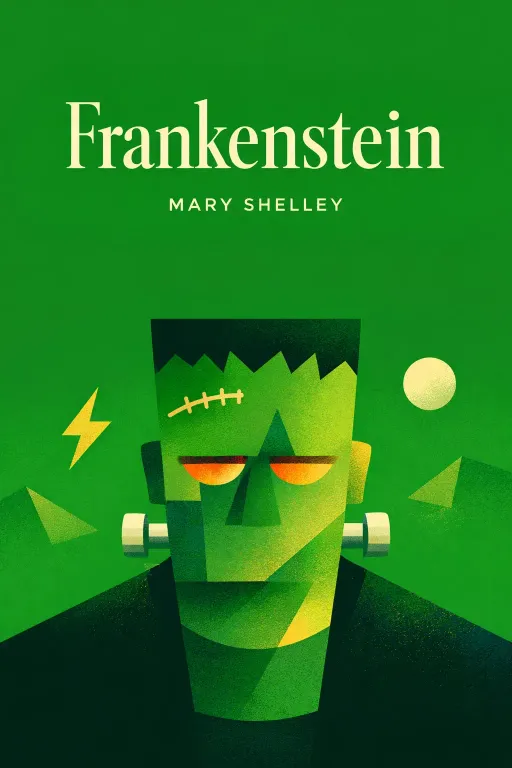
The Monster and His Maker
Introduction
Narrator: On a dreary night in November, a young student of unhallowed arts beholds the accomplishment of his toils. With an anxiety that almost amounts to agony, he infuses a spark of life into the lifeless thing that lies at his feet. The creature's dull yellow eye opens; it breathes hard, and a convulsive motion agitates its limbs. But instead of the triumph of creation, the student is filled with breathless horror and disgust. The beauty of his dream vanishes, and he flees from the wretch he has brought into the world, abandoning it to a cold and confusing existence. This act of creation without responsibility, and the tragic consequences that unfold from it, form the core of Mary Shelley's groundbreaking novel, Frankenstein; or, The Modern Prometheus. It is a story that dissects the very nature of humanity, ambition, and the profound question of who, in the end, is the true monster.
The Birth of a Monster and a Myth
Key Insight 1
Narrator: The creation of Frankenstein is a story as compelling as the novel itself, born from a confluence of personal tragedy, intellectual heritage, and a legendary challenge. Mary Shelley was the daughter of two of the era's most radical thinkers: the feminist Mary Wollstonecraft and the political philosopher William Godwin. Her life was steeped in loss from the beginning, as her mother died just days after giving birth to her. This shadow of creation intertwined with death would haunt her work.
The novel's direct genesis occurred in the summer of 1816, a period known as the "year without a summer" due to volcanic ash clouding the sky. Confined by incessant rain to a villa on the shores of Lake Geneva, a young Mary Shelley, her partner Percy Bysshe Shelley, the infamous Lord Byron, and his physician John Polidori passed the time by reading German ghost stories. As a diversion, Byron proposed a challenge: that they each write their own supernatural tale. For days, Mary struggled, feeling a "blank incapability of invention." But the group's late-night conversations, filled with philosophical debates about the nature of life and the new scientific theory of galvanism—the idea that electricity could reanimate dead tissue—planted a seed in her imagination. One night, she experienced a terrifying "waking dream." In her mind's eye, she saw the "pale student of unhallowed arts kneeling beside the thing he had put together." She witnessed the hideous phantasm stir with a half-vital motion and then, with horrifying clarity, saw the creator flee in terror from his own creation. That vision, born of intellectual discourse and personal anxiety, became the hideous progeny she would unleash upon the world.
The Tragedy of Unchecked Ambition
Key Insight 2
Narrator: The novel's protagonist, Victor Frankenstein, is a man driven by a dangerous and obsessive thirst for knowledge. His story is a cautionary tale about the perils of ambition divorced from moral responsibility. As a youth, he becomes fascinated not with the observable world, but with the "secrets of heaven and earth." He dismisses modern science as limited and instead delves into the forbidden works of ancient alchemists like Cornelius Agrippa, hoping to discover the elixir of life.
A pivotal moment occurs when, at fifteen, he witnesses a bolt of lightning utterly obliterate an oak tree. A natural philosopher explains the modern theory of electricity, and for a moment, Victor sees the foolishness of his alchemical heroes. Yet this insight is temporary. At the University of Ingolstadt, after the death of his mother, his ambition is rekindled by the charismatic Professor Waldman, who speaks of modern chemists who "penetrate into the recesses of nature" and acquire "almost unlimited powers." This lecture reignites Victor's soul. He exclaims internally, "So much has been done... more, far more, will I achieve." He dedicates himself to discovering the cause of life, isolating himself from friends and family for two years. In a "workshop of filthy creation," he toils obsessively, his health failing as he assembles his creature. The enthusiastic frenzy of discovery blinds him to the horror of his work, a blindness that is shattered the moment his creation opens its eyes.
The Awakening of a Wretched Soul
Key Insight 3
Narrator: Shelley masterfully shifts the narrative to give voice to the abandoned, allowing the reader to experience the world from the creature's perspective. His first moments are not monstrous, but infantile and confusing—a "strange multiplicity of sensations" he cannot distinguish. He learns about the world through painful trial and error, discovering the pleasure of fire's warmth and the pain of its burn, the relief of finding berries and the misery of hunger.
His first encounters with humanity are brutal. A shepherd shrieks and flees; villagers attack him with stones. This violent rejection drives him to seek refuge in a small hovel attached to a cottage inhabited by a family, the De Laceys. From this hidden vantage point, his true education begins. He observes their gentle manners, their love for one another, and their sadness, which he eventually learns stems from poverty. This discovery sparks his own capacity for empathy. In a profound act of benevolence, the creature stops stealing their food and begins secretly gathering firewood for them at night. The family, unaware of their helper, attributes the aid to a "good spirit." During this time, the creature is filled with a longing to connect, yet this hope is crushed when he sees his own reflection in a pool of water and is "filled with the bitterest sensations of despondence and mortification" at his own "miserable deformity."
The Education of a "Fallen Angel"
Key Insight 4
Narrator: The creature's intellectual and emotional development accelerates when he discovers a lost satchel of books. Through Goethe's The Sorrows of Werter, he learns of complex human emotions and despondency. From Plutarch's Lives, he learns of history, virtue, and vice. But it is John Milton's Paradise Lost that has the most profound impact. He reads it as a true history and sees his own situation reflected in its pages. He relates to Adam, a unique creation "united by no link to any other being in existence." But he feels a far deeper connection to Satan. Like the fallen angel, he is an outcast who views the happiness of his "protectors" with the "bitter gall of envy."
This sense of damnation is cemented when he finds and reads Victor Frankenstein's journal, which details the horror and disgust his own creator felt upon his animation. He learns he was not a beloved Adam, but a loathed abomination. This knowledge transforms his sorrow into rage. He curses his creator for forming a monster so hideous that even he was repulsed. The education that gave him self-awareness also brought him an unbearable understanding of his own wretchedness, solidifying his identity as a solitary and abhorred being.
The Cycle of Vengeance and Ruin
Key Insight 5
Narrator: Driven by a desperate hope that the blind patriarch, De Lacey, will judge him by his words and not his appearance, the creature makes his move. The encounter begins with kindness, as the old man offers him comfort. But when the rest of the family returns, their sight betrays them. Agatha faints, Safie flees, and Felix violently attacks the creature, driving him away. This final, brutal rejection shatters his last hope for human connection. "From that moment," he declares, "I declared everlasting war against the species, and, more than all, against him who had formed me."
This vow initiates a devastating cycle of revenge. The creature murders Victor's young brother, William, and cleverly frames the innocent servant, Justine Moritz, for the crime, ensuring her execution. His revenge is not random; it is a calculated campaign to "desolate" Victor's heart. After Victor destroys the female companion he had started to create, the creature delivers his most chilling threat: "I will be with you on your wedding-night." Victor, in his self-absorption, misinterprets this as a threat against his own life. On his wedding night, he stands guard, only to hear a dreadful scream. The creature has murdered his beloved Elizabeth. This final act of cruelty destroys Victor's remaining family, as his father dies of grief, and transforms Victor's own life into a singular, obsessive pursuit of the fiend across the frozen wastes of the north.
Conclusion
Narrator: The ultimate takeaway from Frankenstein is that monstrosity is not born, but made. The novel powerfully argues that the true horror lies not in the creature's grotesque form, but in the creator's act of abandonment and society's subsequent rejection. Victor Frankenstein's sin is not his ambition to create life, but his failure to take responsibility for the life he creates. The creature's descent into malice is a direct consequence of the cruelty and isolation he endures. He is, as Percy Shelley noted in his review, a "child of necessity," his wickedness flowing inevitably from the ill-treatment he receives.
Mary Shelley's masterpiece leaves us with a question that echoes through the centuries: Who is the real monster? Is it the physically hideous being who yearns for love but is met with hate, or the brilliant, handsome creator who shirks his duty and unleashes suffering upon the world? The novel challenges us to look beyond appearances and consider how our own actions—or inactions—can shape the humanity, or the monstrosity, in others.