

Frankenstein's Paternity Test
Golden Hook & Introduction
SECTION
Daniel: Okay, Sophia. You've just finished Frankenstein. Give me your five-word review. Sophia: Uh… 'Bad Dad Creates Sad Lad.' Daniel: That's... brutally accurate. Mine is: 'Worst post-grad project ever.' Sophia: It’s amazing how that simple, funny summary captures so much of Mary Shelley's Frankenstein; or, The Modern Prometheus. And the story behind the book is almost as famous as the novel itself. Daniel: It really is. This is the book that was famously born out of a ghost story competition on a rainy night in Switzerland, with literary giants like Lord Byron and her husband, Percy Bysshe Shelley. Sophia: And Mary Shelley was only eighteen when she started writing it, which is just mind-boggling. Daniel: Exactly. And what's even more incredible is how she channeled her own profound experiences with loss—losing her own mother just days after her birth, and then the tragic death of her own infant child—into this timeless story about creation, abandonment, and what it means to be human. It really brings us to the heart of the creator himself, Victor Frankenstein.
The Creator's Sin: The Tragedy of Unchecked Ambition
SECTION
Daniel: Victor doesn't start as a monster. The book goes to great lengths to show us he had this idyllic childhood. He was adored by his parents, who taught him patience and charity. He was their "plaything and their idol." Sophia: So he’s set up as this golden boy from a noble, loving family. Where does it all go so wrong? Daniel: It begins with his ambition. He becomes obsessed with natural philosophy, but not the modern science of his day. He’s drawn to the ancient alchemists—Cornelius Agrippa, Paracelsus. He wants to discover the "elixir of life," to "banish disease from the human frame." Sophia: He’s not just trying to understand the world; he’s trying to conquer it. To conquer death itself. Daniel: Precisely. And this ambition leads him to the University of Ingolstadt, where he dedicates himself entirely to chemistry and anatomy. For two years, he becomes a recluse, neglecting his health, his family, everything, all for one goal: to animate lifeless matter. Sophia: And then comes the big moment. The lightning, the lab, the classic scene we all know. Daniel: Right. He describes it so vividly. It’s on "a dreary night of November," at one in the morning, that he beholds the "accomplishment of my toils." He gathers his instruments and infuses a "spark of being into the lifeless thing that lay at my feet." Sophia: The culmination of years of work. He must have been ecstatic. Daniel: You would think so. But what happens next is the true turning point of the entire novel. He says, "by the glimmer of the half-extinguished light, I saw the dull yellow eye of the creature open; it breathed hard, and a convulsive motion agitated its limbs." Sophia: Chills. Just absolute chills. Daniel: But here’s the twist. Victor says, "now that I had finished, the beauty of the dream vanished, and breathless horror and disgust filled my heart." Sophia: Hold on. He spends two years on this, painstakingly selecting what he thought were beautiful features—lustrous black hair, pearly white teeth—and the second it opens its eyes, he's disgusted? Why? What did he expect? Daniel: That’s the million-dollar question. It seems the reality of his success was far more horrifying than the ambition. The watery eye, the shriveled complexion, the straight black lips—it was a "horrid contrast" to his dream. He had created a wretch. And his reaction is not to help, or to teach, or to guide. He runs. Sophia: He just… runs away? Daniel: He runs away. He abandons his creation in the laboratory, paces his room all night, and then has this horrific nightmare. He dreams he’s embracing his beloved Elizabeth, but when he kisses her, her lips become "livid with the hue of death," and she transforms into the corpse of his own dead mother, crawling with worms. Sophia: Wow. So his subconscious is screaming at him. He's equated his act of creation with death and decay. Daniel: Exactly. His sin isn't playing God. It’s the sin of abandonment. He’s a deadbeat dad on a cosmic scale. He creates this 'newborn,' and the moment it takes its first breath, he bolts out the door in terror. And that single act of abandonment is the catalyst for every single tragedy that follows.
The Creature's Plea: The Making of a Monster
SECTION
Sophia: And to understand those tragedies, we have to do something the book does so brilliantly: we have to listen to the monster. Daniel: We absolutely do. The novel pulls this incredible switch halfway through, where the Creature confronts Victor in the Alps and demands to tell his story. And his narrative is one of the most eloquent and heartbreaking parts of English literature. Sophia: So what was his 'birth' like from his perspective? Daniel: It was pure chaos. He describes it as a "strange multiplicity of sensations." He says, "I saw, felt, heard, and smelt, at the same time." Light was painful. Sounds were confusing. He was essentially an infant in an eight-foot-tall body, a "poor, helpless, miserable wretch" who sat down and wept from the sheer pain of existence. Sophia: That's so different from the grunting monster we see in the movies. He's a blank slate, completely vulnerable. How does he even survive? Daniel: Through trial and error. He learns about hunger and finds berries. He learns about cold and finds a cloak. He discovers a fire left by beggars and, after painfully burning his hand, figures out how to maintain it. He's a scientist in his own right, learning through observation and deduction. Sophia: But he's totally alone. What happens when he finally encounters people? Daniel: It’s a disaster. He wanders into a village, and the moment he enters a cottage, "the children shrieked, and one of the women fainted." The villagers attack him with stones and drive him away in terror. This is his first lesson about humanity: they are violent and full of hate for what they don't understand. Sophia: That's heartbreaking. So he learns to hide. Daniel: Yes, and he finds a little hovel, a pigsty really, attached to a cottage. And through a small crack in the wall, he begins his true education. He secretly watches the family inside—the blind old man, De Lacey, and his children, Felix and Agatha. Sophia: And what does he see? Daniel: He sees kindness for the first time. He sees their "gentle manners," their love for one another. He hears the old man’s beautiful music, which gives him feelings of "a mixture of pain and pleasure." He eventually realizes they are poor and suffering, and in a moment of profound empathy, he stops stealing their food and starts secretly gathering firewood for them at night. Sophia: He becomes their secret helper, their "good spirit," as they call it. He's showing more humanity than the humans who attacked him. Daniel: Exactly. He's learning to be good. He learns to speak and read by listening to them teach a visitor, an Arabian woman named Safie. He devours books he finds in the woods: The Sorrows of Werter, Plutarch's Lives, and most importantly, Milton's Paradise Lost. Sophia: He reads Paradise Lost? That's some heavy reading for a beginner. Daniel: And it changes him. He sees himself as both Adam, a lonely creation with no link to any other being, and as Satan, an outcast angel filled with envy for the happiness he sees but can't have. But the final blow comes when he finds Victor's journal in the pocket of the coat he took from the lab. Sophia: Oh no. What does it say? Daniel: It details his own creation, describing his "odious and loathsome person" and Victor's horror and disgust. It's the ultimate rejection. He learns that his own creator loathed him from the moment of his birth. He cries out, "Accursed creator! Why did you form a monster so hideous that even you turned from me in disgust?" Sophia: I can't even imagine that pain. To have your worst fears about yourself confirmed by your own father, your own god. Daniel: It's devastating. And it's this complete and utter rejection from every corner—from strangers, from the family he grew to love, and from his own creator—that finally turns his benevolence to bitterness. After a final, failed attempt to connect with the blind De Lacey is met with violence from Felix, he finally snaps. He looks at the burning cottage of the family that fled from him and says, "from that moment I declared everlasting war against the species, and, more than all, against him who had formed me."
The Legacy of Frankenstein: Why We Still Fear the Monster in the Mirror
SECTION
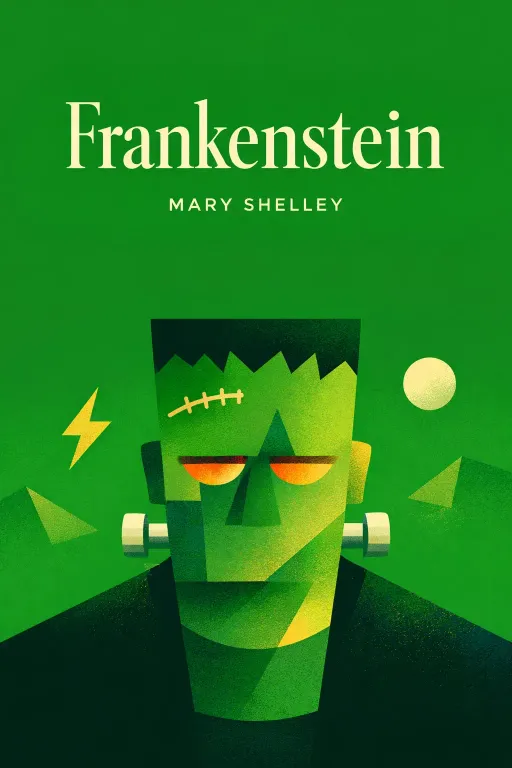
Sophia: And that 'war' is what cements the story in our minds. But it's interesting, when we think of 'Frankenstein' today, we don't usually picture Victor. We picture the monster. Why has that image become so dominant? Daniel: That's the fascinating legacy of the book. Mary Shelley came from a family of writers, but the most enduring part of her work is visual. The story was adapted for the stage almost immediately, and the reviews from 1823 said the play was of "astonishing, of enchanting, interest." People needed to see the monster. Sophia: And then came the movies. Daniel: Then came the movies. More than any other novel, Frankenstein became a cinematic phenomenon. But it was James Whale's 1931 film, starring Boris Karloff, that created the image we all know. The flat head, the bolts in the neck, the green skin, the lumbering walk. Sophia: So the popular image is a grunting, inarticulate brute, but Shelley's original was this eloquent, self-taught philosopher who quotes Milton. That's a huge disconnect. Daniel: A massive disconnect. Karloff's monster became an independent icon, a celebrity. So much so that most people now mistakenly call the monster "Frankenstein." The creation has completely eclipsed the creator in the popular imagination. Sophia: And that image has become a symbol for so many of our modern fears, hasn't it? Daniel: Absolutely. The story is a perfect canvas for our anxieties. The "mad scientist" trope comes directly from Victor Frankenstein. The fear of "playing God" is a debate that resurfaces with every new scientific breakthrough, from the cloning of Dolly the sheep in the 90s to the development of artificial intelligence today. Sophia: It's that question of responsibility again. Are we thinking about the consequences of what we create? Are we prepared to be parents to our own inventions, or will we just run away in horror when they don't turn out the way we dreamed? Daniel: Exactly. The monster in the story becomes a mirror. For Victor, he was a mirror of his own hubris and failure. For us, he's a mirror for our collective fears about science, about otherness, and about the potential for our own creations to turn on us.
Synthesis & Takeaways
SECTION
Sophia: So, coming back to our original question—who is the real monster? It seems the book's answer is... it's complicated. Victor is monstrous for his neglect, for his cowardice. But the Creature becomes monstrous through his suffering and his quest for revenge. It's a cycle of monstrosity born from a single act of abandonment. Daniel: Precisely. And that's the story's enduring power. It's not a simple horror story about a monster on a rampage. It's a profound tragedy about our responsibility to the things we create, whether that's a child, a piece of technology, or an idea. The moment we turn away in disgust from our "hideous progeny," as Shelley called her novel, we risk unleashing a monster into the world. Sophia: It really makes you think about what 'monsters' in our own lives or society we might be creating through neglect or fear. A powerful question to sit with. Daniel: We'd love to hear your thoughts. Who did you find more sympathy for, Victor or his creation? Let us know on our social channels. Sophia: This is Aibrary, signing off.