

** The Productivity Paradox: Why Doing More Isn't Getting You Ahead
Golden Hook & Introduction
SECTION
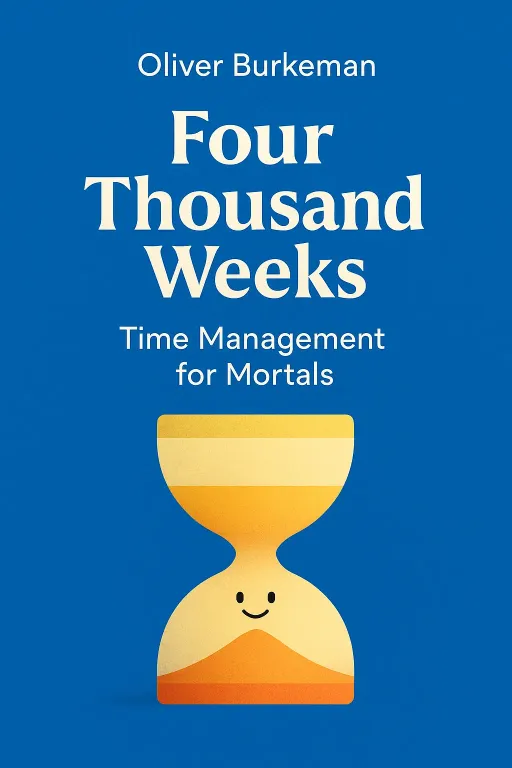
Orion: Have you ever felt like you're on a hamster wheel? You get more efficient, you clear your emails faster, you finish projects ahead of schedule... and your reward is just... more. More emails, more projects, a higher bar. It’s a paradox: the better you get at managing your time, the less of it you seem to have. This isn't a personal failure; it's what Oliver Burkeman calls "The Efficiency Trap," and it's a core idea in his brilliant book,.
Orion: Today we're joined by Mike, a veteran leader in the government sector, to explore this very dilemma. Mike, thanks for being here.
Mike: It's great to be here, Orion. That hamster wheel analogy is painfully accurate.
Orion: I thought it might be. With over 15 years in a structured environment, you must have seen this paradox play out countless times. Today, we're going to dive deep into this from two perspectives, both from Burkeman's book. First, we'll explore the 'Efficiency Trap'—why getting better at your job can actually make you feel more overwhelmed. Then, we'll discuss the liberating power of 'Strategic Neglect' and how to become a better procrastinator on purpose.
Mike: I'm intrigued. "Strategic neglect" sounds both dangerous and wonderful.
Deep Dive into Core Topic 1: The Efficiency Trap
SECTION
Orion: It is! But first, let's set the stage with that Efficiency Trap. Burkeman tells this very relatable story about his own journey as a self-proclaimed 'productivity geek.' He was drowning in email, a feeling I think we all know. So, his first move was to adopt the 'Inbox Zero' system. He was determined to get his inbox to zero every single day.
Mike: A noble, if perhaps foolish, quest.
Orion: Exactly. And a funny thing happened. The faster and more efficiently he replied to emails, the faster people replied back to. His efficiency didn't reduce his workload; it just increased the of communication. He was essentially rewarded for being a good emailer with more email.
Mike: That's it. That's the core of the issue in any large organization. We call it 'competence punishment.' The reward for doing great work, for being reliable and efficient, is that you're given more work. You become the 'go-to' person, and your reward for clearing your plate is that everyone else puts their work on it. It’s a recipe for burnout, especially for the most dedicated public servants.
Orion: You've hit it on the head. It's a systemic issue, not a personal one. Burkeman reinforces this with a fantastic historical example. In the early 20th century, when American households started getting 'labor-saving' devices like washing machines and vacuum cleaners, you'd assume housewives gained hours of free time, right?
Mike: Logically, yes. That's the sales pitch.
Orion: But that's not what happened. The historian Ruth Schwartz Cowan found that instead of gaining free time, society's standards of cleanliness just rose to meet the new technology. Suddenly, you were expected to wash clothes far more frequently. The definition of a 'clean' house expanded. The work just filled the time that the new efficiency created.
Mike: That is a perfect parallel. It's all about rising expectations. In government, when a new software or technology promises to speed up a process, it never leads to shorter workdays. It leads to demands for more data, more reports, more granular analysis—all within the same timeframe. The technology doesn't end up serving us; we end up serving the technology's expanded potential.
Orion: And that's the feeling Burkeman calls 'existential overwhelm.' The list of potentially valuable things to do—whether at work or in life—is functionally infinite. The more capable and efficient you become, the more of that infinity you feel you be tackling. You're not getting closer to the bottom of the list; the list just keeps getting longer. It's a rigged game.
Mike: So the very tools and mindsets we adopt to gain control are actually causing us to lose it. It's a feedback loop. The more overwhelmed we feel, the more we seek out the next productivity hack, which just makes us more 'efficient' and, in turn, more overwhelmed.
Orion: Precisely. You run faster and faster, but the finish line just keeps moving further away.
Deep Dive into Core Topic 2: Strategic Neglect
SECTION
Orion: So if becoming more efficient is a trap, what's the alternative? This is where Burkeman's thinking gets really radical and, I think, incredibly useful. He argues we need to stop trying to win an unwinnable game and instead embrace our finitude. We have to practice what I'd call 'Strategic Neglect.'
Mike: Okay, now we're at the 'dangerous and wonderful' part. How does one strategically neglect things without their career or life catching on fire?
Orion: It's a controlled burn. Burkeman illustrates this with a famous story about Warren Buffett and his personal pilot. The pilot is feeling unfocused, so Buffett tells him to make a list of his top 25 career goals. Once he has the list, Buffett tells him to circle his top 5.
Mike: Standard prioritization exercise. I've done that a dozen times.
Orion: Right. So the pilot says, 'Okay, I get it. I'll focus on my top 5, and I'll work on the other 20 in my spare time. They're still important.' And this is where Buffett delivers the punchline. He says, 'No. You've got it wrong. The other 20 are your 'Avoid-at-All-Cost' list.'
Mike: Wow.
Orion: 'These,' Buffett says, 'are the ambitions that are seductive enough to distract you, to pull you off course from the things that matter.' They're the 'good' ideas that kill the 'great' ones.
Mike: That completely reframes everything. It's not about 'A' priorities and 'B' priorities. It's about 'A' priorities and 'things that will actively sabotage the A priorities.' As a leader, that's a powerful and, frankly, a very difficult message to implement. Your job isn't just to say 'yes' to the right things, but to have the courage to say a hard 'no' to good, but not great, things.
Orion: It's the art of choosing what to fail at. And to do that, Burkeman introduces another key principle: 'Pay yourself first.' We've all heard this in personal finance, but he applies it to time. If something is your absolute top priority—a critical work project, time with your family, your health, your self-care—you must schedule it. You put that rock in the jar before anything else, and you let the less important, urgent-seeming tasks fight for the scraps of time that are left.
Mike: That's a huge mindset shift. Most of us, especially in demanding jobs, do the exact opposite. We spend our days trying to 'clear the decks' of all the small, urgent stuff—the emails, the quick requests—assuming that we'll eventually earn this pristine, four-hour block of time for the 'deep work.'
Orion: But the decks never clear, do they?
Mike: Never. The small stuff is infinite. It's like trying to shovel the tide. You clear one wave of emails, and another one is already rolling in.
Orion: And that's the illusion! Burkeman says you have to be willing to accept the anxiety of letting the small stuff pile up, or even letting some of it burn. You have to be willing to disappoint some people in minor ways in order to delight the people and projects that matter in major ways. And that often includes delighting yourself by actually doing the work you care about.
Mike: It requires a level of confidence and clarity that's hard to come by. It's easier to look busy and responsive to a hundred small things than it is to look 'unresponsive' while you're quietly making progress on the one big thing that actually moves the needle.
Orion: That's the courage it takes. The courage to stay on the bus, as another of Burkeman's parables goes.
Synthesis & Takeaways
SECTION
Orion: So, to bring it all together, the modern productivity chase puts us in an Efficiency Trap, where doing more just creates more to do. The only way out isn't a new app or a better system, but a philosophical shift: embracing our finitude and practicing Strategic Neglect—consciously choosing our failures so we can achieve our real successes.
Mike: It's a fundamental shift from being a manager of tasks to being a leader of priorities. It's about accepting that you can't win the game of 'getting everything done,' so you have to choose to play a different, more meaningful game entirely. It's about defining what's truly important, not just what's urgent.
Orion: Perfectly said. And for our listeners, Burkeman offers several practical tools in the book's appendix, but here's a powerful one to start with today: 'Decide in advance what to fail at.' Take a look at your upcoming week. What is one area—maintaining a perfectly tidy house, answering every non-critical email within an hour, a side project you're only lukewarm about—that you can consciously decide to let slide? What will you choose to underachieve on, to create the space for your true number one priority?
Mike: That's a challenging but incredibly liberating question. It forces you to define what 'winning' actually looks like for you, instead of just spending all your energy trying not to lose at everything. That’s a great thought to end on.
Orion: Absolutely. And that's our four thousand-week question for today. Mike, thank you so much for your insights.
Mike: My pleasure, Orion. This was a fantastic conversation.









