

Personalized Podcast
Golden Hook & Introduction
SECTION
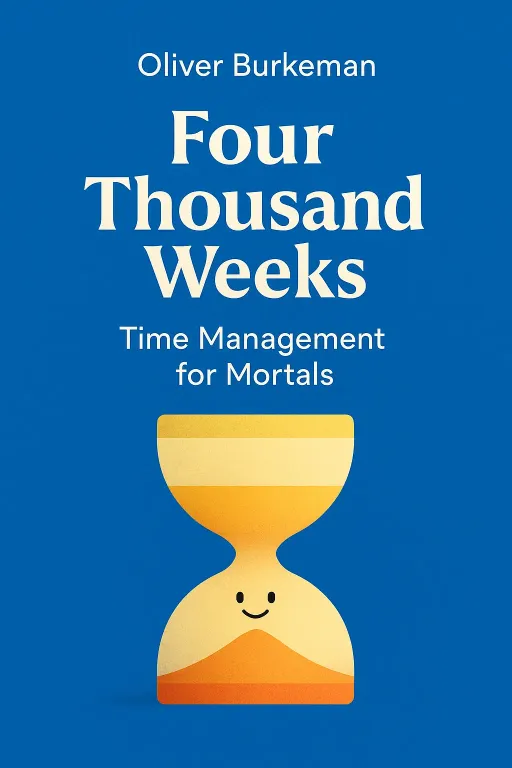
Dr. Celeste Vega: If you live to be eighty years old, you have about four thousand weeks on this planet. That is it. Just four thousand weeks. When you hear that number, does it make you want to download a new calendar app, or does it make you want to take a deep, quiet breath? Today, we are tackling Oliver Burkeman's brilliant book, Four Thousand Weeks: Time Management for Mortals, but we are doing it through a very unique lens. We are going to explore why our obsession with mastering time is actually making us miserable, and how this exact same trap shows up in how we feed ourselves, care for our bodies, and try to live healthy lives. To help me unpack this, I am joined by Büşra Bayıroğlu, a dietitian and healthcare professional who sees the daily struggle of people trying to optimize their lives. Welcome, Büşra.
Büşra Bayıroğlu: Thank you, Celeste. I am so excited to be here. You know, when I first read that number, four thousand weeks, it hit me right in the chest. In my work as a dietitian, I meet so many people who are desperately trying to optimize every single aspect of their lives. They want the perfect meal prep, the perfect workout routine, and the perfect work schedule. They treat their bodies and their time like machines that just need the right programming. But Burkeman's book reminds us that we are mortal. We are finite. And trying to control everything is actually a recipe for burnout.
Dr. Celeste Vega: It really is. Today, we are going to look at this book from three key perspectives. First, we will dive into the efficiency trap and why clearing the decks is a total illusion. Then, we will talk about facing our limitations, or what Burkeman calls embracing our finitude, and how that changes our relationship with our goals. Finally, we will share some highly practical, limit-embracing tools that you can start using today to reclaim your peace of mind.
Büşra Bayıroğlu: I love that roadmap, Celeste. It is so relevant because, in healthcare, we often see that the hardest part of building a healthy habit isn't the lack of information. It is the overwhelming pressure of trying to do it all perfectly. So, let us break down why that pressure is a lie.
Deep Dive into Core Topic 1
SECTION
Dr. Celeste Vega: Let us start with the history of how we got here. Burkeman points out that before the Industrial Revolution and the invention of the clock, people didn't really think of time as a resource to be spent or saved. He talks about the medieval peasant. Now, their lives were incredibly hard, of course, but they lived according to what historians call task orientation. The cows needed milking, the harvest needed gathering, and when the work was done, it was done. They didn't lie awake at night feeling guilty that they weren't being productive enough because time wasn't an abstract conveyor belt they had to keep up with.
Büşra Bayıroğlu: That is a fascinating contrast. Today, we treat time as this external commodity. We say we are running out of time or we need to make time. And what do we do? We turn to productivity hacks. But Burkeman tells this wonderful, self-deprecating story about his own adventures as a productivity geek. He tried scheduling his day in fifteen-minute blocks, using the Pomodoro Technique, and aiming for Inbox Zero. And what happened? The more efficient he became, the more emails he received, and the busier he felt. He calls this the efficiency trap.
Dr. Celeste Vega: Exactly. It is like a rigged game. The management expert Jim Benson used a great phrase for this. He said that becoming more efficient just makes you a limitless reservoir for other people's expectations. When you reply to emails faster, people send you more emails. It is a never-ending cycle. Burkeman compares it to Sisyphus pushing the boulder up the hill, or what he calls Sisyphus's Inbox.
Büşra Bayıroğlu: I see this exact same efficiency trap in nutrition and wellness all the time. People think, if I can just find the perfect meal prep system, or the fastest way to cook, or the ultimate diet app, then I will finally have my health completely under control. They are chasing this when-I-finally mindset. When I finally get my schedule organized, then I will start eating healthy. When I finally lose those ten pounds, then I will start enjoying my life. But that day never comes because the horizon keeps moving.
Dr. Celeste Vega: Yes, the when-I-finally mind is such a trap. It postpones our actual lives into some imaginary future. Burkeman argues that this is a form of emotional avoidance. We use these productivity strategies and optimization goals to avoid confronting the painful constraints of reality. We don't want to admit that we cannot do everything, so we pretend that we are just one life-hack away from total mastery.
Büşra Bayıroğlu: It is so true. And the internet makes this so much worse. Burkeman talks about existential overwhelm, which is this feeling that there is an inexhaustible supply of things worth doing, seeing, and experiencing, but we only have this tiny sliver of time to do them. Think about the attention economy. Social media platforms are literally designed by thousands of engineers to hijack our attention. Burkeman mentions that live stream from BuzzFeed back in 2016 where two reporters spent forty-five minutes wrapping rubber bands around a watermelon until it exploded. Over three million people watched it. We are distracted from distraction by distraction, as the poet T. S. Eliot wrote.
Dr. Celeste Vega: That watermelon story is wild, but it perfectly illustrates how easily our attention is captured by the trivial. And Burkeman's point is that attention isn't just a resource. Attention is life itself. Your experience of being alive is simply the sum of everything you paid attention to. So, if we are constantly distracted, we are literally letting our lives be stolen from us.
Büşra Bayıroğlu: That is a profound shift in perspective. If attention is life, then choosing what to ignore is actually a survival skill. In my field, we talk a lot about mindful eating, which is really just paying attention to the sensory experience of eating. But people struggle with it because they are so used to eating while scrolling through their phones or working at their desks. They are trying to optimize their time by multitasking, but they end up missing the actual experience of nourishment.
Dr. Celeste Vega: And that brings us to the psychological root of distraction. Why do we want to be distracted in the first place? Burkeman has this really interesting chapter called The Intimate Interrupter. He argues that we don't just get distracted by external things. We actively seek out distraction because focusing on a difficult, meaningful task forces us to confront our limitations. When you sit down to write that book, or plan that healthy meal, or do that hard workout, you have to face the reality that your work might not be perfect, and that you are limited by your actual talent and energy. Distraction is a way to escape that discomfort.
Büşra Bayıroğlu: That makes so much sense. He tells the story of Steve Young, who trained to become a monk in Japan. Young had to do this intense ritual where he doused himself with freezing cold water three times a day in the middle of winter. At first, he tried to avoid the pain by thinking of other things, but he found that made the suffering unbearable. When he finally forced himself to concentrate entirely on the sensation of the cold, to lean into the discomfort, the agony evaporated. The lesson is that the real problem isn't the activity itself, but our internal resistance to experiencing it.
Dr. Celeste Vega: What a powerful metaphor. When we stop resisting the reality of our limitations and the discomfort of the present moment, the anxiety actually starts to lift.
Deep Dive into Core Topic 2
SECTION
Büşra Bayıroğlu: This leads us naturally to the second big idea, which is embracing our finitude. Burkeman argues that we need to stop trying to do everything and instead make conscious choices about what to neglect. He calls this the art of creative neglect.
Dr. Celeste Vega: I love that term, creative neglect. It is so liberating. Burkeman offers three great principles for this. The first is to pay yourself first with time. This is a concept borrowed from personal finance. If you wait until the end of the month to save money from what is left over, you will never save anything. You have to save first. The same goes for time. If you wait until you have cleared your to-do list to work on your creative projects, or spend time with your family, or cook a healthy meal, you will never do it. You have to claim that time first, at the start of the day or the week, and let other things go undone.
Büşra Bayıroğlu: That is incredibly practical. I often tell my clients that if they want to prioritize meal planning, they have to schedule it like an important doctor's appointment. You don't wait for free time to magically appear. You claim it. And that means accepting that some other chores or emails will just have to wait.
Dr. Celeste Vega: Exactly. The second principle is to limit your work in progress. Burkeman suggests having a hard limit on the number of active projects you are working on at any given time. Say, no more than three. You cannot start project number four until one of the first three is completely finished. This forces you to focus and actually complete things, rather than having twenty half-baked projects making you anxious.
Büşra Bayıroğlu: That is a brilliant strategy for habit formation too. In nutrition, people often try to change everything at once. They want to drink more water, cut out sugar, start meal prepping, and go to the gym five days a week, all starting on Monday. It is too much work in progress. They get overwhelmed and give up. But if they limit their focus to just one habit, like drinking more water, and stick with it until it is automatic, they are much more likely to succeed.
Dr. Celeste Vega: Yes, radical incrementalism. Burkeman actually cites research by Robert Boice on academic writing habits. Boice found that the most productive academics wrote in brief, daily sessions, sometimes as short as ten minutes, and never longer than four hours. They didn't wait for massive blocks of uninterrupted time. They just made small, consistent efforts.
Büşra Bayıroğlu: That is so reassuring. It is the consistency that matters, not the grand gestures. And the third principle Burkeman mentions is resisting the allure of middling priorities. He shares the famous story, often attributed to Warren Buffett, about making a list of the top twenty-five things you want to achieve in life. You then circle the top five and focus on them. But the real secret is what you do with the other twenty. You don't treat them as second-tier goals. You actively avoid them at all costs because they are the ones that are seductive enough to distract you from the five that matter most.
Dr. Celeste Vega: That is a tough one, isn't it? It is easy to say no to things we don't want to do. The real challenge is saying no to things we do want to do, but that aren't our absolute highest priorities. It requires a kind of mourning for the lives we won't live. Burkeman talks about the inevitability of settling. We hate the word settling because we live in a culture that tells us we should never settle. We want the perfect career, the perfect partner, the perfect lifestyle. But Burkeman argues that settling is actually a beautiful, necessary choice. When you commit to one partner, or one career, or one city, you are closing off other options, yes, but you are also finally making that choice real.
Büşra Bayıroğlu: He references a fascinating study by Daniel Gilbert at Harvard, the poster experiment. Participants were allowed to choose a free art print to keep. One group was told they could exchange their print for a different one within a month. The other group was told their choice was final. Interestingly, the group that was stuck with their decision, the ones who had to settle, ended up being much happier with their print than the group that kept their options open.
Dr. Celeste Vega: That is the paradox of limitation. Commitment brings freedom and satisfaction. When we stop trying to keep all our options open, we can finally show up for the life we actually have.
Synthesis & Takeaways
SECTION
Büşra Bayıroğlu: This brings us to what Burkeman calls Cosmic Insignificance Therapy. It sounds a bit dark at first, but it is actually incredibly comforting. He points out that on a cosmic timescale, our individual lives are a minuscule flicker of near-nothingness. The universe doesn't care if you achieve world-changing greatness or if you have a perfectly optimized inbox. This realization relieves us of the crushing burden of needing to live a cosmically significant life.
Dr. Celeste Vega: It really does. We don't have to be Michelangelo or Einstein to have a meaningful life. Burkeman uses a lovely comparison. He says we do not disapprove of a chair because it cannot be used to boil water for tea. A chair is just a chair, and it is perfectly good at being a chair. In the same way, a human life doesn't need to be extraordinary to be valuable. Preparing a simple, nourishing meal for your family, or being a kind neighbor, or just enjoying a quiet walk, these are deeply meaningful ways to spend our finite time.
Büşra Bayıroğlu: That is so beautiful, Celeste. In my work, I see so much guilt and shame around food and body image. People feel like they are failing if they don't look like fitness models or eat a perfectly clean diet. But cosmic insignificance therapy reminds us that we can drop these impossible standards. We can accept who we are, with all our imperfections, and just focus on doing the next and most necessary thing, as Carl Jung advised.
Dr. Celeste Vega: Yes, Jung's advice to quietly do the next and most necessary thing is the ultimate antidote to overwhelm. You don't need to have the whole future figured out. You just need to take the next right step, with conviction, in the present moment. Because, as Jorge Luis Borges wrote, time is the substance we are made of. We don't have time. We are time.
Büşra Bayıroğlu: Exactly. We cannot get outside of time to master it. We can only live inside it, moment by moment.
Dr. Celeste Vega: So, as we wrap up today's conversation, let us leave our listeners with a few practical tools from Burkeman's appendix to help them embrace their finitude. Büşra, what is one tool that really resonates with you?
Büşra Bayıroğlu: I love the idea of keeping a done list. Most of us start the day with a massive to-do list, and we end the day feeling like failures because we didn't cross everything off. We are always in productivity debt. But a done list starts at zero, and every time you do something, even something small like drinking a glass of water, or replying to an urgent message, or taking a five-minute stretch break, you write it down. It shifts your focus from what you haven't done to what you have actually accomplished. It builds a sense of progress and self-compassion.
Dr. Celeste Vega: That is a wonderful tool. Another one I highly recommend is deciding in advance what to fail at. This is what Jon Acuff calls strategic underachievement. You cannot excel at everything. So, consciously choose a few areas of your life where you are going to lower your standards. Maybe you decide that your lawn is going to be a bit messy, or that you are going to buy pre-chopped vegetables instead of cooking everything from scratch, or that your house won't be perfectly dust-free. By giving yourself permission to fail in those areas, you free up energy for the things that truly matter to you.
Büşra Bayıroğlu: That is so liberating. It removes the sting of shame. And my final favorite tool is practicing doing nothing. Blaise Pascal famously wrote that all of man's unhappiness stems from his inability to stay quietly in his room alone. We are so addicted to constant stimulation and hurry. But training yourself to just sit quietly, even for five minutes, without checking your phone or planning the future, helps you regain your autonomy and teaches you to tolerate the discomfort of the present moment.
Dr. Celeste Vega: What a perfect place to end. Our four thousand weeks are precious, not because we can use them to achieve perfect efficiency, but because they are limited, fragile, and beautiful. Thank you so much, Büşra, for sharing your insights with us today.
Büşra Bayıroğlu: Thank you, Celeste. It has been a truly grounding conversation.
Dr. Celeste Vega: And to our listeners, we leave you with this question to ponder: What is one middling priority that you are ready to creatively neglect today, so you can finally show up for the life you actually have? Until next time, take a deep breath, embrace your limits, and enjoy the week you are in.









