

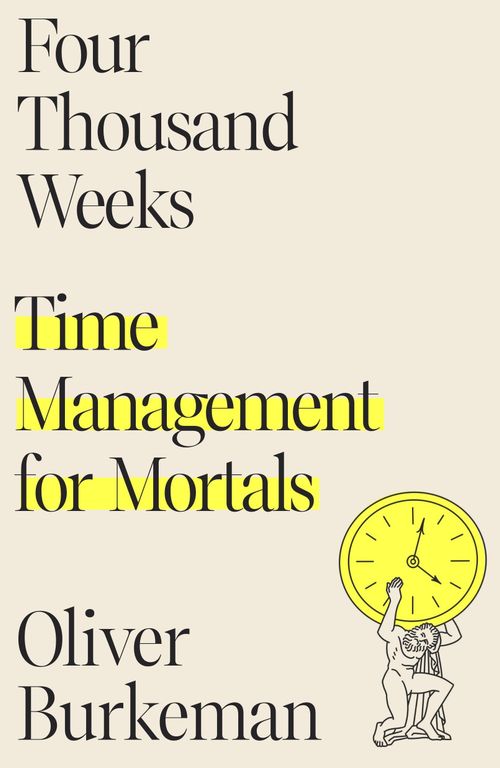
Four Thousand Weeks
Time Management for Mortals
Introduction
Nova: Here's a number that might stop you in your tracks: four thousand. That's roughly how many weeks the average human gets to live, assuming you make it to eighty. Oliver Burkeman opens his book with this piece of arithmetic, and honestly, it's the kind of math you can't unsee.
Nova: And that's exactly the reaction Burkeman is counting on. But here's the twist: Four Thousand Weeks is not a depressing book. It was a New York Times bestseller, named one of Time magazine's 100 Must-Read Books of 2021, and readers across the globe describe it as strangely liberating. Burkeman spent years writing a productivity column for The Guardian, and he came to a counterintuitive conclusion: our entire approach to time management is making us miserable.
Nova: Exactly. The subtitle is Time Management for Mortals, and that word mortals is doing a lot of heavy lifting. Most time management advice pretends we can eventually get on top of everything if we just find the right system. Burkeman says that's a fantasy, and chasing it is what actually wastes our lives. Today we're diving into why accepting your limits might be the most freeing thing you ever do.
Why Four Thousand Weeks Hits Different
The Math That Changes Everything
Nova: Let's start with the number itself. Four thousand weeks. Burkeman doesn't let you hide from it. If you're forty, you've used roughly half. If you're thirty, you've already spent more than a third. He writes that the average human lifespan is absurdly, terrifyingly, insultingly short.
Nova: Right, but here's why it works. Burkeman argues that until you actually feel the brevity of your life in your bones, you'll keep operating under the illusion that there's always more time. You'll keep putting off what matters. The discomfort of staring at four thousand weeks is, in his words, the entire therapy.
Nova: Exactly. He draws on the philosopher Martin Heidegger, who made this radical claim: we don't have a limited amount of time. We are a limited amount of time. Your existence and your time aren't two separate things. You are your time. And once that sinks in, every choice about how you spend a Tuesday afternoon becomes profoundly significant.
Nova: And Burkeman points out that people who have near-death experiences tend to grasp this instantly. When you've genuinely confronted your mortality, you stop treating the present as a dress rehearsal for some future moment when your real life will finally begin. The present is all there is.
Why Getting Better at Things Makes Everything Worse
The Efficiency Trap
Nova: Here's a pattern you might recognize. You discover a new productivity system. You clear your inbox faster. You organize your calendar more effectively. And what happens? More emails show up. More meetings fill the newly organized space. You're not winning. You're treading water faster.
Nova: Burkeman calls this the efficiency trap. And it's not just about email. The faster you complete tasks, the more tasks expand to fill the available time. Rendering yourself more efficient won't result in the feeling of having enough time because the demands will increase to offset any benefits.
Nova: In a sense, yes. Burkeman says the worst aspect of this trap is one of quality. The harder you struggle to fit everything in, the more of your time you end up spending on the least meaningful things. Because when you believe you should be able to do it all, you never stop to ask whether any given activity is the best use of your time. You just try to cram more in.
Nova: Burkeman's answer is what he calls an anti-skill. Instead of trying to make yourself more efficient, learn to stay with the anxiety of feeling overwhelmed without automatically responding by trying to fit more in. Don't clear the decks. Decline to clear the decks. Focus on what's truly of greatest consequence while tolerating the discomfort of knowing the decks are filling up with things you may never get to.
The Joy of Missing Out
Choosing Is Losing
Nova: One of Burkeman's most challenging ideas is that every real choice involves a genuine loss. When you decide to spend an evening with your family instead of finishing a work project, you're not cleverly balancing two goods. You're choosing one and accepting the cost of not choosing the other.
Nova: Exactly. And Burkeman says that's the root of so much modern anxiety. He draws on the philosopher Rainer Maria Rilke: choosing anything means foreclosing something else. There's no workaround. The goal is to make peace with that.
Nova: He calls it the joy of missing out. JOMO, if you will. Here's the logic: missing out is what makes our choices meaningful in the first place. Every decision to use a portion of time on anything represents the sacrifice of all the other ways you could have spent that time. To willingly make that sacrifice is to take a stand on what matters most to you. If you didn't have to decide what to miss out on, your choices couldn't truly mean anything.
Nova: Burkeman puts it bluntly: you have to choose a few things, sacrifice everything else, and deal with the inevitable sense of loss that results. The core challenge of managing our limited time isn't how to get everything done. That's never going to happen. It's how to decide most wisely what not to do and how to feel at peace about not doing it.
Why Distraction Is an Existential Problem
Attention Is Life Itself
Nova: Burkeman makes this striking claim: your attention just is your life. Your experience of being alive consists of nothing other than the sum of everything to which you pay attention. At the end of your life, looking back, whatever compelled your attention from moment to moment is simply what your life will have been.
Nova: Exactly. And Burkeman argues that most distractions aren't about the thing itself being so compelling. They're motivated by the desire to flee something painful about our experience of the present. We reach for our phones because being fully present with a difficult task or an uncomfortable emotion feels intolerable.
Nova: Right. And Burkeman connects this to Zen Buddhism, which holds that the entirety of human suffering can be boiled down to this effort to resist paying full attention to the way things are going because we wish they were going differently. There's a liberation in grasping that there are certain truths about being a limited human from which you'll never be liberated.
Nova: That's the argument. And it connects to his broader philosophy about leisure, which I find fascinating. Burkeman points out that before the Industrial Revolution, leisure wasn't a tool for recovery so you could be more productive. For Aristotle, leisure was the highest virtue. Self-reflection and philosophical contemplation were worth choosing for their own sake. Work existed to enable leisure, not the other way around.
Nova: And Burkeman says that's the trap. He introduces a distinction between telic and atelic activities. Telic activities are aimed at a goal: you do them to complete them. Atelic activities have no completion point. Walking for the sake of walking, not to hit a step count. Playing with a child, not to achieve a developmental outcome. Modern life has a way of turning everything into a telic activity, and when everything is oriented toward some future payoff, the present moment is never worth inhabiting fully.
Nova: Exactly. Burkeman says that spending at least some of your leisure time wastefully, focused solely on the pleasure of the experience, is the only way not to waste it. In order to most fully inhabit the only life you ever get, you have to refrain from using every spare hour for personal growth.
The Liberating Power of Not Mattering
Cosmic Insignificance Therapy
Nova: Here's one of my favorite ideas from the book. Burkeman offers something he calls cosmic insignificance therapy. The premise is this: when things all seem too much, what better solace than a reminder that they are, in the grand scheme of things, not that big a deal?
Nova: It might, but stay with me. Burkeman writes: what you do with your life doesn't matter all that much, and when it comes to how you're using your finite time, the universe absolutely could not care less. But the twist is that this is incredibly freeing. Instead of holding yourself to some impossible standard of a well-spent life, you get to spend your finite time focused on a few things that matter to you, in themselves, right now, in this moment.
Nova: Yes. The Jungian psychotherapist James Hollis tells a story Burkeman shares about a successful vice president of a medical instruments company. This man was utterly miserable despite his success. The therapy helped him realize he'd been living his entire life trying to impress a father who had died decades earlier. Cosmic insignificance therapy says: let go of that impossible burden. You're free to live for what actually moves you.
Nova: That's exactly it. Mexico, Burkeman notes, has often outranked the United States in global indices of happiness. The point isn't that ambition is bad. It's that the relentless instrumentalization of every moment for future profit steals the present from you.
Nova: Beautifully put. Burkeman writes: the presence of problems in your life isn't an impediment to a meaningful existence but the very substance of one. A meaningful life isn't one without challenges. It's one where you've chosen challenges that genuinely matter to you.
Practical Wisdom for Mortals
Ten Tools for Embracing Your Finitude
Nova: Despite being a philosophical book, Burkeman doesn't leave you hanging without practical guidance. The appendix offers ten tools for embracing your finitude, and I want to highlight a few of the most powerful ones.
Nova: Tool number one: adopt a fixed volume approach to productivity. Decide in advance how many hours you'll work each day, and when those hours are done, stop. Period. The work is never done, so if you wait until everything is finished, you'll never stop. The boundary has to be set before the work, not after.
Nova: Tool number two: serialize. Focus on one big project at a time, or at most one work project and one non-work project. Don't move on until that project is finished. Train yourself to tolerate the anxiety of having everything else on hold.
Nova: Burkeman would say that's just another way of avoiding the discomfort of committing to one thing. The third tool I love: decide in advance what to fail at. Instead of seeking perfect work-life balance, consciously choose your imbalances. If keeping a pristine lawn isn't a priority, decide that and stop beating yourself up about the overgrown grass.
Nova: Exactly. Another great one: keep a done list, not just a to-do list. At the end of each day, write down what you actually accomplished. There's good evidence that small wins are deeply motivating, and we tend to fixate only on what's left undone.
Nova: He does. One tool is to embrace boring and single-purpose technology. Remove social media apps from your phone. Switch your screen to grayscale. Where possible, choose devices like e-readers that have only one function. The point isn't to eliminate technology but to make it harder for your attention to be hijacked.
Nova: Practice doing nothing. Set a timer for five to ten minutes, sit down, and stop trying to do anything. Don't focus on your breathing. Don't try to think or not think. Just be. If you can't bear the discomfort of not acting, you're more likely to make poor choices simply to feel like you're doing something. Learning to do nothing is training for making better choices when you do act.
Conclusion
Nova: So here's where we land. Four Thousand Weeks is not a book about doing more. It's a book about being more present for the life you actually have. Oliver Burkeman spent years as a productivity obsessive and came out the other side with a radically different message: the goal isn't to get on top of your time. The goal is to inhabit it.
Nova: And the paradox, which he demonstrates throughout the book, is that this approach actually makes you more effective at the things that matter. When you stop trying to do everything, you can finally do a few things deeply. When you stop treating rest as a productivity tool, you can actually rest. When you accept that you'll miss out on most of what life offers, the things you do choose become infinitely more meaningful.
Nova: Burkeman closes the book with a line that captures the whole philosophy: the empowering potential of giving up hope. Give up the hope that someday you'll feel totally in control. Give up the hope that this is just a dress rehearsal. Give up the hope that with one more productivity system, you'll finally get on top of everything. When you let go of those impossible hopes, you're free to live the life that's actually in front of you, right now, with all its limitations and all its shimmering possibilities.
Nova: This is Aibrary. Congratulations on your growth!