

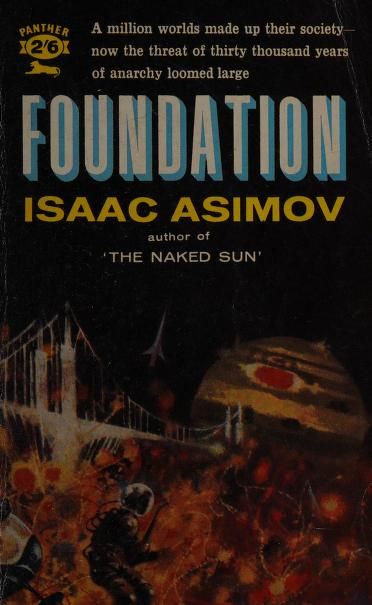
Foundation
Introduction
Nova: Imagine a civilization so vast it spans the entire galaxy. We are talking about twenty-five million inhabited worlds, all united under one Galactic Empire. It has lasted for twelve thousand years. It is the pinnacle of human achievement. And then, one man walks into a room and says, it is all going to collapse in less than five centuries.
Atlas: That is a hell of a way to start a party. I am guessing people were not exactly lining up to buy him a drink after that announcement?
Nova: Not exactly. That man was Hari Seldon, and his prediction was not just a hunch or a political opinion. It was math. This is the starting point of Isaac Asimov's Foundation, arguably the most influential science fiction novel ever written. It is a story that does not just look at the future of technology, but the future of humanity itself, viewed through the lens of a fictional science called psychohistory.
Atlas: Psychohistory. It sounds like a mix of a therapy session and a social studies project. But in Asimov's world, it is basically a crystal ball made of calculus, right?
Nova: Exactly. And today, we are diving deep into the world of Terminus, the Seldon Plan, and why a book written in the 1940s is still the blueprint for how we think about big data, sociology, and the rise and fall of civilizations today.
Atlas: I have always wondered if we are actually living in a Seldon Plan right now without knowing it. Let us get into it.
Key Insight 1
The Mathematics of Destiny
Nova: To understand Foundation, you have to understand psychohistory. Asimov defined it as a branch of mathematics that deals with the reactions of human conglomerates to fixed social and economic stimuli. Basically, it is the idea that while you cannot predict what one person will do, you can predict with absolute certainty what a billion people will do.
Atlas: It is like insurance actuary tables but for the entire species. I can't tell if you are going to trip on the sidewalk today, but I can tell you exactly how many people in New York will trip on a sidewalk this year.
Nova: That is a perfect analogy. Asimov actually used the comparison of gas laws in physics. You cannot track the movement of a single molecule of gas, it is too chaotic. But you can predict the pressure and temperature of the whole volume of gas very accurately. Seldon applied that to the Galactic Empire. He saw the trends of corruption, the stagnation of technology, and the breakdown of trade routes. To him, the fall was not a possibility; it was a mathematical inevitability.
Atlas: But if the fall is inevitable, why bother? If the math says we are doomed, why not just enjoy the last few centuries of luxury on the capital planet, Trantor?
Nova: Because Seldon saw two paths. Path one: the Empire falls, and the galaxy descends into thirty thousand years of barbarism and chaos before a second empire rises. Path two: he intervenes, sets up a Foundation, and uses psychohistory to guide humanity so that the dark age only lasts one thousand years.
Atlas: So he is not trying to save the Empire. He is trying to save the future. He is essentially trying to hack history.
Nova: Precisely. But there is a catch. For psychohistory to work, the population being studied has to remain ignorant of the predictions. If people know what is supposed to happen, they change their behavior, and the math breaks. It is the ultimate secret society project.
Atlas: That is a massive gamble. You are basically playing god with the entire galaxy, but you can't tell anyone you are doing it. It makes Seldon a bit of a cold, calculating figure, doesn't it?
Nova: He is often portrayed as this distant, holographic grandfather figure. He records these messages to be played centuries after his death, appearing in a Time Vault to tell the people of the Foundation if they have successfully navigated a crisis. It is like a pre-recorded 'I told you so' from across the ages.
Key Insight 2
The Encyclopedia and the Decoy
Nova: So, Seldon convinces the Empire to let him set up a colony on a remote, resource-poor planet called Terminus. He tells the Emperor he is gathering all human knowledge into an Encyclopedia Galactica so that when the dark age hits, the knowledge won't be lost.
Atlas: Wait, so the Foundation is just a bunch of librarians? That does not sound like a galactic superpower in the making.
Nova: That is the brilliant part. The Encyclopedia was a decoy. Seldon did not care about the books; he cared about the people. He put a concentrated group of scientists and engineers on a planet with no natural resources, surrounded by hostile, decaying kingdoms that were losing their grasp on high technology.
Atlas: Ah, the classic 'necessity is the mother of invention' setup. If they have no metal and no fuel, they have to get smart or they die.
Nova: Exactly. This leads us to the first Seldon Crisis. About fifty years after the Foundation is established, the neighboring four kingdoms break away from the Empire. They have the ships and the soldiers, but they are losing the ability to maintain their nuclear reactors. They are literally sliding back into coal and oil power.
Atlas: And the Foundation still has the nuclear tech. I see where this is going. It is like bringing a flashlight to a world that just ran out of batteries.
Nova: But the leaders of the Foundation at the time, the Encyclopedists, are useless. They are too busy arguing over footnotes in their books. This is where we meet Salvor Hardin, the first great hero of the series. He is the Mayor of Terminus City, and he realizes that the Encyclopedia is a sham.
Atlas: Hardin is the one with the famous quote, right? Violence is the last refuge of the incompetent?
Nova: That is the one. It is the core philosophy of the first book. Hardin does not fight the neighboring kingdoms with blasters. He uses the Foundation's superior technology to create a religion. He gives the kingdoms nuclear power but wraps it in a priesthood. Only the Foundation-trained 'priests' know how to run the reactors. If a king tries to attack the Foundation, the priests just shut off the power. No lights, no heat, no ships.
Atlas: That is genius. He turned science into a deity to maintain control. It is a bit manipulative, but it kept the peace without firing a single shot.
Nova: It is the first major shift in the Seldon Plan. The Foundation moves from being a group of scholars to being a religious power center. Seldon's hologram appears in the Time Vault and confirms that Hardin was right. The Encyclopedia was just a way to get them to Terminus. The real goal was to survive that first threat of annexation.
Key Insight 3
From Religion to Trade
Nova: As the decades pass, the religious angle starts to wear thin. People in the outer kingdoms start to realize that the 'holy' nuclear glow is just physics. This leads to the next phase of the Foundation's evolution: the era of the Traders.
Atlas: I love this progression. It is like watching a civilization speed-run human history. We go from the age of faith to the age of commerce.
Nova: Exactly. We meet characters like Hober Mallow, a master trader who realizes that you do not need a priesthood to control people if you make them dependent on your gadgets. He starts selling nuclear-powered household items. Toasters, heaters, jewelry that glows.
Atlas: It is the consumerism trap. If I rely on your tech for my morning coffee and my wife's necklace, I am not going to support a war against you.
Nova: Mallow's insight was that economic warfare is more effective than religious or physical warfare. When the Foundation is threatened by a powerful remnant of the old Empire, Mallow does nothing. He literally just waits. He lets the enemy's economy collapse because they can't get the spare parts for the Foundation-made tech that their entire society now runs on.
Atlas: It is a very cynical view of human nature, isn't it? Asimov is basically saying that as long as people have their comforts and their trade, they won't care who is in charge or what the grand plan is.
Nova: It is very deterministic. Asimov was heavily influenced by Edward Gibbon's The Decline and Fall of the Roman Empire. He wanted to see if those historical patterns could be applied to a galactic scale. In the first book, the individual heroes like Hardin and Mallow are important, but the story makes it clear that if they hadn't stepped up, someone else would have. The social pressures were so great that the outcome was inevitable.
Atlas: That is the part that always trips me up. If everything is inevitable, do the characters even have free will? Or are they just actors following a script written by Hari Seldon a hundred years ago?
Nova: That is the central tension of the whole series. The characters often struggle with that. They wonder if they are actually making choices or if they are just the 'fixed stimuli' Seldon calculated. It makes the Foundation feel less like a traditional adventure and more like a grand chess game where the players have been dead for centuries.
Key Insight 4
The Black Swan and the Mule
Nova: Now, we have to talk about the moment the math fails. Because if the Seldon Plan was perfect, the book would be a bit boring, right? Everything just goes according to plan for a thousand years? No.
Atlas: Right, there has to be a wrench in the gears. Something Seldon couldn't see coming.
Nova: Enter the Mule. He appears in the second book, Foundation and Empire, but he is the ultimate counterpoint to everything we have discussed. The Mule is a mutant with the ability to mentally manipulate people's emotions. He can make an entire army fall in love with him or make a defiant leader feel absolute despair.
Atlas: Oh, that completely breaks psychohistory. Seldon's math was based on the behavior of large groups of normal humans. It did not account for a single individual with superpowers who could rewrite those behaviors on a whim.
Nova: Exactly. The Mule is what modern thinkers call a 'Black Swan' event. An unpredictable, high-impact outlier. He conquers the Foundation in a matter of weeks. The hologram of Hari Seldon appears in the Time Vault right as the Mule is attacking, and Seldon starts talking about a completely different crisis because he had no idea the Mule would exist.
Atlas: That must have been a terrifying moment for the people in that room. Their god-figure is giving a speech about a civil war that isn't happening, while a mutant conqueror is literally at the gates.
Nova: It is one of the greatest twists in sci-fi history. It forces the characters to realize that the Plan is not a safety net. It can fail. This leads to the search for the Second Foundation, a mysterious group Seldon allegedly set up at the 'other end of the galaxy' to keep the Plan on track if the first one failed.
Atlas: So Seldon had a backup for his backup. He knew his math might have holes, so he created a group of mentalics, people with powers similar to the Mule, to act as the hidden guardians of the timeline.
Nova: It adds a whole new layer of conspiracy. Now you have the First Foundation, which is all about physical science and technology, and the Second Foundation, which is about the science of the mind. They are the ones who have to secretly defeat the Mule and put history back on the rails without anyone knowing they exist.
Key Insight 5
The Legacy of the Foundation
Nova: It is hard to overstate how much Foundation has influenced the real world. Paul Krugman, the Nobel Prize-winning economist, famously said he became an economist because he wanted to be a psychohistorian. He wanted to find the math behind human society.
Atlas: It is funny because today we actually have something that looks a bit like psychohistory. We call it Big Data and Algorithmic Prediction. Companies like Google and Meta are basically trying to do exactly what Seldon did: predict mass behavior based on data points.
Nova: And that is where the book feels incredibly modern. Asimov was writing before the first digital computer was even fully functional, yet he anticipated a world where data is the ultimate power. He also influenced Star Wars. The idea of a Galactic Empire, a desert planet at the edge of the galaxy, and a fallen civilization? That is all Foundation.
Atlas: Even the concept of the 'Force' feels like a more mystical version of the mental powers of the Second Foundation. But Asimov's version is much more grounded in sociology and political science. It is less about good vs. evil and more about stability vs. chaos.
Nova: That is a great point. In Foundation, there are no true villains, only different forces of history. Even the Empire isn't 'evil' in the way the Sith are; it is just old, tired, and dying. The conflict comes from the friction of a changing world.
Atlas: I think that is why it stays relevant. We are always living through some kind of 'Seldon Crisis.' Whether it is climate change, the rise of AI, or economic shifts, we are all looking for a Hari Seldon to tell us that there is a plan and that we will get through the dark age.
Nova: And Asimov's answer is that we can get through it, but only if we are willing to adapt. We can't rely on the old ways of doing things. We have to move from religion to trade to whatever comes next. The only constant is change, and the only way to survive it is to understand the patterns.
Conclusion
Nova: Isaac Asimov's Foundation is more than just a space opera. It is a meditation on history, a warning about the fragility of civilization, and a hopeful look at the power of human reason to overcome chaos. It reminds us that while we might feel like small cogs in a massive machine, the collective actions we take can shape the course of the next thousand years.
Atlas: It definitely makes me want to look at a spreadsheet and see if I can find any hidden patterns in my own life. Or at least, it makes me appreciate that 'violence is the last refuge of the incompetent' is a pretty good rule to live by.
Nova: If you haven't read it, or if you have only seen the recent TV adaptation, I highly recommend going back to the original stories. They are fast-paced, full of intellectual puzzles, and they will make you think about the world in a completely different way.
Atlas: Just don't expect any laser sword fights. It is all about the power of the mind and the inevitability of the math.
Nova: This is Aibrary. Congratulations on your growth!