The Great Ideological Debate
Golden Hook & Introduction
SECTION
Nova: Imagine you are designing the operating system for a brand new society. You have two primary lines of code you can write. One line dictates that every single interaction must be voluntary, decentralized, and driven by individual choice. The second line dictates that the system must ensure collective wellbeing through centralized planning and shared resources. Which one do you prioritize?
Atlas: That sounds like a recipe for a very messy argument at a dinner party. Most people jump straight into the politics of that choice, but for the people listening—the builders, the architects, the ones actually trying to manage teams or businesses—this isn't just political theory. It is a fundamental design problem.
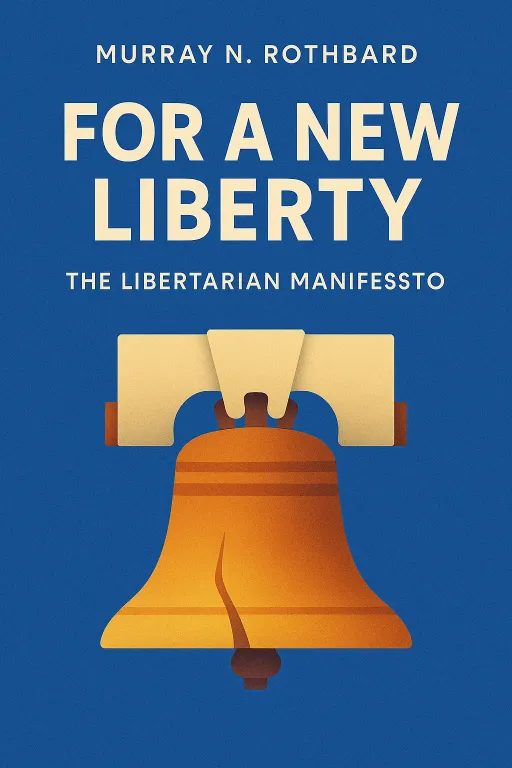
Nova: Exactly. And that is why we are looking at two very different blueprints today. We are diving into For a New Liberty by Murray N. Rothbard, the firebrand of the libertarian movement, and Socialism by Michael Newman, a sharp, historical analysis of democratic socialism.
Atlas: Right. Rothbard is the one who took the non-aggression principle and turned it into an entire architecture for living, right? He basically argued that the state is an unnecessary middleman in almost everything.
Nova: He did. Rothbard was a central figure in the Austrian School of economics, and he wrote this book during a time of significant cultural upheaval, really pushing the idea that market forces could handle everything from roads to education to national security. It is polarizing, rigorous, and completely uncompromising.
Atlas: And then you have Michael Newman. His approach feels like the necessary counterweight. He moves away from the abstract theory and looks at the historical record—at what actually happens when democratic societies use collective ownership to tackle systemic poverty. He is looking for the practical outcomes of welfare frameworks.
Nova: Today, we are going to bridge these two worlds. We are going to figure out when you should let the market run wild and when you need to step in and plan the collective outcome.
The Philosophy of Decentralization
SECTION
Atlas: Okay, let us start with the Rothbard side of the coin. The non-aggression principle. It sounds simple on paper: you do not initiate force against anyone. But how does that actually work for, say, a city? Does that mean no police? No public roads?
Nova: Rothbard takes that principle to its logical extreme. He argues that if you truly believe in the non-aggression principle, then state functions are inherently coercive. He suggests that private companies can provide everything. Think about security. Instead of a centralized police force, he envisions private protection agencies competing for your business. If one agency is corrupt or ineffective, you switch to another.
Atlas: Wait, that sounds like a nightmare scenario. If I am in a dispute with a neighbor, and we use different private security firms, are we just hiring two private armies to settle a property line issue? That feels like it would lead to more conflict, not less.
Nova: That is the exact critique many people have. But Rothbard’s response is that in a fully decentralized system, the cost of violence becomes prohibitively high. He argues that competition creates a marketplace for dispute resolution. If security firms are constantly fighting, their insurance premiums go up, their reputation goes down, and they lose customers. He posits that market forces would incentivize peace because peace is more profitable than war.
Atlas: I can see the logic, but it assumes everyone is acting rationally to maximize profit. What about the human element? The impulsive anger? The sheer chaos of human interaction? It feels like Rothbard is building a system for robots, not people.
Nova: That is a fair point. He is building a system based on economic incentives. He essentially views the state as a monopoly that has no incentive to improve because it cannot go out of business. By introducing competition, he believes you force every service—whether it is road maintenance or education—to innovate and lower costs.
Atlas: So, for our listeners who are building teams, the Rothbardian view is basically radical decentralization. You push decision-making down to the lowest possible level. You let the market—or in a company, the individual departments—compete for resources. The idea is that the best ideas rise to the top because they survive the market test.
Nova: Yes. And it is a powerful lens for an architect. If you have a team that is stagnant, maybe you do not need more planning. Maybe you need to introduce more autonomy. Maybe you need to let different sub-teams compete to solve the same problem. Rothbard’s philosophy is that centralized control is the enemy of efficiency.
The Case for Collective Care
SECTION
Atlas: But then you have the other side of the aisle. Michael Newman’s perspective on socialism is not about destroying the state, but using it as a tool. He looks at democratic socialism not as a theoretical utopia, but as a series of experiments in how to protect the vulnerable.
Nova: Newman’s work is fascinating because he acknowledges the failures of state planning while simultaneously pointing out that the market has no built-in mechanism for equity. He highlights how collective ownership can address systemic poverty. His central argument is that the market is great at creating wealth, but terrible at distributing it in a way that allows everyone to thrive.
Atlas: That is the classic tension, right? Efficiency versus equity. I imagine a lot of our listeners who are managing teams deal with this daily. You want the team to be high-performing—that is the market side—but you also need to make sure the junior employees are not being exploited—that is the collective side.
Nova: Exactly. Newman would argue that without some form of collective planning, you end up with a race to the bottom. If you rely entirely on market forces, you might optimize your business for short-term profit at the cost of your employees' health or the company's long-term culture.
Atlas: What is the most compelling case study Newman brings up?
Nova: He looks closely at the Scandinavian models, where state-guided welfare frameworks are the norm. He explores how these systems aim to eliminate systemic poverty by ensuring basic needs like healthcare and education are not subject to the volatility of the market. The result is a more stable society, which, ironically, allows for more risk-taking because the safety net is there.
Atlas: That is a really interesting point. It is almost like a paradox. By providing a safety net, you might actually encourage more innovation because people are not terrified of losing everything.
Nova: Precisely. Newman argues that collective planning is not about stifling the individual, but about creating the conditions where the individual can actually pursue their goals without the looming threat of destitution.
Atlas: So, for an architect, the Newman approach is about the infrastructure of the team. It is the benefits, the culture, the intentional planning of how people are treated. You cannot just let the team "compete" for basic respect or fair pay. That has to be a planned, collective standard.
Nova: That is the perfect way to phrase it. You need a baseline of security before you can have the competitive, high-performance environment that Rothbard envisions.
The Architect's Framework
SECTION
Atlas: Okay, so we have these two poles. We have the Rothbardian view: decentralize everything, let the market decide, trust the individual. And we have the Newman view: plan the foundation, ensure equity, trust the collective. How does a listener actually use this?
Nova: I think the key is to stop seeing them as opposing ideologies and start seeing them as two different tools in your management toolbox. You need to identify which problems require which tool.
Atlas: Give me an example. How do you decide?
Nova: Ask yourself two questions. First, is this a problem of discovery or a problem of maintenance? If you are trying to discover a new product, a new market, or a new way to solve a user's pain point, you want Rothbardian decentralization. You want teams competing, you want rapid iteration, you want the market—or your data—to tell you what works. You do not want a committee planning that.
Atlas: That makes sense. You need the chaos of competition to find the breakthrough. But what about the second question?
Nova: The second question is, does this problem affect the core stability of the system? If you are dealing with team morale, fair compensation, or professional development, you need Newman’s approach. These are not things you want to be subject to the whims of a volatile market. You want a planned, collective approach to ensure everyone is operating from a position of strength.
Atlas: I love that. It is like saying you need a market for innovation and a planned economy for culture.
Nova: Yes. Think about it. If you have a team of developers, you might want them to compete on who can build the most elegant solution to a technical bug. That is a Rothbardian competition. It drives innovation. But you do not want them competing on who gets to take a vacation or who gets a living wage. That should be a centralized, planned policy that applies to everyone equally.
Atlas: That is a really powerful distinction. I think a lot of leaders get this backwards. They try to plan the innovation—which kills it—and they let the culture become a free-for-all—which destroys the team.
Nova: And that is where the burnout comes from. When you force people to compete for things that should be guaranteed, you create anxiety. And when you force people to follow a bureaucratic plan for things that should be creative, you create stagnation.
Atlas: So, the takeaway for our listeners is to audit their own systems. Look at your team, look at your business. Where are you over-planning? Where are you under-planning?
Nova: Exactly. If you have a process that is moving too slowly, ask yourself if you have injected enough competition and decentralization. If you have a team that is burnt out or anxious, ask yourself if you have enough collective planning and security.
Synthesis & Takeaways
SECTION
Atlas: This has been a massive shift in how I look at organizational design. It is not about choosing a side, it is about choosing the right tool for the right job.
Nova: That is the core of it. The brilliance of Rothbard is in his belief in the individual's capacity to innovate when given freedom. The brilliance of Newman is in his belief in our collective capacity to create a stable foundation for that freedom.
Atlas: And for the Focused Architect, for our listener who is building a legacy, the lesson is clear. You are the one who has to decide where the market ends and the plan begins. You are the one who has to balance the drive for the new with the need for the secure.
Nova: And remember, this is not a one-time decision. Your team, your business, your society—they are dynamic. What worked yesterday might not work tomorrow. You have to be willing to constantly recalibrate.
Atlas: I think that is the most important part. Don’t get stuck in one ideology. Stay fluid. The goal isn't to be right; the goal is to build something that lasts.
Nova: And building something that lasts requires the wisdom to know when to let go and when to hold on. We hope this exploration gives you a better map for navigating those choices in your own life and work.
Atlas: Absolutely. And as we wrap up, I want to leave you with a quick challenge. This week, look at one process in your team that feels broken. Ask yourself: Is this broken because it is too rigid, or because it is too chaotic? Are you trying to plan the creative, or are you ignoring the foundation?
Nova: That is the perfect experiment to run. We would love to hear how you apply this. Until next time, keep building, keep questioning, and keep growing.
Atlas: This is Aibrary. Congratulations on your growth!