The Evolution of Human Freedom
Golden Hook & Introduction
SECTION
Nova: Most people think freedom is about having choices, like which brand of coffee to buy or which city to live in. But what if the most important freedom isn't about choice at all? What if it's about the absence of someone else's boot on your neck?
Atlas: That sounds like a recipe for a very intense dinner party, Nova. You are jumping straight into the deep end today. I am guessing you are talking about Murray Rothbard?
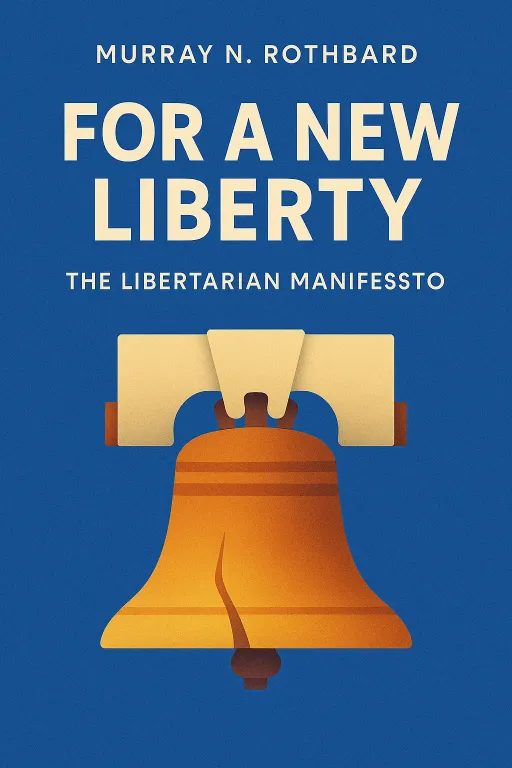
Nova: You guessed it. Today we are looking at the clash between two heavyweights of social thought. We are diving into Murray Rothbard’s For a New Liberty and Yuval Noah Harari’s Sapiens. Rothbard gives us the radical blueprint for individual sovereignty, while Harari zooms out to show us why we are hardwired to build these massive, imagined systems that cage us in.
Atlas: It is a wild pairing. Rothbard is the ultimate individualist, the guy who wants to strip away the state, and Harari is the ultimate storyteller, explaining why we, as a species, are obsessed with stories like nations, money, and corporations. It is like putting a lone wolf in a room with a social anthropologist.
Nova: Exactly. Rothbard wrote For a New Liberty during a time of massive social upheaval in the seventies, and it remains one of the most uncompromising defenses of the non-aggression principle ever put to paper. It is a book that makes people either cheer or get incredibly defensive. And then you have Sapiens, which took the world by storm more recently, arguing that our ability to believe in things that do not exist—like legal systems or currency—is our superpower.
Atlas: Right, so we have the philosophy of the individual versus the biology of the collective. I am already feeling the tension. Let’s see if we can figure out where our actual freedom sits in the middle of all that.
The Non-Aggression Principle and the Individual
SECTION
Nova: Let’s start with Rothbard. The core of his argument is the non-aggression principle, or the NAP. It is elegant in its simplicity. He argues that no one has the right to initiate physical force against another person or their property. That is it. That is the bedrock of his entire philosophy of liberty.
Atlas: It sounds incredibly logical, like a math equation for human behavior. But I have to play the skeptic here. In the real world, how does that actually function? I am thinking about a city. You have thousands of people interacting, traffic, shared resources, public spaces. If you take away the central authority that enforces rules, doesn't the whole thing just collapse into chaos?
Nova: That is the big critique, right? People assume that without a state, you get a war of all against all. But Rothbard would argue that the state is actually the primary aggressor. He claims that most of the chaos we see is actually caused by government intervention, not the lack of it. Think about it like a messy apartment share.
Atlas: I have definitely lived in those.
Nova: Exactly. Imagine you have four roommates. If you have a set of house rules that are clear, voluntary, and agreed upon, things generally work. But if one roommate decides they are the landlord, they start charging you rent for your own room, and they start dictating what you can eat for breakfast, the dynamic shifts from cooperation to resentment.
Atlas: That is a fair analogy. But in an apartment, you can move out. If you don't like the state, moving out is not exactly a simple process. It is not like leaving a bad lease.
Nova: That is the core of Rothbard’s frustration. He is talking about the fundamental right to own yourself. If you own your body, you own the fruits of your labor. If someone else—the state—claims a portion of your labor through taxation, Rothbard views that not as a social contract, but as a form of theft. It is a radical shift in perspective. He isn't asking for better government; he is asking for the elimination of the coercive apparatus entirely.
Atlas: It makes me think about the modern professional landscape. We talk so much about autonomy at work, about having ownership over our projects. Rothbard is essentially taking that desire for professional autonomy and scaling it up to the entire human experience. But here is where I get stuck. If we operate purely on the non-aggression principle, how do we handle massive, complex problems like climate change or global pandemics? It feels like an individualistic framework in a world that is fundamentally interconnected.
Nova: That is the million-dollar question. And that is exactly why we need to pivot to Harari. Because while Rothbard is looking at the individual as the ultimate unit, Harari is looking at the species. He would say that the only reason we are even having this conversation is because we are capable of believing in shared myths.
Imagined Orders and the Power of Myth
SECTION
Atlas: Okay, let’s unpack that. I love the idea of "imagined orders" in Sapiens. It sounds like something out of a sci-fi novel, but Harari is talking about stuff like money, right?
Nova: Precisely. Think about a dollar bill. Biologically, it is just a piece of paper or a digital entry in a ledger. It has no intrinsic value. You cannot eat it, you cannot build a shelter with it, and it won't keep you warm at night. But because millions of people believe in the story of the dollar, it becomes the most powerful object on earth.
Atlas: It is a collective hallucination.
Nova: That is the perfect way to put it. Harari argues that this is our secret weapon. Chimpanzees can cooperate, but only with other chimps they know personally. Humans can cooperate with millions of strangers because we all subscribe to the same stories—religions, nations, corporations, human rights. These are all "imagined orders." They exist only in our collective imagination.
Atlas: So, if Rothbard is saying "break the chains of the state," Harari is coming in and saying, "Wait, the state is a story we are all telling ourselves." If we stop telling that story, the state vanishes.
Nova: Exactly. If everyone woke up tomorrow and decided that the concept of a "nation" was a lie, nations would cease to exist. The borders would still be there, the walls would still be there, but the that gives them power would dissolve.
Atlas: That is both terrifying and empowering. It means we aren't stuck with the systems we have. We are the ones powering them. But it also explains why it is so hard to change anything. You are not just fighting a policy; you are fighting a story that billions of people have invested their entire lives into.
Nova: And that is the friction point. Rothbard wants us to be sovereign individuals, free from coercion. Harari explains that our very nature is to be part of these massive, imagined systems that require conformity to function. We are caught in a tug-of-war between our desire for absolute freedom and our evolutionary need to belong to a collective story.
Atlas: This feels like it hits on the "Analytical Architect" side of things. We are trying to build our lives, our careers, and our societies. If we want to design a better future, we have to recognize which structures are timeless truths—like physics or biology—and which are just "imagined orders" we can rewrite.
Nova: You hit the nail on the head. Think about corporate culture. We treat it like a law of nature. "This is how we do things here." But it is just an imagined order. If a company can change its culture, it proves that the old culture was just a story. The same applies to our personal lives. We tell ourselves stories about what we can or cannot do, what we deserve, or how we must act to be successful.
Atlas: I see this all the time. People feel trapped in a career path because they think, "This is what a successful person does." They are living in an imagined order of their own making. They are acting like the state is mandatory, when in reality, they have more agency than they realize.
Nova: And that brings us back to Rothbard. Even if you cannot dismantle the state overnight, you can start applying the non-aggression principle to your own relationships and your own mind. Stop coercing yourself. Stop believing in the stories that don't serve your sovereignty.
Atlas: It is about reclaiming the power to write your own story, rather than just playing a character in someone else’s. But I wonder, is there a danger in going too far? If everyone decides to stop believing in the collective stories—the laws, the contracts, the shared norms—doesn't that lead to the collapse of the very cooperation Harari talks about?
Nova: That is the balancing act. It is not about destroying cooperation; it is about choosing better stories to cooperate around. We don't need to believe in coercive systems to have a functioning society. We can build voluntary orders. Think about open-source software, or decentralized networks. These are new "imagined orders" that are based on voluntary participation rather than coercion.
Atlas: That is a fascinating way to look at it. We are moving from top-down, coercive stories to bottom-up, voluntary ones. It is like we are upgrading our software.
Synthesis & Takeaways
SECTION
Nova: Precisely. And that is the synthesis. We need the individual sovereignty that Rothbard champions to keep us from becoming cogs in a machine, but we need the ability to build shared, voluntary stories that Harari identifies to solve the problems that are too big for any one person to handle.
Atlas: I am thinking about the listener who is sitting there, maybe feeling a bit stifled by their current environment. If they want to take one step today, what should they do?
Nova: Start by auditing your own "imagined orders." Ask yourself: Which of the rules in my life are actually necessary for my survival and well-being, and which are just stories I have inherited? When you realize that a constraint is just a story, you gain the power to rewrite it.
Atlas: That is a powerful exercise. It turns your life into a design project rather than a prison sentence. It makes me realize that freedom is not a destination you reach; it is a muscle you exercise every time you question the status quo.
Nova: It is the ultimate act of courage. Rothbard and Harari might seem like they are on opposite sides of the spectrum, one focusing on the atom and the other on the galaxy, but they both point to the same truth: we are far more powerful than we give ourselves credit for. We are the authors of our own reality.
Atlas: I love that. We are not just living in the world; we are constructing it, one belief at a time. It makes the future feel a lot less daunting and a lot more like a blank canvas.
Nova: And that, I think, is the most important takeaway for anyone trying to navigate this changing world. You don't have to accept the stories you were handed. You have the tools, and you have the agency to build something better.
Atlas: Well, that is definitely going to keep me thinking for the rest of the week. This has been a great deep dive.
Nova: It has been a pleasure to break this down with you. Remember, the next time you feel like you are trapped by a rule or a system, ask yourself if it is a law of nature or just a story. And then, start writing a better one.
Atlas: I am ready to start editing my script. Thanks for the conversation, Nova.
Nova: Anytime, Atlas. For everyone listening, start small, stay curious, and keep questioning those stories. This is Aibrary. Congratulations on your growth!