Deconstructing State Power and Alternative Social Architectures
Golden Hook & Introduction
SECTION
Nova: Let’s play a quick game. I’ll name a fundamental pillar of modern society, and you give me the first word that comes to mind regarding its architecture. Ready?
Atlas: I am ready. My architect brain is primed. Hit me.
Nova: Healthcare.
Atlas: Bureaucracy.
Nova: Interesting. How about... roads?
Atlas: Maintenance.
Nova: And finally, social safety nets.
Atlas: Complexity.
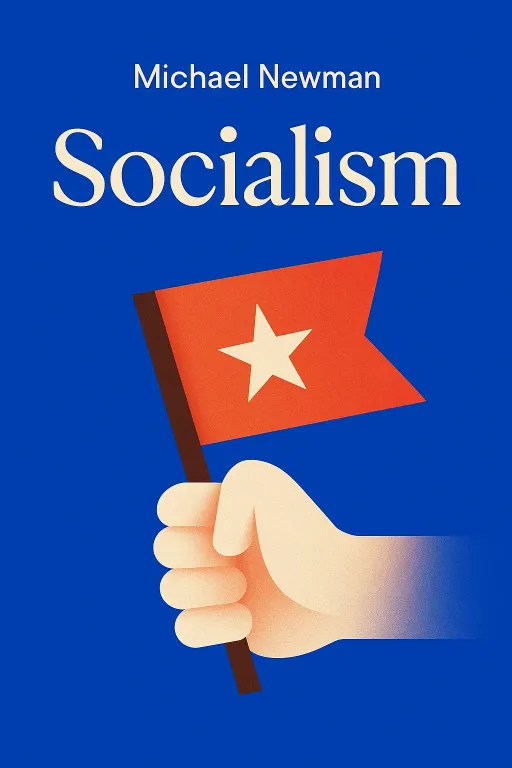
Nova: You see a pattern there. You’re looking at these systems through the lens of their current management, which is almost exclusively centralized. Today, we are going to tear those blueprints apart and look at the foundation. We are diving into two deeply contrasting visions of how society should be structured. First, we have Socialism by Michael Newman, which deconstructs the historical and theoretical framework of collective ownership. Then, we are placing that right next to For a New Liberty by Murray N. Rothbard.
Atlas: That is a collision of worlds. Rothbard is essentially the heavyweight champion of the libertarian manifesto.
Nova: Exactly. Rothbard’s work, which emerged in the early 1970s during a period of massive disillusionment with state interventions, argues for a purely voluntary society. Newman, on the other hand, provides a rigorous historical account of how cooperative systems have attempted to prioritize human welfare over market efficiency. We are looking at two very different ways to organize the human experience.
Atlas: I love the tension there. As someone who thinks about building systems, I find the conflict between collective welfare and voluntary efficiency fascinating. It is the ultimate design challenge.
The Architecture of Collective Welfare
SECTION
Nova: Let’s start with that first pillar: collective welfare. When Michael Newman writes about socialism, he isn’t just talking about a political platform. He is analyzing the historical attempt to create a system where human welfare is not a byproduct of market activity, but the primary target.
Atlas: I can see the appeal of that from a design perspective. If you are building a society from scratch, you want the outcome to be equitable. You want to ensure that basic needs like healthcare or education are met for everyone, regardless of their starting position. That is a noble goal.
Nova: It is. The core argument Newman highlights is that markets often fail to account for the human cost of efficiency. When you prioritize pure market efficiency, you often leave behind those who cannot compete in that specific environment. The cooperative systems he describes are attempts to create a buffer, a structure where the collective resources are pooled to ensure that no individual falls below a certain standard of living.
Atlas: That makes sense. But here is the problem I run into when I look at these systems. When you build a centralized structure to manage that welfare, you create a layer of management that inevitably becomes detached from the reality on the ground. The people making the decisions about the welfare systems are rarely the people who need them.
Nova: That is the central critique that Newman addresses. He acknowledges that the historical reality of these systems often led to massive, unwieldy bureaucracies. The challenge is the information problem. How does a central planner know exactly what a community in a remote area needs, compared to a city center?
Atlas: Exactly. It is a data transmission issue. By the time the feedback from the ground reaches the top of the hierarchy, the situation has already changed. The bureaucracy is always lagging behind reality. That is why, when I look at these systems, I see a fundamental design flaw. The feedback loop is too slow.
Nova: You have hit on the exact point that Rothbard would use to dismantle that entire framework. He would argue that the flaw is not just in the management, but in the premise of central planning itself.
The Voluntary Society as a System
SECTION
Atlas: I have been waiting to get into Rothbard. For a New Liberty is essentially a blueprint for a system that relies on spontaneous order rather than central design.
Nova: It is. Rothbard’s argument is that if you remove the state, the market will not just fill the vacuum; it will fill it more efficiently. He suggests that every single service the state currently provides—education, roads, police, courts—could be provided by private, voluntary entities competing for customers.
Atlas: That sounds incredibly radical to most people, but if you look at it as an architect, it is just a different distribution of nodes. Instead of one central server handling all the traffic, you have a decentralized network of smaller servers. If one fails, the whole system doesn't go down.
Nova: That is the perfect analogy. Rothbard’s vision is a network of contracts. He argues that when people have to pay for a service directly, they become much more discerning customers. They demand quality, innovation, and lower costs. When the state provides a service, it is often a monopoly. There is no incentive to improve because the customer cannot take their business elsewhere.
Atlas: I see the logic, but I have to play devil’s advocate here. What about the externalities? What about the things that don't have a clear price tag? For example, environmental protection or public safety. How do you incentivize a private company to protect a resource that doesn't belong to them?
Nova: That is one of the most critical questions in the libertarian framework. Rothbard would argue that the reason we have these problems in the first place is because of undefined property rights. If you had clear property rights over the air, the water, and the land, you could sue anyone who pollutes your property. The market would then price in the cost of pollution.
Atlas: That is an interesting way to reframe it. Instead of regulation, you have litigation and liability. It changes the role of the legal system from a regulator to an arbiter of property rights.
Nova: Exactly. It moves the responsibility from a central planning board to the individual property owners. But let’s step back and look at the human element. Both systems—the cooperative welfare model and the voluntary market model—are trying to solve the same problem: how to organize human activity to maximize well-being.
Atlas: One focuses on the safety of the collective, and the other focuses on the liberty of the individual.
Nova: And both have their own unique failure modes. The collective model risks becoming static and bureaucratic. The voluntary model risks becoming fragmented or, in the eyes of its critics, indifferent to those who cannot afford to participate.
Bridging the Gap and Practical Application
SECTION
Atlas: This is where I want to bring it back to our listener. We are both architects of our own lives. We aren't trying to write a manifesto for a new country, but we are trying to build effective systems in our own businesses and careers. How do we take these two massive, opposing ideologies and actually use them?
Nova: I think the answer lies in the concept of modularity. Look at your own life. You have areas where you need stability and collective support—maybe that is your team at work, or your family structure. Those areas often function best with clear, cooperative agreements, not unlike the welfare model.
Atlas: Right. Within a team, you don't want a hyper-competitive market where everyone is hoarding resources. You want a cooperative environment where knowledge is shared and welfare is prioritized.
Nova: Exactly. But then look at your output, your innovation, your professional growth. That is where you want the market. You want to be rewarded for your unique value. You want the freedom to pivot, to experiment, and to take risks. That is where the voluntary, decentralized model shines.
Atlas: So, the takeaway is to stop looking for a single system that solves everything. Instead, be an architect of your own ecosystem. Use cooperative, collective models for the foundation—the things that keep you stable and secure—and use voluntary, market-based models for the growth and innovation layers.
Nova: That is a brilliant synthesis. It’s about choosing the right tool for the specific layer of your life.
Atlas: I love that. Let’s make this concrete for the listener. The task is to map out one service in your daily life or business that is currently managed by a centralized, rigid system. Maybe it is your project management process, your communication flow, or even how you handle your personal finances.
Nova: And then, brainstorm how to decentralize it. If you were to rebuild that process as a voluntary, efficient network, what would it look like?
Atlas: If I look at my own work, I often see meetings as a centralized, state-like entity. Everyone is forced to attend, there is a rigid agenda, and the efficiency is often low. What if I treated meetings as a voluntary market? People only attend if they see value, or if they are paid in some way—perhaps with my time or focus. If no one wants to attend, the meeting shouldn't exist.
Nova: That is a perfect application of the Rothbardian principle. You are replacing a mandatory, top-down structure with a voluntary, value-driven one.
Atlas: And it forces you to make the agenda better. If the meeting is voluntary, you have to provide real value to get people in the room. It’s a great way to improve the quality of your output.
Nova: It really is. By looking at these two books, you aren't just reading theory. You are gaining a toolkit for questioning the systems you take for granted every single day.
Atlas: It makes me think about the legacy we are building. A legacy isn't just what you produce; it is the systems you leave behind for others to work within. Are you building a bureaucracy, or are you building a network?
Nova: That is a profound way to close. It is not about choosing one ideology over the other. It is about understanding the mechanics of power, ownership, and cooperation so you can build something that actually works for the people involved.
Atlas: And that is the ultimate goal of the Focused Architect. You want to build systems that are not only efficient but also deeply human.
Nova: I couldn't have said it better. This is Aibrary. Congratulations on your growth!