

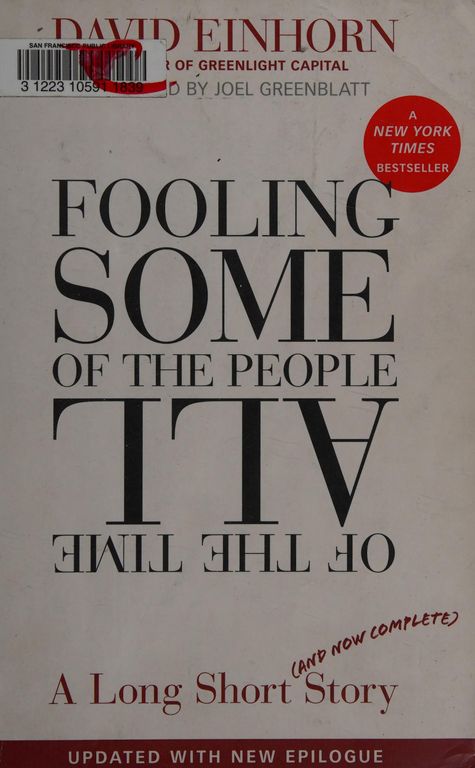
Fooling some of the people all of the time
Introduction: The Art of Betting Against the Market
Introduction: The Art of Betting Against the Market
Nova: Welcome back to the show. Today, we are diving deep into a book that isn't just about investing; it’s about corporate warfare, forensic accounting, and the sheer tenacity required to call out a fraud when everyone else is cheering the emperor’s new clothes. We are talking about David Einhorn’s seminal work, "Fooling Some of the People All of the Time."
Nova: : That title alone is provocative, Nova. It suggests a level of systemic deception that goes beyond simple bad luck or a poor earnings report. What makes this book essential reading, especially for someone who thinks value investing is just about finding cheap stocks?
Nova: Exactly. Einhorn, the founder of Greenlight Capital, isn't just a value investor; he’s an activist short-seller. This book is the chronicle of his multi-year battle against a company called Allied Capital. It’s a masterclass in deep research, but more importantly, it’s a look at the dark side of the market where the game seems rigged against the truth-tellers.
Nova: : So, this isn't a dry textbook on balance sheets. It’s a narrative. What was the central thesis Einhorn was trying to prove with this long, drawn-out fight?
Nova: The thesis was simple: Allied Capital was misrepresenting its financial health, particularly how it valued its portfolio of small business loans. Einhorn argued that the company was essentially fooling regulators, analysts, and investors for years. The book details how he went from initial skepticism in 2002 to publicly shorting the stock and then fighting tooth and nail to get the truth recognized. It’s a story about patience, conviction, and the incredible headwinds you face when you challenge the establishment.
Nova: : It sounds exhausting. If he was right, why did it take so long? That’s the part I want to understand. Why is it so hard to expose a fraud, even when you have the evidence?
Nova: That’s the core tension of the book, and we’re going to unpack that right after the break. We’ll look at the specific accounting tricks Allied used and how Einhorn’s methodology differs from the typical long-only value investor. Stay with us.
Key Insight 1: The Target and the Thesis
The Anatomy of a Short: The Allied Capital Saga
Nova: Welcome back. We’re dissecting "Fooling Some of the People All of the Time." Let’s start with the antagonist: Allied Capital. For listeners unfamiliar, what exactly was Allied Capital, and what was the initial red flag for Greenlight?
Nova: : Allied Capital was a small business lender, essentially a Business Development Company, right? They were lending money to smaller firms. What was the specific accounting maneuver that caught Einhorn’s eye?
Nova: It was all about valuation, specifically how they valued the equity stakes they held in their portfolio companies. Einhorn noticed that Allied was consistently valuing these illiquid, often struggling, private companies at extremely high, subjective multiples. He argued that if you looked at the actual cash flows and the quality of the underlying businesses, the valuations were pure fantasy. He famously said their accounting was like "a magic trick."
Nova: : A magic trick that kept the stock price afloat. How long did Einhorn hold this short position before he felt comfortable going public with his findings? Because the book is a long story, suggesting this wasn't a quick trade.
Nova: It was a marathon. Einhorn first became skeptical around 2002. He didn't just short it and walk away; he presented his findings at the Value Investing Congress. He was essentially using his reputation as a public forum to pressure the company and alert other sophisticated investors. The fight lasted years, spanning multiple presentations and updates.
Nova: : That public presentation aspect is crucial. It sounds like he wasn't just trading; he was campaigning. What was the immediate reaction from Allied management when Einhorn started making these claims?
Nova: Hostility, pure and simple. The book details how Allied management fought back aggressively, using their resources to discredit Einhorn, question his motives, and even challenge the very concept of short-selling. They tried to paint him as a market manipulator trying to profit from bad news, which, of course, is the inherent accusation against any short-seller.
Nova: : It highlights the asymmetry of power. The company has PR teams, lawyers, and the benefit of the doubt from the market. The short-seller has a spreadsheet and a microphone. Did the regulators, like the SEC, take his concerns seriously right away?
Nova: That’s where the book gets really damning. Einhorn argues that the regulatory framework failed them initially. He presented evidence, but the process was slow, and the company was politically connected. He felt the system was designed to protect the incumbent, not the truth-seeker. It took years of sustained pressure before serious scrutiny began to materialize.
Nova: : So, the lesson here isn't just about spotting bad accounting, but understanding that once you spot it, you are entering a long, expensive, and often lonely fight against entrenched interests.
Nova: Precisely. It’s the difference between being a passive analyst and an active short-seller. You have to be prepared for the fight, and you have to be willing to be wrong for a long time, even when you know you are fundamentally right about the underlying business.
Nova: : It makes you wonder how many other Allied Capitals are out there right now, being defended by management and ignored by the crowd.
Nova: That leads perfectly into our next segment, where we look at Einhorn’s toolkit. How does a value investor transition into this kind of adversarial role?
Key Insight 2: Deep Dive into Forensic Research
The Activist Investor's Toolkit: Research Meets Conviction
Nova: We’re moving from the story to the strategy. David Einhorn’s philosophy, as detailed in the book and through Greenlight Capital, is built on deep, fundamental research. What specific research techniques did he employ against Allied that an average investor might overlook?
Nova: : I imagine it goes far beyond just reading the 10-K. When you’re shorting, you have to be certain the company can’t simply talk its way out of the problem. What was the forensic element here?
Nova: It was incredibly granular. Einhorn’s team didn't just look at the reported numbers; they tried to reverse-engineer the assumptions. They dug into the footnotes, cross-referenced Allied’s portfolio companies with public records, and essentially tried to build a shadow balance sheet based on what the assets were worth, not what Allied they were worth. They were looking for the subjective inputs that management could manipulate.
Nova: : That sounds like the ultimate application of the margin of safety principle, but applied to the downside. If you can prove the assets are worth 50 cents on the dollar, and the stock is trading at a dollar, you have a massive margin of safety on the short side.
Nova: Exactly. And this is where the value investing mindset helps the short-seller. Einhorn isn't looking for a temporary dip; he’s looking for a structural, fundamental mispricing based on fraudulent or unsustainable premises. He’s looking for a company that eventually fail or be forced to restate its financials.
Nova: : The book also touches on the importance of patience. How long did Greenlight hold the short, and what did that patience cost them in terms of capital volatility during the fight?
Nova: The patience was immense. For years, Allied’s stock price was stubbornly high, sometimes even rising after Einhorn presented his case because the market initially dismissed him or believed the company’s counter-narrative. Einhorn had to manage his own investors’ expectations while the stock was moving against him. He mentions that shorting a fraud is often a long-term trade, not a quarterly one, because the market takes time to digest uncomfortable truths.
Nova: : That’s a huge psychological hurdle. Most portfolio managers are judged quarterly. How did Einhorn justify holding a losing position publicly for so long?
Nova: By sticking to his core principles: never lose money, and only bet when the conviction is absolute. He viewed the capital tied up in the short as an insurance policy against a known risk, even if the market wasn't pricing that risk correctly yet. He was betting on the eventual convergence of price and value, even if that convergence was painful in the interim.
Nova: : Did he ever discuss the ethics of short-selling in the book? Because critics often say short-sellers are just looking to profit from bad news, potentially destabilizing companies.
Nova: He addresses this head-on. He argues that short-sellers are essential market watchdogs. They provide an impartial evaluation that analysts paid by the company often cannot. He frames it as providing a necessary counterweight to the inherent optimism bias in the market. In the case of Allied, he argued that by exposing the fraud, he was protecting thousands of other investors who were being systematically misled. He sees it as a vital, albeit adversarial, form of market efficiency.
Nova: : So, the book isn't just a diary of a trade; it’s a philosophical defense of the short-selling profession, using Allied Capital as the ultimate case study.
Nova: It is. And the payoff, when it finally came, was significant, though the journey was the real story. Let’s transition now to the aftermath—the regulatory failures and the broader impact this book had on the investment world.
Key Insight 3: Systemic Failures and Takeaways
The Regulatory Reckoning and Market Lessons
Nova: We’ve established that Einhorn found the problem, but the market and regulators were slow to react. What specific systemic failures did the Allied Capital saga reveal about the financial ecosystem?
Nova: : It seems like a classic case of regulatory capture or at least regulatory inertia. Were there specific rules or oversight bodies that were clearly inadequate in handling subjective asset valuation for a company like Allied?
Nova: Absolutely. Einhorn points to the difficulty regulators have in policing subjective judgments, especially when management is skilled at presenting a plausible, albeit false, narrative. The book highlights that auditing standards sometimes allow too much leeway in valuing illiquid assets, creating a loophole that sophisticated management can exploit indefinitely. It’s easier to audit a cash balance than the future prospects of a private loan portfolio.
Nova: : And what about the role of the investment banks and analysts who were covering Allied? Did they play a part in perpetuating the illusion?
Nova: They were part of the chorus cheering the emperor on. Many analysts were either unwilling or unable to conduct the deep forensic work Einhorn’s team did. Furthermore, the book implies a conflict of interest where investment banking relationships or the desire to maintain access to management discouraged truly skeptical coverage. If you issue a sell rating, you might lose access to future IPOs or corporate access events.
Nova: : That’s a chilling thought—that the structure of Wall Street incentivizes cheerleading over skepticism. So, after the dust settled and Allied Capital eventually faced serious consequences, what was the lasting impact of this book on the broader value investing community?
Nova: It validated the activist short-seller model for a generation of investors. It showed that rigorous, patient, public research can, eventually, win. It reinforced the idea that true value investing isn't just about buying low; it’s about understanding something is cheap, and sometimes that reason is fraud. It also spurred conversations about transparency and governance.
Nova: : I read somewhere that Einhorn later applied similar skepticism to other high-profile names, like Lehman Brothers, before the 2008 crisis. Does this book serve as a template for his later successful shorts?
Nova: It absolutely does. The Lehman Brothers call, which he made around 2007, followed the same pattern: deep dive into the balance sheet, identifying hidden risks that the market was ignoring, and then making a public, evidence-based case. The Allied Capital fight was the proving ground for the methodology he would later apply to much larger institutions.
Nova: : It’s fascinating how one company’s saga can illuminate the flaws in an entire system. It’s a story about one stock, but it’s really a story about market integrity.
Nova: Precisely. It’s a testament to the idea that even in the most complex financial markets, the fundamentals eventually matter, but you might need a very long fuse to see the explosion.
Conclusion and Final Takeaways
The Legacy: Patience, Conviction, and the Long Short
Nova: We’ve covered a lot of ground today, exploring David Einhorn’s "Fooling Some of the People All of the Time." If we boil down this intense, multi-year battle into actionable takeaways for our listeners, what are the top three things they should remember?
Nova: : I think the first is the sheer power of patience. This wasn't a trade that paid off in a quarter; it was a multi-year conviction play. The second is the necessity of deep, forensic research—don't just accept the narrative; build your own shadow model.
Nova: I agree completely. And the third, which is unique to Einhorn’s approach, is the willingness to be a public advocate for your thesis. He didn't just trade quietly; he presented his findings repeatedly. He weaponized transparency against obfuscation. That requires a level of conviction that most investors simply don't possess.
Nova: : It also forces us to reconsider the role of the short-seller. Instead of viewing them as purely cynical actors, we should see them as a necessary, albeit painful, component of market self-correction.
Nova: They are the market’s immune system, sometimes fighting off infections that the body itself is too slow or too biased to recognize. Einhorn’s book is a powerful reminder that when you are fighting against a consensus that is fundamentally wrong, you must be prepared to stand alone for a very long time.
Nova: : It’s a story that transcends finance, really. It’s about challenging authority and sticking to your analysis when the world tells you you’re crazy. It’s a great lesson in intellectual courage.
Nova: It is. So, whether you plan to short a stock or just want to be a better long-term value investor, understanding the mechanics of how frauds are sustained and how they are eventually exposed is invaluable. David Einhorn gave us the blueprint in this book.
Nova: : A blueprint etched in years of frustration and eventual vindication. A powerful listen, Nova.
Nova: Indeed. Thank you for joining us for this deep dive into the world of activist short-selling. This is Aibrary. Congratulations on your growth!