

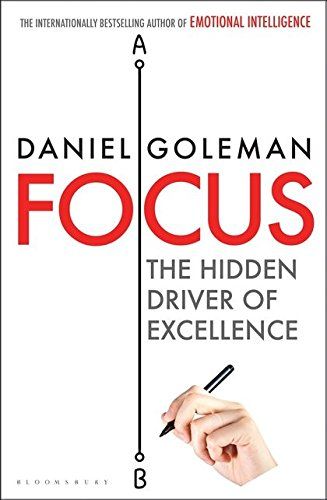
Focus
The Hidden Driver of Excellence
Introduction
Nova: Here's a question for you: what do a goldfish and the average modern human have in common? According to some research, the goldfish now has a longer attention span. That's right — studies suggest our collective ability to focus has dropped to around eight seconds, which is actually one second less than a goldfish. And that was before the pandemic pushed us even deeper into our screens.
Nova: : Wait, seriously? A goldfish beats us? That's a little embarrassing for humanity. But honestly, it doesn't surprise me. I pick up my phone to check one thing, and thirty minutes later I'm watching a video about how to make sourdough and I don't even bake.
Nova: Exactly. And that's exactly the world Daniel Goleman steps into with his book, Focus: The Hidden Driver of Excellence. Published in 2013, this book argues that attention is the most underappreciated mental asset we have. Goleman — who you might know from his groundbreaking work on Emotional Intelligence — makes a compelling case that focus is not just about getting work done. It's the hidden driver behind everything: great leadership, meaningful relationships, creativity, even our happiness.
Nova: : So is this one of those books that just tells us to put our phones down and meditate? Because I feel like I've heard that before.
Nova: It goes way deeper than that. Goleman spent years as a science journalist for The New York Times, and he brings serious neuroscience to the table. He explains what actually happens in your brain when you focus — and when you don't. He breaks attention into three distinct types: inner, other, and outer focus. And he shows how mastering all three is what separates high achievers from everyone else. It's not just about shutting off notifications. It's about fundamentally rewiring how you engage with yourself, with people, and with the world.
Nova: : Three types of focus. Okay, I'm intrigued. Let's dig into this.
Why Your Brain Is Wired to Be Distracted
The Neuroscience of Attention
Nova: Let's start with what's actually happening inside your skull. Goleman describes two major attention systems in the brain. The first is what he calls the top-down system, centered in the prefrontal cortex — that's the part right behind your forehead. This is the system you use when you deliberately decide to concentrate on something. It's voluntary, it's effortful, and it's what we typically mean when we say we're focusing.
Nova: : So that's the good guy. The disciplined part of me that wants to finish this spreadsheet.
Nova: Right. But there's a second system — the bottom-up system — and this one is involuntary and automatic. It's constantly scanning the environment for anything novel or emotionally charged. This system is ancient. It evolved to keep us alive. If a saber-toothed tiger rustled in the bushes, you needed your brain to snap to attention instantly. You couldn't afford to finish your cave painting first.
Nova: : And today the saber-toothed tiger is... a push notification.
Nova: Exactly. Goleman points out that our technology — social media, messaging apps, news alerts — is specifically designed to hijack that ancient bottom-up system. Every buzz, every red dot, every ping triggers a little shot of dopamine and pulls your attention away. What's fascinating is that Goleman explains this through the amygdala. When the amygdala perceives a threat or something emotionally salient, it can hijack the prefrontal cortex. Your thinking brain goes offline, and your reactive brain takes over. He calls it an amygdala hijack.
Nova: : So when I'm trying to work and my phone buzzes, my ancient survival brain kicks in and my modern thinking brain just surrenders?
Nova: Pretty much. And here's where it gets really interesting: Goleman cites research showing that once you're interrupted, it takes several minutes to fully regain your previous level of concentration. Not seconds — minutes. One study found that after an interruption, it takes an average of twenty-three minutes to get back into a state of deep focus. Imagine that: one text message can cost you nearly half an hour of productive work.
Nova: : Twenty-three minutes! That's genuinely alarming. So every time I glance at my phone during a meeting or while writing, I'm paying a much bigger cognitive tax than I realize.
Nova: That's exactly Goleman's point. He also discusses something called cognitive load. When you try to multitask — which is really just rapidly switching between tasks — your cognitive load increases dramatically. You're not doing two things at once. You're doing two things poorly in rapid succession. And the quality of your work suffers across the board. Goleman references Nobel Prize winner Herbert Simon, who said: what information consumes is the attention of its recipients. Hence, a wealth of information creates a poverty of attention.
Nova: : A wealth of information creates a poverty of attention. That's a quote I need to put on my wall. But the big question is: can we actually do anything about this, or are we just at the mercy of our amygdala?
Inner, Other, and Outer Attention
The Three Lenses of Focus
Nova: Great question, and that brings us to the core framework of the book. Goleman organizes all attention into three directions. First, there's inner focus — this is self-awareness. It's your ability to tune into your own thoughts, your emotions, your bodily sensations, your gut feelings, and your core values.
Nova: : So inner focus is basically knowing what's going on inside you. Not just knowing that you're angry, but understanding why.
Nova: Exactly. Goleman argues that inner focus is foundational. Without it, you can't manage yourself effectively. And one of the most powerful aspects of inner focus is what he calls gut feelings. The brain's bottom-up system — the same one we talked about — accumulates decision rules over a lifetime. When you face a choice, it sums up all that experience and presents its advice. But here's the catch: it doesn't communicate in words. It communicates through the gastrointestinal tract. That's literally why we call it a gut feeling.
Nova: : Wait, so my gut feeling is actually my brain's lifetime of experience trying to talk to me? That's wild. But how do you know when to trust it?
Nova: Goleman provides a brilliant example. He tells the story of George Lucas. When Lucas made Star Wars, he went completely against Hollywood convention. The studio wanted final cut on the film, but Lucas — trusting his creative instincts — refused their money and financed it himself. Everyone told him he was crazy. He ran out of money, got turned down by ten banks before the eleventh one came through. But his gut told him his creative vision was worth protecting. That's inner focus in action: the ability to hear your internal compass, even when the whole world is telling you you're wrong.
Nova: : That's a great example. So that's inner focus. What about the second one?
Nova: The second is other focus. This is your ability to tune into other people — their emotions, their needs, their perspectives. It's empathy, essentially. Goleman distinguishes between cognitive empathy, which is understanding what someone else is thinking, and emotional empathy, which is actually feeling what they feel.
Nova: : And I'm guessing this matters beyond just being a nice person.
Nova: It matters enormously. Goleman points to research showing that the neural networks for empathy and attention are interwoven in the brain. Strong other focus makes you a better leader, a better colleague, a better partner. He cites a fascinating finding: people who are wealthier or higher in organizational hierarchies tend to be less accurate at reading emotional cues from others. Power and status can actually dull your empathy unless you deliberately train your other focus.
Nova: : That explains a lot about some bosses I've had. And what about the third type?
Nova: The third is outer focus — what Goleman calls systems awareness. This is your ability to see the big picture, to understand how different elements in a complex system interact. It's what lets you navigate the larger world, whether that's understanding market trends, organizational dynamics, or even global challenges like climate change.
Nova: : So these three types of focus — inner, other, outer — they're like three lenses you can switch between depending on the situation.
Nova: That's a perfect way to think about it. And Goleman's big argument is that true excellence comes from mastering all three. If you only have inner focus, you're self-aware but disconnected from others. If you only have other focus, you're empathetic but have no internal compass. If you only have outer focus, you understand systems but lack self-awareness and empathy. The magic is in the balance — knowing which lens to use and when.
The Surprising Science of Peak Performance
Flow, Willpower, and the Wandering Mind
Nova: Let's talk about flow. Goleman describes flow as the state of maximal cognitive efficiency — what researchers call maximal neural harmony. It's that feeling of being completely absorbed in what you're doing, to the point where time seems to disappear.
Nova: : I know that feeling. When I'm really into something and I look up and three hours have passed and I forgot to eat lunch. It's almost euphoric.
Nova: That's it exactly. Goleman shares a story about a neurosurgeon who was performing an incredibly challenging operation. He was so absorbed that he didn't notice the ceiling of the operating room partially collapsed during the surgery. A nurse had to tell him afterward. That's the level of concentration flow can produce.
Nova: : So how do you get into flow? Is it just luck?
Nova: Not at all. Goleman explains that flow happens when the challenge you're facing perfectly matches your skill level. If the challenge is too low, you're bored. If it's too high, you're anxious. Flow happens right in the sweet spot — what researchers call the inverted U of performance. And one of the key pathways to flow is through deliberately training your concentration. The stronger your focus muscle, the more easily you can enter flow states.
Nova: : That makes sense. So focus is the gateway to flow. But here's what I don't get: Goleman also talks about the value of mind wandering. Isn't that the opposite of focus?
Nova: Great catch. This is one of the most surprising insights in the book. Goleman explains that mind wandering — which researchers estimate we do up to forty percent of our waking hours — is not necessarily a bad thing. In fact, it's crucial for creativity. When you let your mind roam freely, your brain makes novel connections between ideas that deliberate focus might miss.
Nova: : So zoning out in the shower and suddenly getting a great idea — that's actually productive?
Nova: Exactly. Goleman cites research showing that people can generate up to forty percent more original ideas when they let their minds rest. The key is knowing when to focus intensely and when to let go. He calls this open awareness — a receptive, non-judgmental state where you're present but not narrowly focused. It's a complement to laser-sharp concentration, not its enemy.
Nova: : So it's not about being focused all the time. It's about knowing when to narrow your attention and when to widen it.
Nova: Precisely. And then there's willpower. Goleman makes a fascinating point here. Most people think willpower is about gritting your teeth and pushing through. But his research shows that the psychological component of willpower is much bigger than the physical one. The single best booster for willpower? Doing work you genuinely love. When your work aligns with your values and purpose, effort starts to feel effortless.
Nova: : That connects back to the George Lucas example. He made enormous sacrifices, but because he believed in his creative vision, the willpower came naturally.
Why Attention Defines Great Leadership
The Triple Focus Leader
Nova: Let's turn to leadership, because this is where Goleman really puts the triple focus to work. He tells the story of a law firm partner — a classic overachiever — who drove her team into the ground. She micromanaged everything, constantly rewrote perfectly fine reports, criticized relentlessly, and never gave praise. She was so focused on winning that she was completely blind to her impact on the people around her.
Nova: : I've worked for someone like that. A star employee quit and everyone else was looking for the exit.
Nova: Exactly what happened. A star team member quit, and others were looking to transfer. Goleman calls this the pacesetting leadership style — set a fast pace and expect everyone to keep up. It can produce short-term results through personal heroics, but at the expense of building a healthy organization. Harvard Business Review actually called this leadership run amok.
Nova: : So these pacesetters — they're successful in one sense but destructive in another.
Nova: Right. And Goleman notes that the number of overachievers in leadership positions has been climbing steadily since the 1990s. But after the collapse of Enron and the 2008 financial crisis, the dark side of single-minded focus on results became impossible to ignore. These leaders lack what Goleman calls triple focus.
Nova: : Break that down for me. What does a triple focus leader actually look like?
Nova: A triple focus leader balances all three types of attention. First, inner focus: they have the self-awareness to assess their own strengths and weaknesses honestly. They can feel their gut instincts about big decisions. And they stay grounded in their values, even under pressure. Second, other focus: they have genuine empathy. They can zoom in on one person's feelings or zoom out to read the entire room. They mentor people, listen to feedback, and build consensus. Third, outer focus: they understand the larger systems they're operating in — market forces, industry trends, societal shifts.
Nova: : So it's not just about being nice or being smart. It's about having all three operating at once.
Nova: That's exactly it. Goleman writes that a leader tuned out of their internal world will be rudderless. One blind to the world of others will be clueless. And one indifferent to the larger systems they operate in will be blindsided. When Accenture interviewed one hundred CEOs about the skills they needed, fourteen abilities emerged — from thinking globally to embracing change. But the one meta-ability that underpinned everything was self-awareness. You can't compensate for your weaknesses if you don't know what they are.
Nova: : And this applies beyond the C-suite, right? Goleman seems to be saying that we're all leaders in some capacity — as parents, teachers, community members.
Nova: Absolutely. He defines a leader as anyone with a sphere of influence. The triple focus model applies to how you show up as a colleague, a friend, a parent. It's about being fully present with the people in your life, understanding yourself honestly, and seeing the bigger picture of how your actions ripple outward.
Mindfulness, Smart Practice, and Digital Discipline
Training the Attention Muscle
Nova: So after all this diagnosis, the natural question is: what do we actually do about it? Goleman devotes significant attention — forgive the pun — to practical strategies for strengthening focus.
Nova: : I need this part. Give me the actionable stuff.
Nova: The foundation is mindfulness. Goleman argues that every form of meditation, stripped of its belief system, is fundamentally an attentional workout. When you sit and focus on your breath, and your mind wanders, and you bring it back — that's a rep for your attention muscle. Over time, this practice strengthens the prefrontal cortex's ability to regulate the amygdala. You literally build neural circuitry that makes you less reactive and more deliberate.
Nova: : So it's like going to the gym for your brain. But what about people who can't sit still and meditate?
Nova: Goleman also emphasizes what he calls smart practice. This goes beyond the famous ten-thousand-hour rule. It's not just about how much you practice — it's about the quality of that practice. Smart practice means working at the edge of your ability, getting immediate feedback, and maintaining full attention throughout. It's the difference between mindlessly playing the same piano piece a hundred times and deliberately working on the sections where you keep making mistakes.
Nova: : That makes me think about how I approach my own work. Am I really paying attention to where I'm struggling, or am I just going through the motions?
Nova: That's the exact question smart practice asks you to confront. Goleman also has a lot to say about managing digital distractions. He points out that we live in what he calls an attentional economy — businesses and platforms are literally competing for our attention because attention is monetizable. Every app is engineered to pull you in and keep you there.
Nova: : It's an arms race, and our brains are the battlefield.
Nova: Right, but we're not helpless. Goleman recommends practical steps: turn off non-essential notifications, schedule blocks of uninterrupted deep work, create tech-free zones in your day. He also emphasizes the importance of recovery. Just like a muscle, your attention gets fatigued. You need periods of genuine rest — not scrolling through social media, but actual downtime where your mind can wander freely and recharge.
Nova: : And what about kids? I feel like my niece has never known a world without an iPad, and I worry about her attention span.
Nova: Goleman is particularly concerned about children. He cites research suggesting that around eight percent of young gamers meet psychiatric criteria for addiction, with brain chemistry patterns similar to alcoholics and drug abusers. But he's not just doomsaying. He points to social-emotional learning programs in schools that teach kids mindfulness, self-awareness, and emotional regulation. Research shows that children who develop executive control — the ability to ignore impulses, filter out distractions, and stay focused on a goal — fare best in life. This is, according to Goleman, the single most important mental skill for lifelong success.
Nova: : So it's not about banning technology. It's about teaching kids — and ourselves — how to relate to it differently.
Nova: Exactly. Goleman's message is ultimately hopeful. Attention can be trained. It can be strengthened. It's never too late to start.
Conclusion
Nova: So let's step back and pull this all together. Daniel Goleman's Focus makes a powerful case that attention is not just a productivity tool — it's the fundamental currency of a well-lived life. He gives us a framework built around three types of focus: inner focus for self-awareness and values, other focus for empathy and connection, and outer focus for understanding the systems we inhabit.
Nova: : And the key insight is that these three aren't optional extras. If you're deficient in any one of them, something important in your life is going to suffer. No inner focus? You're rudderless. No other focus? You're clueless about people. No outer focus? You're blindsided by the world around you.
Nova: That's it, perfectly put. Goleman also teaches us that focus is a mental muscle. It can be weakened by constant distraction and multitasking, but it can also be strengthened through mindfulness, smart practice, and deliberate recovery. He shows us that peak performance — flow states — depends on focus. He shows us that great leadership requires balancing all three types of attention. And he argues that the most important skill we can teach our children is executive control: the ability to direct and sustain attention.
Nova: : What I find most striking is how counterintuitive some of it is. The fact that mind wandering — which feels unproductive — is actually essential for creativity. The fact that gut feelings are your brain's lifetime of experience trying to communicate with you. The fact that doing work you love is a more powerful willpower booster than any productivity hack.
Nova: That's what makes the book so rich. It challenges our assumptions about what focus really means. It's not about being rigidly disciplined every moment of the day. It's about knowing when to narrow your attention and when to widen it. It's about understanding your own mind well enough to direct it purposefully toward what matters most.
Nova: : If someone wanted to take one thing away from this book and start practicing it tomorrow, what would you suggest?
Nova: I'd say start with a simple mindfulness practice. Even five minutes a day of focusing on your breath and noticing when your mind wanders. That single habit trains the core circuitry of attention. And pair it with one practical boundary around technology — maybe no phone for the first thirty minutes of your day, or turning off all notifications during focused work. Those two things together, practiced consistently, can begin to rewire your relationship with attention.
Nova: : That feels doable. Not easy, but doable. And the payoff — better relationships, better work, a stronger sense of purpose — seems more than worth it.
Nova: Goleman leaves us with a profound thought: what you focus on indicates what you care about. Your attention is a vote for what matters in your life. The question isn't just how to focus better — it's what to focus on. And that's a question worth sitting with.
Nova: : This is Aibrary. Congratulations on your growth!