

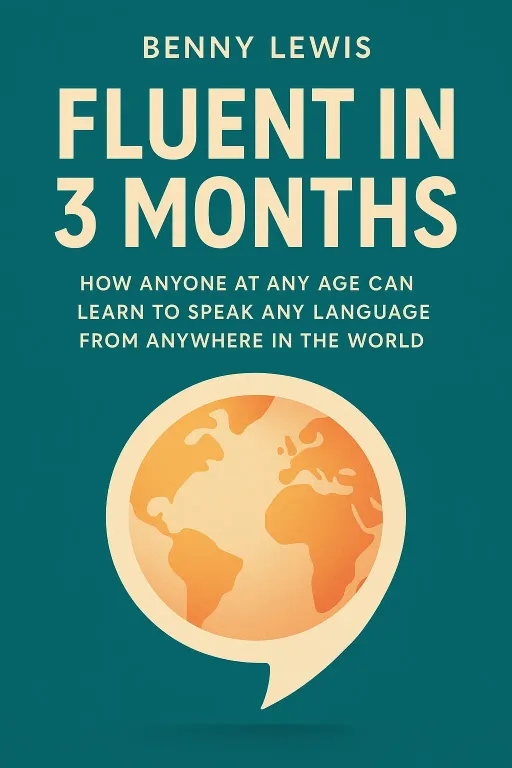
Stop Guessing, Start Mastering: The Guide to Conversational Fluency.
Golden Hook & Introduction
SECTION
Nova: Atlas, I have a challenge for you. Five words. Describe "conversational fluency." Go.
Atlas: Oh, man, five words? Okay… "Awkward pauses, missed opportunities, frustrating." Is that five? I think that’s six.
Nova: Close enough! And perfectly captures the struggle. That feeling, that exact frustration, is what we’re diving into today with a guide that promises to turn that around:. This isn't just another language book; it's a direct challenge to the conventional, often ineffective, ways we've been taught to learn. It’s for anyone who's ever felt like they're building a beautiful, silent library of words, but can't quite get them to sing.
Atlas: "Silent library of words"—that's a fantastic analogy. But "mastering"? That sounds like a tall order when you're just trying to get a coherent sentence out without mentally translating every single word. I imagine a lot of our listeners, especially those in high-stakes professional environments, feel that pressure. They know their stuff, but when the conversation shifts to, say, a nuanced negotiation in a second language, suddenly they're back to feeling like a beginner.
The 'Cold Fact': The Gap Between Knowing Words and Using Them
SECTION
Nova: Absolutely. And that leads us directly to what the book calls "The Cold Fact." It's the brutal truth many aspiring professionals face: despite diligently learning vocabulary, despite grammar drills, despite understanding complex articles, they feel utterly stuck. The real hurdle isn't a lack of words; it's the inability to use them freely, confidently, and spontaneously.
Atlas: That resonates so deeply. I can picture it: someone spending hours on flashcards, acing grammar tests, maybe even consuming media in their target language. But then, they step into a team meeting, or a networking event, or even just a casual chat with an international colleague, and it all just… crumbles. The words are there, but they’re locked behind a mental barrier. What exactly is happening in that moment?
Nova: It’s a classic case of what we call "passive knowledge" versus "active application." Think of it like this: you can read a detailed manual on how to ride a bicycle, understand every gear ratio, every braking mechanism. You might even ace a written test on bicycle mechanics. But until you actually, wobble, fall, and push off, you haven't truly learned to ride. Our hypothetical professional has been doing all the "manual reading" for language. They're excellent at input, but completely out of practice with output. The internal monologue is often a whirlwind of self-correction: "Is that the right tense? Is this word too formal? Will they understand my accent?"
Atlas: So, it's less about the actual linguistic knowledge and more about the performance anxiety and the lack of real-time processing? That’s interesting, because it shifts the problem from "I don't know enough" to "I'm not enough with what I know."
Nova: Exactly. The book highlights that this focus on perfection before participation is a trap. It fosters a fear of making mistakes, which then paralyzes communication. You're so busy trying to be grammatically flawless or perfectly articulate that you miss the opportunity to connect, to express, to actually. And for our listeners, who are driven by advancement and real-world impact, this isn't just frustrating; it’s a direct impediment to their professional growth. Imagine missing out on a crucial project because you couldn't articulate your ideas, not because you lacked the ideas, but because you lacked the fluency to express them.
Atlas: That’s a powerful point. It’s like being a brilliant architect who can design incredible buildings on paper, but has never actually laid a brick or poured concrete. The theoretical knowledge is there, but the practical, hands-on ability to bring it to life is missing. So, if passive learning is the problem, what's the radical solution this guide proposes?
Tactical Insights: Embracing Imperfection and Active Interaction
SECTION
Nova: That’s where the tactical insights come in, drawing from some fascinating minds in language acquisition. One of the core ideas comes from Benny Lewis, author of. His philosophy is an "attack language" approach. What he champions is speaking from day one. Not perfectly, not flawlessly, but. He tells a story of arriving in a new country, knowing almost no words, and immediately trying to engage with locals, making countless hilarious mistakes.
Atlas: Wait, so you’re saying the fastest way to conversational mastery isn't more study, but more messy, imperfect interaction? That challenges everything we've been taught about learning. For someone whose career depends on precision and competence, the idea of "embracing mistakes" sounds… risky.
Nova: It absolutely does, but that's the paradigm shift. Lewis’s argument is that mistakes aren't failures; they're feedback. They're data points. Every time you try to say something and it comes out wrong, you've just learned something crucial about how the language actually works in practice, not just in theory. It's like learning to code: you don't just read the manual; you write code, it breaks, you fix it, and that's how you truly understand. He vividly recounts how these initial, often embarrassing, attempts rapidly accelerated his learning because he was actively the language as a tool, not just studying it as an object.
Atlas: That makes sense in a very practical, almost engineering-like way. You're debugging your language skills in real-time. But what about the anxiety? How do you overcome that initial hurdle of just opening your mouth?
Nova: That’s where Jeremy Harmer's work, particularly from, comes in. Harmer highlights the critical importance of communicative activities. He argues that real fluency isn't about isolated grammar drills; it's about using language to, to. It’s about creating scenarios where the goal isn't linguistic perfection, but successful communication.
Atlas: Can you give an example of what a "communicative activity" looks like for someone trying to move past the "cold fact" we talked about earlier? Beyond just "go talk to someone," which can feel overwhelming.
Nova: Picture this: instead of spending an hour reviewing a list of business idioms, you find a language exchange partner – or even a willing colleague – and you role-play a sales pitch, or a client meeting. The focus isn't on getting every idiom perfect, but on conveying your message, responding to questions, and adapting. You're using the language as a vehicle to accomplish a task, mimicking real-world professional scenarios. Harmer emphasizes that these interactions are where the brain truly processes and internalizes language, because there's a genuine need to understand and be understood. It’s the difference between trying to memorize a dance routine from a diagram, and actually getting on the dance floor and feeling the music. The latter is messy, but it’s real.
Atlas: So, it's about shifting from a passive consumer of language to an active creator and participant. It’s like learning to cook by actually cooking meals, even if they're not Michelin-star worthy at first, rather than just reading cookbooks. That's a powerful shift for anyone who's felt stuck in the theoretical side of language learning. It also aligns with that "resilient achiever" mindset many of our listeners have – they want to apply what they learn, not just collect knowledge.
Nova: Exactly! The book synthesizes these ideas beautifully, showing that consistent, active practice is the undeniable bridge from mere comprehension to truly confident conversation. It’s about understanding that language is a skill, not just a body of knowledge. And like any skill, it improves with deliberate, active, and often imperfect practice.
Synthesis & Takeaways
SECTION
Atlas: This has been incredibly insightful, Nova. It really reframes the entire challenge of conversational fluency. It’s not just about what you know, but about how bravely and consistently you what you know.
Nova: Absolutely. The deep insight here is that the biggest barrier to fluency isn't linguistic—it's psychological. It's the fear of imperfection, the ingrained belief that mistakes are failures rather than essential stepping stones. When you reframe error as data, as a necessary part of the learning process, then the entire landscape of language acquisition changes. You stop guessing and start mastering through active, courageous engagement.
Atlas: That’s such a hopeful way to look at it. It empowers the learner to take control. So, for our listeners who are feeling that "cold fact" frustration, what's one immediate, tiny step they can take to start shifting this paradigm today?
Nova: The book has a fantastic "Tiny Step" recommendation that perfectly encapsulates this philosophy: Find a language exchange partner today. Just today. And have a 15-minute conversation. The goal isn't perfection; it's expression. It's about connecting, even imperfectly, and embracing that initial awkwardness as a sign of progress, not failure. Just 15 minutes of active output can start to rewire that muscle.
Atlas: Just 15 minutes. That feels incredibly achievable, even for the busiest professional. It's about getting into the water, even if you just splash around for a bit.
Nova: Precisely. It’s consistent, active practice that moves the needle. So, go out there, find that partner, and start talking.
Nova: This is Aibrary. Congratulations on your growth!









