

How to Speak Beyond Words Without Common Pain.
Golden Hook & Introduction
SECTION
Nova: You know, Atlas, for years, we’ve been told that learning a new language means endless grammar drills, flashcards, and silent suffering. But what if that entire approach is actually the biggest obstacle to speaking a new language?
Atlas: Oh man, that resonates deeply. I imagine a lot of our listeners have tried the flashcard route, maybe even a few apps, only to feel like they’re hitting a brick wall. It’s incredibly frustrating when you dedicate time, but the words just don't stick or you're too scared to actually use them.
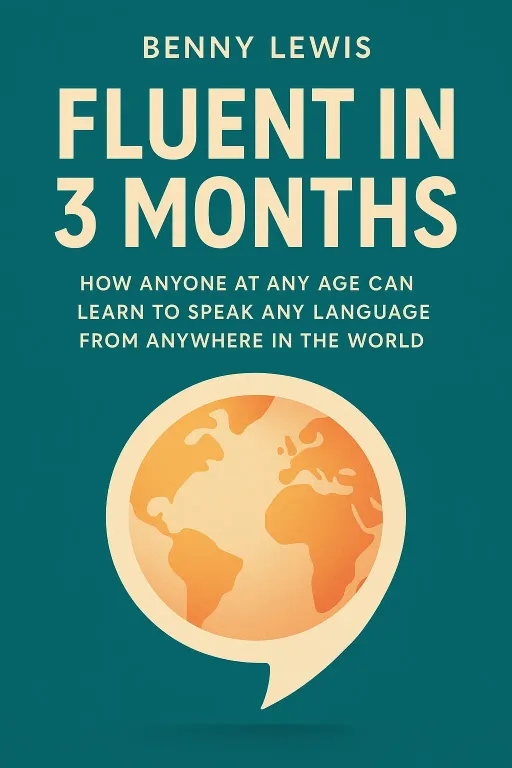
Nova: Exactly! Today, we’re tearing down those walls with insights from Benny Lewis, the polyglot and author behind "Fluent in 3 Months" and "Language Hacking German." What’s fascinating about Benny is that he wasn't a natural language genius; he struggled immensely with languages in school, only to discover his own counter-intuitive methods later in life that allowed him to become fluent in multiple languages as an adult, completely redefining what's possible.
Atlas: That’s actually really inspiring. So, he wasn’t born with it, he built it. That sounds like a journey a lot of our resilient achievers can relate to. What’s the core shift he’s advocating for?
The Myth of Memorization: Embracing Active Communication from Day One
SECTION
Nova: The core shift is this: forget rote memorization and embrace active communication from day one. He argues that perfection is the enemy of progress. Instead of spending months locked away with grammar books, you should be speaking, making mistakes, and learning through interaction. It’s like learning to swim by getting in the water, not by reading a manual about stroke techniques on the poolside.
Atlas: But wait, isn’t that incredibly scary? For someone who values tangible outcomes and wants to master a new skill, the idea of just out loud from the get-go feels counterintuitive. What about sounding ridiculous?
Nova: That’s the brilliant part. Benny’s own journey highlights this. He spent years trying to learn Irish in school, meticulously studying grammar and vocabulary, but he couldn't hold a conversation. It was only when he moved to Spain, and forced himself to speak Spanish immediately, despite his limited vocabulary, that he saw real progress. He describes it as a lightbulb moment: the pain of embarrassment was temporary, but the learning curve was exponential. He was literally speaking from day one, using gestures and a handful of words, and within weeks, he was conversing. He calls it 'embracing the mess'.
Atlas: Huh, 'embracing the mess.' I like that. So, the "pain" isn't the difficulty of the language, but the fear of imperfection, of stepping outside our comfort zone. It’s a mindset hack as much as a language hack. For someone navigating daily pressures, who might only have small pockets of time, is it really efficient to just... bumble through?
Nova: Absolutely. Think of it like this: if you spend all your time preparing for a marathon by reading books about running, you’ll never actually run the race. Benny’s approach says, put on your shoes, step out the door, and start jogging, even if it’s just a block. Each stumble, each wrong turn, is a data point. It tells you where your weaknesses are, what vocabulary you truly need, and how real conversations unfold. It’s a feedback loop that traditional memorization just can't provide. It’s about building confidence through micro-interactions, not grand, flawless performances.
Atlas: That makes sense. It’s less about having all the answers before you start, and more about starting with the answers you have. So, once you’ve embraced that initial leap of faith, how do you actually "hack" the language to achieve conversational fluency quickly?
Tactical Language Hacking: Strategies for Rapid Conversational Fluency
SECTION
Nova: That naturally leads us to the second key idea: tactical language hacking. This isn't about finding magical shortcuts; it's about finding smartcuts. Benny emphasizes 'focused learning'—identifying what you need to communicate effectively and prioritizing that. Instead of learning every verb conjugation, you learn the most common ones. Instead of memorizing obscure nouns, you focus on phrases you’ll use daily.
Atlas: So you're saying it's about strategic efficiency, which sounds perfect for a practical learner. Can you give us an example of one of these 'hacks' in action? Like, how does this look for someone who only has 30 minutes a day, perhaps during a commute or a lunch break?
Nova: A perfect example is what Benny calls 'mission-based learning.' Instead of "I'm going to study German today," it's "I'm going to learn how to order coffee in German today, and then I'm going to practice it with an online tutor or even just pretend-order from myself in the mirror." He provides actionable steps, such as using language exchange apps like italki or HelloTalk, even if you only know "hello" and "thank you." The goal is not perfection, but interaction. He would prepare five simple phrases, like "My name is Nova," "I am learning German," "How are you?" and "Can you repeat that?" and use them immediately. The act of using them, even poorly, builds neural pathways and confidence far faster than passive study.
Atlas: That’s a great way to put it. It’s like, instead of trying to climb Mount Everest in one go, you’re focusing on mastering the first base camp. It makes the whole endeavor feel less daunting and more achievable, especially for someone who needs to see tangible progress to stay motivated. What's the absolute smallest, most digestible step someone could take today, right after listening to this, to put this into practice?
Nova: The tiny step Benny often recommends, and one that Nova's Take on these resources highlights, is to find five common phrases in your target language – things like "hello," "thank you," "how are you?" "please," and "excuse me." Then, commit to using of them in a real-world context today. Even if it's just with yourself, speaking it out loud, imagining a conversation. The goal is to break the silence barrier and activate your vocal cords in that new language.
Synthesis & Takeaways
SECTION
Atlas: That gives me chills. It transforms language learning from a grueling academic exercise into an exciting, active adventure. It's about empowering yourself to communicate, not just accumulate vocabulary. It's about finding your voice, even if it's a little wobbly at first.
Nova: Exactly. The profound insight here is that true fluency isn't about avoiding mistakes; it's about making them so frequently and learning from them so rapidly that your communication ability compounds. It reveals that our biggest hurdle isn't the complexity of the language, but our own ingrained fear of imperfection. Trusting your ability to adapt, as a resilient achiever does daily, is the true superpower here.
Atlas: Honestly, that sounds like my Monday mornings. You navigate daily pressures, you adapt, you grow. So, whether you're looking to explore new cultures or simply master a new skill, the lesson is clear: start speaking, embrace the journey, and celebrate every tiny, imperfect step.
Nova: And remember that tiny step: find those five common phrases, and commit to using just one today. Break that barrier, even if it's just with yourself. You'll be amazed at how quickly that fear dissipates and the excitement takes over.
Atlas: This is Aibrary. Congratulations on your growth!









