Unlocking Your Deepest Focus: The Secret to Meaningful Work
Golden Hook & Introduction
SECTION
Atlas: Nova, what if the biggest threat to your success, to success, isn't your competition, or even your own mistakes, but the very tools designed to make us more productive?
Nova: Whoa, Atlas, that's a brilliant paradox. You're talking about the insidious nature of modern distraction, aren't you? The constant pings, the endless feeds, the feeling of always being "on" but never truly.
Atlas: Exactly! It feels like we're all scattered, trying to juggle a dozen things at once, and at the end of the day, we've done a lot, but what have we accomplished? What's stuck?
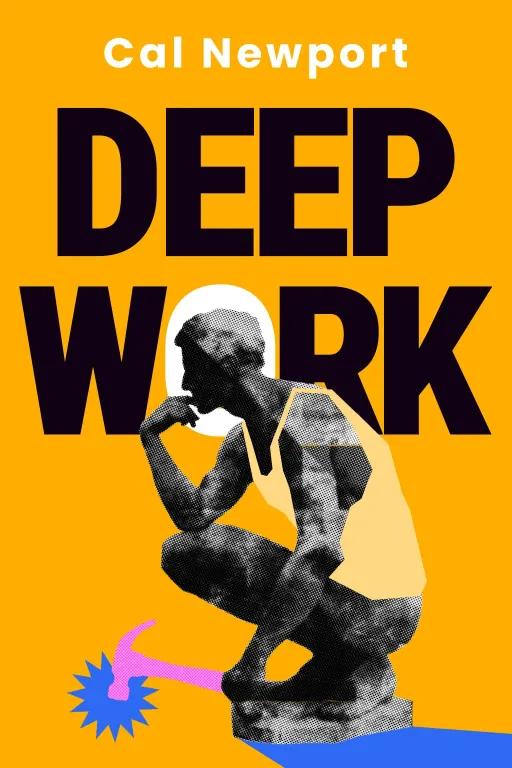
Nova: Well, that feeling of being perpetually scattered is precisely what Cal Newport tackles in his widely acclaimed book, "Deep Work." Newport, a computer science professor who impressively manages to publish numerous books and papers while avoiding social media, argues that the ability to focus without distraction on a cognitively demanding task is a superpower in today's economy. And building on that, we're also diving into the foundational work of Mihaly Csikszentmihalyi, whose seminal book "Flow" introduced the world to the concept of complete absorption, a state where time seems to disappear.
Atlas: That makes me wonder, so we’re essentially talking about reclaiming our attention, not just for the sake of getting more done, but for something deeper?
Nova: Absolutely. The core of our podcast today is really an exploration of how cultivating sustained, undistracted attention can unlock both unparalleled productivity and profound personal satisfaction in an increasingly chaotic world.
The Scarcity of Deep Work: Why Distraction is the Enemy of Meaningful Output
SECTION
Nova: Let's start with Newport's concept of "deep work." He defines it as professional activities performed in a state of distraction-free concentration that push your cognitive capabilities to their limit. These efforts create new value, improve your skill, and are hard to replicate. The opposite is "shallow work," which is non-cognitively demanding, logistical-style tasks, often performed while distracted. Think email, meetings, social media.
Atlas: But isn't multitasking just efficient? For someone juggling multiple projects and responsibilities, like many of our listeners, this idea of completely shutting everything else out sounds almost impossible, or at least highly inefficient. We’re told to be responsive, to keep many balls in the air.
Nova: That's the common misconception, Atlas. Newport argues that multitasking actually creates what he calls "attention residue." Imagine you're working on a complex report, then you quickly check an email. Even if you switch back to the report immediately, your attention doesn't fully return. A residue of your attention remains stuck on that email, thinking about its contents, the reply you need to send, or the implications. That residue reduces your cognitive capacity for the main task.
Atlas: Oh, I know that feeling! It’s like leaving a dozen mental tabs open in your brain, even if you’re only looking at one. You can feel the drain.
Nova: Exactly. It's a constant, low-level cognitive load that prevents you from ever truly diving deep. Consider a software engineer trying to debug a complex program while their Slack channel is constantly buzzing. Each notification pulls them out, and each time they return, they're not quite at 100%. The quality of their code suffers, the time it takes increases, and the frustration builds. That’s the cost of shallow work.
Atlas: So, what does this look like in practice? Are we saying people need to lock themselves in a cabin in the woods to get anything meaningful done? Because for most of us, that's not exactly practical advice.
Nova: Not at all! While some extreme examples exist, Newport's methods are about strategic application. It involves scheduling deep work blocks, creating rituals around them – like going to a specific place, having a specific coffee, or even listening to particular music – and then rigorously protecting that time. It's about saying no to distractions, even small ones, and embracing boredom in those moments when your brain naturally wants to wander.
Atlas: Embracing boredom? That sounds almost revolutionary in our always-on culture. It’s like we’ve forgotten how to just without stimulation.
Entering the Flow State: The Intersection of Peak Performance and Profound Fulfillment
SECTION
Nova: And when you really master that kind of focused effort, when you consistently practice deep work, you often find yourself in a state Mihaly Csikszentmihalyi called "Flow." This is where the magic truly happens.
Atlas: Wow, that sounds almost… mystical. Is this just for artists and athletes, or can anyone really get into this state? And how is it different from just being really productive?
Nova: It’s absolutely not just for a select few, Atlas. Flow is a state of complete absorption in an activity. You become totally immersed in what you're doing, to the point where you lose all sense of time, self-consciousness, and even your surroundings. It's that feeling when you're so engrossed in a task that hours fly by, and you emerge feeling energized, not drained. A surgeon performing a delicate operation, a chess grandmaster in the middle of a complex game, or even someone deeply engrossed in writing a challenging piece of code – they can all experience flow.
Atlas: So it's not just about getting more done, but actually getting more done? That changes the whole equation for someone feeling burnt out just trying to keep up. It sounds incredibly fulfilling.
Nova: It is, and that's the key difference. Productivity is about output; flow is about optimal experience and intrinsic reward. Csikszentmihalyi identified several conditions for flow: you need clear goals, immediate feedback on your progress, and a balance between the challenge of the task and your skill level. If it's too easy, you get bored; too hard, you get anxious. The sweet spot is where the challenge slightly exceeds your current skills, pushing you to grow.
Atlas: That makes perfect sense. Like when you’re learning a new skill, and you hit that point where it’s still hard, but you’re making progress, and you just want to keep going. The satisfaction isn't just from finishing, but from the act of doing it.
Nova: Exactly! It’s what makes work feel less like a chore and more like a game. The long-term benefits are immense: increased happiness, enhanced skill development, greater creativity, and a deeper sense of meaning in your life. It's where peak performance and genuine enjoyment converge, transforming effort into an intrinsically satisfying experience.
Synthesis & Takeaways
SECTION
Nova: So, bringing it all together, deep work isn't just a strategy for getting more done; it's the to experiencing flow. By intentionally eliminating distractions and dedicating focused attention to cognitively demanding tasks, we create the conditions for those moments of profound absorption and fulfillment.
Atlas: It sounds like we're not just talking about a productivity hack, but a way to find more meaning in our daily lives, to actually enjoy the process of creating and contributing. It's about living a richer life, not just a busier one. So, what's one immediate step our listeners can take to start feeling this, to move towards that deep work and flow state?
Nova: Here’s your healing moment for the week: I challenge everyone listening to schedule a single 30-minute block of distraction-free time this week. Pick a task that truly matters to you, something you’ve been putting off or that requires real concentration. Turn off notifications, close unnecessary tabs, silence your phone. Just 30 minutes. See what happens.
Atlas: Just 30 minutes can feel like a lifetime in our distracted world, but the potential payoff—that feeling of genuine accomplishment and absorption—is absolutely worth it. It’s about taking back control of your attention, one focused block at a time.
Nova: This is Aibrary. Congratulations on your growth!