

The Power of Play: How Games Unlock Deeper Engagement and Learning.
Golden Hook & Introduction
SECTION
Nova: We've been told our whole lives that games are distractions, a waste of time, something to grow out of. But what if that's fundamentally wrong? What if games hold the key to unlocking our deepest potential, for learning, for engagement, for actually changing the world?
Atlas: Whoa, hold on. Are you seriously suggesting games are than just a way to kill time? Because I've definitely "killed time" with a few hundred hours in various digital worlds.
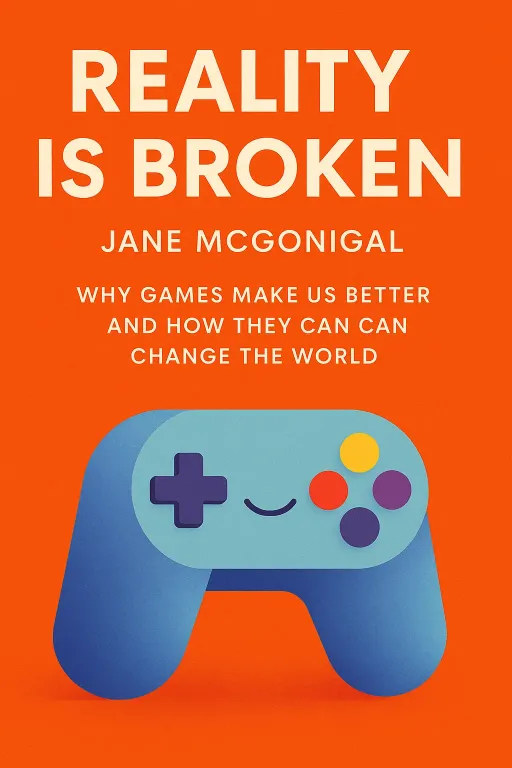
Nova: Absolutely, Atlas! And that's exactly what we're diving into today. Our insights spring from a powerful book, "Reality Is Broken: Why Games Make Us Better and How They Can Change the World" by Jane McGonigal. What's fascinating about McGonigal is she's not just an academic; she's a world-renowned game designer. She literally builds these immersive experiences. So, she brings this incredible practitioner's insight to the table, arguing that games aren't just escapism. They're meticulously engineered systems that tap into our most fundamental human needs.
Atlas: Okay, so how does a game designer's perspective on "broken reality" translate to, say, a struggling math curriculum or a complex corporate training module for an educator or an innovator? Because I imagine a lot of our listeners are thinking, "My learners aren't here to play."
Nova: Exactly! And that's where the magic begins. McGonigal argues that games fulfill deep human needs for satisfying work, success, social connection, and meaning. Think about it: in many educational programs, especially in complex fields, engagement and motivation are huge struggles. We're often missing those very elements that games provide in spades.
Deep Dive into Core Topic 1: Games as Fulfiller of Deep Human Needs
SECTION
Atlas: So you're saying the underlying of a game is what's important, not just the pixels or the controller?
Nova: Precisely. Let's take that need for "satisfying work" and "meaning." In the real world, our work can sometimes feel fragmented, the goals unclear, the feedback delayed. But a well-designed game? It's the opposite. Think about a complex, multi-stage quest in a role-playing game. You're given a grand objective – "Save the kingdom!" – but it's broken down into dozens of smaller, manageable tasks. Each task has a clear goal: "Find the ancient scroll," "Defeat the shadow beast." You get immediate feedback, often visual and auditory, celebrating your mini-successes.
Atlas: Right, like when you level up, or you get a cool new item. It's instantly gratifying.
Nova: Exactly. You invest hours, sometimes days, in what might seem like repetitive tasks – gathering resources, battling minor enemies – but it's all framed within this larger, meaningful narrative. You feel a sense of progress, of growing mastery, and crucially, your actions have a visible impact on the game world. You're not just reading about saving the kingdom; you're it, one meticulously designed step at a time. That's satisfying work.
Atlas: That's compelling in a fantasy world. But for educators trying to teach, say, advanced physics or intricate historical timelines, how do you inject "meaningful narrative" into equations or dates? Aren't we just talking about gamification, slapping points and badges on things? Because I imagine a lot of our listeners want to build compelling programs, not just superficial rewards.
Nova: That's a critical distinction, Atlas. It's not just about gamification, which can often be extrinsic. It's about that tap into these deep human needs. For physics, it's not about giving points for solving a problem. It's about framing the problem as a real-world engineering challenge: "You need to design a bridge that can withstand this specific force, using only these materials. Your goal is to optimize for cost and durability." The "quest" becomes the design process itself, with clear parameters, immediate simulation feedback on whether the bridge collapses, and the meaning comes from solving a tangible problem.
Atlas: Ah, I see. So it's about making the learning the satisfying work, rather than just a means to an end for a grade. It’s about creating a problem-solving scenario that feels like a mission.
Deep Dive into Core Topic 2: The Psychology of Flow and Game Design (Mihaly Csikszentmihalyi)
SECTION
Nova: And that quest-like structure, Atlas, brings us directly to our second powerful idea: the concept of 'flow,' eloquently described by Mihaly Csikszentmihalyi in his groundbreaking book, "Flow: The Psychology of Optimal Experience." This is where games truly shine.
Atlas: Flow. I've heard that term. Is that like when you're so absorbed in something you lose track of time?
Nova: Precisely. Csikszentmihalyi describes flow as that optimal state of consciousness where you are fully immersed and energized by an activity. It's characterized by clear goals, immediate feedback, intense concentration, a loss of self-consciousness, and a distorted sense of time. When you're in flow, you're performing at your peak, learning rapidly, and feeling deeply satisfied. And games are masters at creating this.
Atlas: I can definitely relate. I've definitely lost hours in games feeling like that. But how do you, as an educator, that balance of challenge and skill for a diverse group of learners? Some students are already masters, others are struggling with the basics. It sounds like an impossible tightrope walk, especially for someone focused on instructional design.
Nova: It's challenging, but it's achievable through careful design. Think about a well-designed puzzle game, like 'Portal' or even classic 'Tetris.' The game starts simple, teaching you the basic mechanics. But as you progress, the challenges increase incrementally, always pushing you just beyond your current skill level. You fail, you get immediate feedback, you adjust your strategy, and you try again. The game doesn't punish failure; it uses it as a learning opportunity.
Atlas: So the game is constantly adapting to your skill level, giving you just enough challenge to keep you engaged, but not so much that you get frustrated and quit.
Nova: Exactly! It creates this beautiful, self-reinforcing learning loop. You're constantly getting better, and the game responds by offering slightly harder problems, keeping you in that sweet spot of flow. This is what Nova's Take, referring to our podcast's core philosophy, highlights: by integrating game mechanics and principles, you can transform passive learning into an intrinsically motivating and highly effective experience. It’s about designing the to adapt to the learner, not just giving them a new textbook.
Atlas: That's a huge shift in instructional design. It moves from a static, one-size-fits-all curriculum to something much more dynamic and responsive. I imagine that would significantly reduce cognitive load for learners too, by keeping them appropriately challenged.
Synthesis & Takeaways
SECTION
Nova: It absolutely would. So, when you combine McGonigal's insights about games fulfilling our deepest human needs with Csikszentmihalyi's work on flow, you see that play isn't trivial; it's a fundamental mechanism for engagement and deep learning. Games aren't just fun; they're powerful models for optimal human experience and skill acquisition. They show us how to design environments where people are intrinsically motivated to engage, persist, and master complex challenges.
Atlas: So, for our listeners who are curriculum designers, educational innovators, or just practical strategists looking to improve engagement, it's not about making every lesson a video game. It's about identifying one challenging module in your program and asking: "How can I inject a 'quest' structure into this, giving learners clear goals, immediate feedback, and a sense of progress? How can I create that 'flow state' by balancing challenge and skill, making the learning itself the reward?"
Nova: Precisely. It's about embracing the mindset of a game designer in your educational innovation. It’s about recognizing that the human drive for play and challenge is a powerful, untapped tool for transforming learning environments. And the tiny step recommendation from the book content is perfect: pick one module, and brainstorm game-like element to increase engagement. Start small, experiment, and see the impact.
Atlas: That's actually really inspiring. But what might be the biggest hurdle for educators trying to adopt this 'play' mindset in systems often focused on rigid outcomes and standardized testing?
Nova: The biggest hurdle, I think, is the ingrained perception that 'play' is frivolous. We need to reframe it not as a distraction from serious learning, but as the most serious, most effective way to learn. It's about shifting from external pressure to intrinsic motivation, proving that deep engagement leads to profound outcomes.
Atlas: That makes sense. It’s a paradigm shift that could empower a lot of educators and learners.
Nova: This is Aibrary. Congratulations on your growth!









