The High Performance Flow State
Golden Hook & Introduction
SECTION
Nova: Your brain processes about eleven million bits of information every single second, but your conscious mind can only handle about forty. Most of us spend our workdays drowning in that massive gap, desperately trying to catch up with our own cognitive overload.
Atlas: Wow, that explains why my brain feels like a browser with fifty open tabs by nine in the morning. It is exhausting just thinking about it.
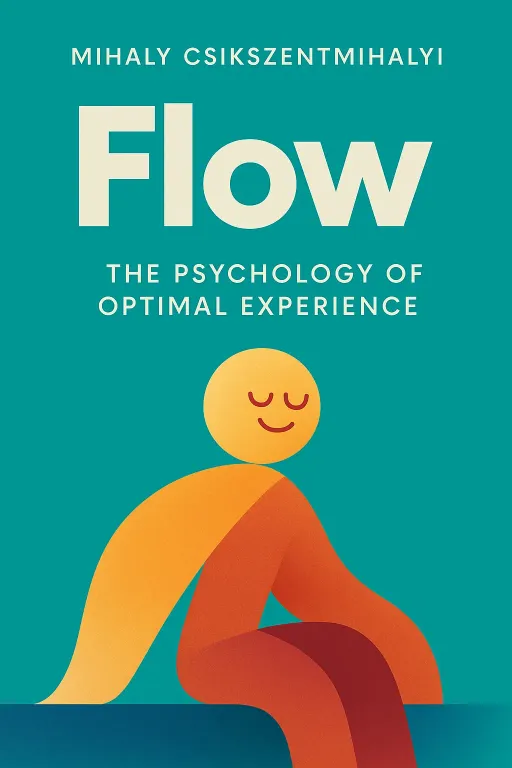
Nova: It really is, and that is exactly why we are diving into a combination of two powerhouse books that offer a blueprint to escape that mental chaos. Today, we are looking at Flow by Mihaly Csikszentmihalyi, a widely acclaimed masterpiece on optimal human experience, alongside The High 5 Habit by Mel Robbins, a highly rated and incredibly practical guide on self-validation.
Atlas: I have been looking forward to this discussion because on the surface, these two books seem like they come from completely different worlds. You have Csikszentmihalyi, this legendary academic psychologist researching deep cognitive states, and then you have Mel Robbins, who is famous for high-energy, relatable life hacks. How do a high-five in the mirror and a deep state of cognitive flow actually connect?
Nova: They connect at the most fundamental level of human performance, which is self-perception and attention. Csikszentmihalyi, who actually developed his theories after observing how people rebuilt their lives after the trauma of World War Two, wanted to understand what makes life truly worth living. He discovered that the most joyful, productive moments of our lives happen when we are completely absorbed in an activity. But here is the catch, you cannot get into that state of absorption if your brain is constantly attacking itself with doubt.
Atlas: That makes sense. If you are busy telling yourself that you are failing or that you are not prepared, you are wasting those precious forty bits of conscious attention on self-criticism.
Nova: Exactly. Mel Robbins developed her method during a period of intense personal and financial ruin. She found that a simple, physical gesture could bypass that mental spiral and prime the nervous system for action. By combining her physical validation hack with Csikszentmihalyi's cognitive design, we can essentially build a reliable pipeline to high performance.
The Science of Flow and the Challenge-Skill Sweet Spot
SECTION
Nova: Let us start with the core of Csikszentmihalyi's work. He defined flow as a state where you are so involved in an activity that nothing else seems to matter. The ego falls away, time flies, and every action, movement, and thought follows inevitably from the previous one, like playing jazz.
Atlas: That sounds amazing, but for our listeners who are managing high-pressure projects or leading teams, it can feel like a luxury they cannot afford. How does someone actually trigger this state on purpose?
Nova: The key lies in a very specific relationship between two variables, the challenge level of the task and your current skill level. If the challenge is too high for your skills, you experience anxiety. If the challenge is too low, you slide into boredom. The flow state exists in a narrow channel where the challenge is just slightly above your current skill level, forcing you to stretch without breaking.
Atlas: Oh, I see. It is like playing tennis against someone who is just a little bit better than you. You have to focus entirely on the ball, you cannot look away, but you also do not feel completely hopeless.
Nova: That is a perfect analogy. When you are in that sweet spot, your brain undergoes a process called transient hypofrontality. The prefrontal cortex, which is the part of your brain responsible for your inner critic, your sense of time, and your self-consciousness, temporarily quietens down. That is why people in flow report that their worries seem to vanish.
Atlas: That sounds like a superpower. But what about the person who is stuck doing repetitive administrative work, or someone who is constantly putting out fires and dealing with unpredictable interruptions? How do they design a task for flow when they do not have total control over their workload?
Nova: The secret is that flow is not about the task itself, but how we structure the task. Csikszentmihalyi studied assembly line workers who managed to find flow by turning their repetitive tasks into a game, trying to beat their own efficiency records by fractions of a second. You can take a routine professional task, like writing a report or analyzing a dataset, and artificially increase the challenge. You can set a tight but realistic time limit, or challenge yourself to write it with absolute clarity and no unnecessary words.
Atlas: That is a fascinating way to look at it. We can actively design the challenge to meet our skills, rather than waiting for the perfect project to land on our desk.
Nova: Exactly. It is about taking agency over your attention. When you actively set clear goals, seek immediate feedback, and balance the challenge with your skills, you are setting up the exact conditions required for flow to emerge.
The Neurological Spark of Self-Validation
SECTION
Nova: But here is the obstacle most of us face before we even get to the challenge-skill matrix. We wake up, look in the mirror, and immediately start listing our flaws, our mistakes, and everything we are dreading that day. We start the day in a state of cognitive defense.
Atlas: Oh, I know that feeling all too well. It is like starting a race with your shoelaces tied together. You are already exhausted before you even take the first step.
Nova: Yes, and that is where Mel Robbins' research on physical self-validation becomes a game-changer. In her work, she highlights how we have been conditioned since childhood to view a high-five as a gesture of support, belief, and celebration. We do it for teammates when they miss a shot, and we do it to celebrate a victory.
Atlas: That sounds a bit out there, though. High-fiving myself in the mirror? It feels a little silly, maybe even a bit embarrassing. Does a physical gesture like that actually change anything in our biology?
Nova: It actually triggers an immediate neurological response. When you high-five your reflection, your brain recognizes the physical shape of that gesture. It bypasses your conscious self-criticism because the brain already associates that movement with positive reinforcement. It instantly releases a small dose of dopamine and activates your Reticular Activating System, which is the filter your brain uses to decide what information is important.
Atlas: So basically, we are hacking our own neural pathways. We are using a physical shortcut to tell our brain that we are on our own team, before our conscious mind can start listing all the reasons we might fail today.
Nova: Precisely. You are rewriting the morning script. Instead of pointing out your wrinkles or remembering an awkward email you sent yesterday, you are physically validating yourself. This simple act silences the default mode network in your brain, which is the network responsible for rumination and self-doubt.
Atlas: That is incredibly interesting because it means we do not have to wait until we feel confident to act confidently. We can use our body to change our mind.
Nova: That is the core of the biological connection. Your mind follows your physical state. By priming your nervous system with that high-five, you lower your baseline anxiety. When your anxiety is lower, your brain has more cognitive bandwidth available. That extra bandwidth is exactly what you need to step into the challenge-skill channel and find your flow state.
Designing Your High-Performance Day
SECTION
Atlas: Okay, let us put these two ideas together into a concrete plan. How does a strategist or a professional translate this into a daily routine that actually works?
Nova: It starts with a two-step morning formula. Step one is the brain prime. Tomorrow morning, right after you brush your teeth, look yourself in the eye and high-five your reflection in the mirror. Do not overthink it, just let the physical gesture do the work of silencing your internal critic.
Atlas: I will admit, it is going to feel weird the first time, but I can see how it acts as a pattern interrupt. What is step two?
Nova: Step two is designing your high-leverage task for the day. Before you open your email or look at your notifications, identify one professional task that sits right in that sweet spot where challenge meets your skill level. This should be a task that requires your deep focus, something that pushes your abilities just enough to demand your full attention.
Atlas: That sounds like a great way to protect our energy. But in the real world, we are constantly bombarded with urgent emails and messages. How do we protect that flow block from being hijacked by other people's priorities?
Nova: You have to treat that block of time as an absolute commitment. Schedule fifteen minutes to half an hour of uninterrupted time. Close your communication apps, put your phone in another room, and let your brain fully commit to the challenge. Remember, consistency is far more powerful than duration. A focused fifteen minutes in a flow state will yield better results than two hours of distracted multitasking.
Atlas: I love that approach because it makes the process feel manageable. We do not need to rewrite our entire lives overnight. We just need to build momentum with small, intentional steps.
Nova: Exactly. Small steps build great momentum. When you successfully complete that designed task, you receive a natural hit of dopamine. That success reinforces your self-belief, making the next day's high-five even more authentic, which in turn makes entering flow even easier. It becomes a positive feedback loop of high performance.
Synthesis & Takeaways
SECTION
Atlas: We have covered some deep ground today. We started with the academic science of optimal experience and connected it to a practical physical habit that alters our brain chemistry.
Nova: We really did. The central insight here is that high performance is not about pushing ourselves to the point of exhaustion. It is about aligning our biology and our focus. By silencing our inner critic through physical self-validation, we free up the cognitive resources we need to engage deeply with our work.
Atlas: It is a complete reframing of how we approach our daily lives. Instead of viewing productivity as a battle against ourselves, we can view it as a collaborative process where we design our environment and our habits to support our minds.
Nova: That is the deeper meaning of these works. In an age where our attention is constantly fragmented by technology and external demands, reclaiming our focus is the ultimate act of agency. When you match your skills with the right challenges, you are not just getting things done, you are experiencing the very best of what your mind can do.
Atlas: For everyone listening, your challenge tomorrow is simple. High-five your reflection in the morning, design your high-leverage task, and protect that time to find your flow.
Nova: This is Aibrary. Congratulations on your growth!