The Creative Flow State: Harnessing Your Deepest Focus
Golden Hook & Introduction
SECTION
Nova: Atlas, before we dive in, quick question: what’s the first thing that comes to mind when I say “flow state”?
Atlas: Oh, easy. It’s that magical moment when I finally get my kids to bed and the house is quiet... for precisely seven minutes.
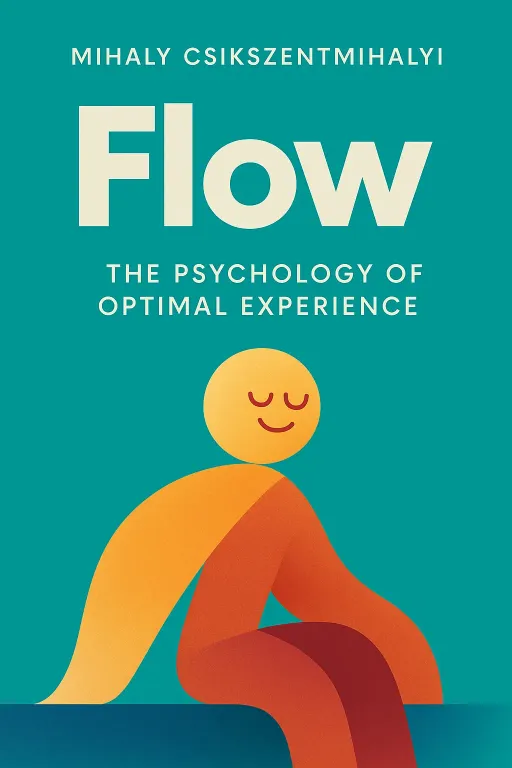
Nova: A relatable, albeit brief, moment of peace! But today, we’re actually exploring the flow state, as defined by Mihaly Csikszentmihalyi in his seminal work,. Csikszentmihalyi, a Hungarian-American psychologist, dedicated his career to studying happiness and creativity, coining the term 'flow' after observing artists who became so engrossed in their work they'd forget hunger or fatigue. The book itself became a global phenomenon, widely acclaimed for bringing scientific rigor to a deeply personal experience.
Atlas: That’s a fascinating origin story for a concept that feels so… elusive. So we’re talking about more than just peace and quiet, then?
Nova: Absolutely. We’re talking about where your best work happens, where time warps, and joy is intrinsic to the activity itself. And then, we’ll move into how to consistently there, drawing on Cal Newport’s.
Atlas: I can see how those two ideas connect perfectly. Let’s dive in.
Understanding the Flow State: What it is and Why it Matters
SECTION
Nova: So, Csikszentmihalyi defines flow as optimal experience. It’s when a person is fully immersed in an activity, feeling a sense of energized focus, full involvement, and enjoyment in the process. Think of a surgeon performing a complex operation, a musician nailing a tricky solo, or a writer completely lost in their story.
Atlas: Oh, I love that image. It’s like the universe just… disappears, and it’s just you and the task. But can anyone achieve this? Or is it just for these highly skilled, high-stakes professions? Because I imagine a lot of our listeners, especially those who are creative crafters, might feel like that level of absorption is reserved for professional artists.
Nova: That’s such a great question, and it’s a common misconception. Csikszentmihalyi’s research shows that flow isn't exclusive to artists or athletes. He studied people from all walks of life – factory workers, chess players, even people just doing household chores. The key isn’t the activity itself, but the under which it’s performed.
Atlas: Okay, so if it’s not just for the elite, what are those conditions? Give me the recipe. What needs to be in place for someone to experience this “optimal experience”?
Nova: The recipe has a few critical ingredients. First, there needs to be a clear set of goals. You know exactly what you’re trying to achieve. Second, immediate feedback. You can tell right away if you’re doing well or if you need to adjust. And perhaps most importantly, a balance between the challenge of the task and your own skill level.
Atlas: Wait, hold on. So if a task is too easy, I get bored. Too hard, I get anxious. It’s that sweet spot where my abilities are stretched but not broken? That makes sense. It’s like when I’m trying to learn a new photography technique. If it’s too simple, I zone out. If it’s too complex, I get frustrated and quit.
Nova: Exactly! That’s the classic flow channel. Csikszentmihalyi documented countless examples, but one particularly vivid one involved a rock climber. This climber wasn’t just physically strong; they described a mental state where every movement was precise, every handhold felt instinctively right. The sheer concentration required to navigate the rock face eliminated all other thoughts – worries about work, future plans, past regrets – they were completely present. The challenge was immense, but their skills were honed, and the immediate feedback was whether their foot slipped or held.
Atlas: Wow. That gives me chills. That’s such a hopeful way to look at it, because it means we don’t have to be born with some special gift. We can actually our work to hit that sweet spot. That’s a profound insight. But what’s the payoff? Why should we even care about this "flow state" beyond just just feeling good in the moment?
Nova: The payoff is immense. Flow isn’t just about enjoyment; it’s intrinsically linked to personal growth and creativity. When you’re in flow, you’re pushing your boundaries, learning, and developing new skills. It’s the ultimate form of self-actualization, where you feel truly alive and engaged. It’s where your best and most original ideas often emerge, because your mind is operating at its peak, unburdened by distraction. It fuels that joy a creative crafter feels when they are truly immersed in their work.
Atlas: So it’s not just about getting things done, it’s about personal fulfillment and intellectual exploration at its highest level. That makes total sense.
Cultivating Deep Work for Consistent Flow
SECTION
Nova: And that naturally leads us to the second key idea we need to talk about: how do we actually into this flow state more consistently, especially in our modern, hyper-distracted world? This is where Cal Newport's becomes indispensable.
Atlas: Ah, the "distracted world" part resonates deeply with me. It feels like every app, every notification, every email is designed to pull us of that flow channel. So, Newport's argument is basically: turn off your phone?
Nova: That’s certainly part of it, but it’s much more strategic than just a digital detox. Newport argues that deep work—which he defines as professional activities performed in a state of distraction-free concentration that push your cognitive capabilities to their limit—is the skill that allows you to quickly master complicated information and produce better results in less time. It’s the engine that drives flow.
Atlas: Okay, so deep work is the vehicle, and flow is the destination. I can see that. But how do you deep work? For someone who's constantly juggling projects, or trying to carve out creative time, it sounds almost impossible. I imagine a lot of our listeners are thinking, "I barely have time to breathe, let alone enter a monastic work state!"
Nova: It’s a challenge, but Newport offers concrete strategies. One of the most powerful is what he calls the "monastic approach," which isn't about joining a monastery, but about scheduling long, uninterrupted blocks of time for deep work. He cites examples like Carl Jung, who had a stone tower retreat where he would go to write, completely cut off from the world. Or Bill Gates, famous for his "Think Weeks," where he'd isolate himself with books and papers to grapple with big ideas.
Atlas: That sounds amazing, but also incredibly privileged. For most of us, completely isolating ourselves for a week just isn't realistic. Isn’t that just for people with unlimited resources? Is there a version for the rest of us? For the "creative crafter" who maybe only has an hour here or there?
Nova: Absolutely. Newport understands that not everyone can adopt a monastic schedule. He also advocates for the "bimodal approach," where you dedicate specific, long periods—say, a day or two a week—to deep work, while the rest of your week is more shallow, allowing for meetings and emails. And then there's the "rhythmic approach," which is about creating a consistent, daily ritual. Think of it like a workout schedule for your brain: 60-90 minutes at the same time every day, dedicated solely to your most cognitively demanding tasks.
Atlas: I see. So it’s about intentionality, not necessarily isolation. It’s about creating boundaries, even small ones, around your creative time. Because honestly, the biggest enemy of flow for me isn’t necessarily noise, it’s the constant nagging feeling that I be checking my email or social media. It’s that internal pull to be “accessible.”
Nova: Exactly. Newport talks about the importance of creating rituals around deep work. It could be starting with a specific drink, going to a particular location, or having a set routine to signal to your brain, "Okay, now it's time to focus." The goal is to minimize decision fatigue and create a clear path into that focused state where flow can emerge. It's about building "flow triggers" into your day. It empowers you to cultivate that deep focus, rather than waiting for it to strike.
Synthesis & Takeaways
SECTION
Nova: So, when you put Csikszentmihalyi and Newport together, you get this incredibly powerful synergy. Flow tells us what that optimal state feels like and why it’s so profound for our creativity and well-being. Deep Work gives us the practical, disciplined roadmap to actually get there, consistently.
Atlas: That’s a great way to put it. It’s like one gives us the vision, and the other gives us the vehicle. For anyone who feels like their creative energy is constantly being fragmented, or who struggles to dedicate consistent time to their passions, this is more than just productivity advice. It’s about reclaiming control over your most valuable resource: your attention.
Nova: Precisely. It’s about transforming sporadic moments of inspiration into a sustainable, joyful practice. And the beautiful thing is, you don’t need grand gestures. It can start small.
Atlas: So what’s one concrete thing our listeners can do this week? Something that embraces both the understanding of flow and the practice of deep work. I know our listeners are always looking for practical guides and actionable steps.
Nova: My recommendation is this: set aside just 30 minutes this week. A completely distraction-free block of time. Turn off notifications, close unnecessary tabs, put your phone in another room. Immerse yourself fully in a creative project, even if it’s just brainstorming, sketching, or writing a few sentences. Just 30 minutes to experience that dedicated focus, and see what emerges.
Atlas: I love that. Start small, but start with intention. It's about embracing the journey of creation and trusting that innate curiosity to lead you to those incredible flow states. And that’s a journey I think everyone can benefit from.
Nova: Absolutely. It’s about finding the joy in the process itself.
Atlas: This is Aibrary. Congratulations on your growth!