

Beyond the 'Why': How Understanding Your Brain Unlocks Deeper Motivation
Golden Hook & Introduction
SECTION
Nova: Imagine you're trying to inspire your team, your kids, or even yourself, to do truly great work. Your first instinct might be to offer a bonus, a prize, or even a stern warning. What if that very instinct is completely counterproductive?
Atlas: Whoa. Counterproductive? That sounds like heresy to anyone who's ever used a sticker chart for their kids or a commission structure for their sales team. Are you saying all those years of motivational speeches were a waste?
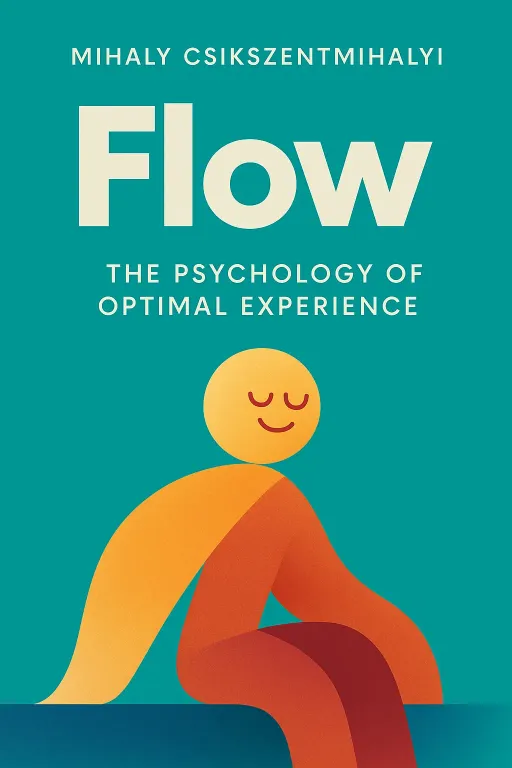
Nova: Well, it’s certainly more nuanced than we’ve been led to believe. Today, we're tearing down some of those old ideas by diving into two groundbreaking works: Daniel Pink's, and by Mihaly Csikszentmihalyi. Pink, who actually started his career as a political speechwriter, made a radical pivot to reveal the hidden truths about what truly moves us.
Atlas: That's a fascinating background for someone writing about motivation. It means he’s seen how people are swayed by words and ideas, not just money. So, what’s the big secret he uncovered? What's the truth beyond the carrot and stick?
Nova: Exactly. He argues that for creative, knowledge-based work, external rewards often true innovation and sustained engagement. It’s a blind spot in how many organizations and even individuals approach work.
Atlas: I've definitely felt that. Like when a hobby starts to feel like a chore once there’s an expectation or a deadline attached. So, if it's not external rewards, what is it that truly fuels us?
The Intrinsic Motivation Revolution: Autonomy, Mastery, Purpose
SECTION
Nova: Pink distills it down to three innate psychological needs: autonomy, mastery, and purpose. Think of them as the operating system for our internal drive. Autonomy is our desire to direct our own lives. Mastery is our urge to get better and better at something that matters. And purpose is the yearning to do what we do in service of something larger than ourselves.
Atlas: Okay, so autonomy, mastery, purpose. That sounds… almost idealistic. How does that actually work in the real world, especially for our listeners who are aspiring innovators, often in high-pressure environments where deadlines and deliverables are king? How do you give people 'autonomy' when there’s a clear chain of command?
Nova: That's a brilliant question, and it's where the nuance comes in. It’s not about anarchy. Take the example of Atlassian, the software company behind Jira and Confluence. They created a program called "FedEx Days." Once a quarter, engineers were told to work on for 24 hours, as long as it wasn't part of their regular job. The only rule? They had to present their results to the rest of the company the next day.
Atlas: So, complete freedom for a day? What did they come up with? I imagine a lot of naps or video games.
Nova: Far from it! These 24-hour sprints, infused with autonomy, led to a stunning amount of innovation. Many critical fixes and new features, some of which became successful products, were born during these FedEx Days. The engineers weren't paid extra; they were driven by the sheer autonomy to choose their project, the mastery of tackling a new challenge, and the purpose of contributing something meaningful to the company.
Atlas: That’s fascinating. It’s like, when you remove the external pressure, the creativity actually. It gives people a sense of ownership over their work. I can see how that would resonate with someone trying to build a clearer sense of direction in their own career. But what about mastery? How do you foster that when you’re constantly having to learn new things, or when the goalposts keep moving?
Nova: Mastery is a deeply personal journey, a desire to continually improve. Think of a musician practicing scales for hours, or a chess grandmaster studying endlessly. They aren't doing it for a gold star; they're driven by the intrinsic satisfaction of getting better. In a professional context, it means creating opportunities for continuous learning, providing feedback that focuses on growth, and allowing for deep work that pushes skills to their limits.
Atlas: I still struggle with the idea that money isn't a primary motivator. I mean, we all need to pay the bills. Isn't there still a place for financial incentives? We can't just expect people to work purely for the love of it, right?
Nova: Absolutely, Atlas. Money is a threshold motivator. If you're not paid enough to take money off the table as a concern – to cover your basic needs and feel fairly compensated – then it be a primary motivator. Pink is clear about this. But once that threshold is met, once people feel they’re paid fairly, then the impact of additional financial incentives diminishes rapidly for complex, creative tasks. In fact, for those types of tasks, studies often show that higher monetary incentives can lead to performance. It's a surprising finding that challenges a lot of deeply held corporate beliefs.
Achieving Flow State: The Peak of Intrinsic Drive
SECTION
Nova: And it’s this quest for mastery and purpose that often leads us to the second profound insight we're discussing today: Mihaly Csikszentmihalyi’s concept of 'flow.' He spent decades studying what makes people truly happy and engaged, and he found this state of optimal experience.
Atlas: Flow state. I’ve heard that term. Is it just another word for being "in the zone"? What does it actually like? How can we tell if we’re in it, or if we’re just really focused? My listeners, the resilient seekers, are always looking for ways to optimize their mental states.
Nova: It’s far more than just focus, Atlas. When you're in flow, you're so completely immersed in an activity that nothing else seems to matter. Time seems to disappear. You lose self-consciousness, and there's an effortless concentration. It’s a state where your skills are perfectly matched to the challenge at hand, and you get immediate feedback on your progress.
Atlas: That sounds incredible. Almost like a superpower. Can you give me an example that really paints a picture of what that feels like?
Nova: Imagine a surgeon performing a delicate operation, completely absorbed, every movement precise, every decision instantaneous. Or a rock climber scaling a difficult face, each handhold, each foot placement a part of a fluid, intense dance with the rock. Or even a writer so engrossed in their story that they forget to eat. There’s a clarity of goals, an absence of worry, and a sense of effortless control. Csikszentmihalyi's extensive research, often involving beeper studies where participants reported their feelings throughout the day, revealed that these moments of profound intrinsic satisfaction were not found during passive leisure, but during challenging, goal-oriented activities.
Atlas: So it’s not passive relaxation; it’s active engagement. That makes perfect sense for anyone who's ever felt truly alive when solving a complex problem or mastering a new skill. But how do you that state? It sounds like something that just happens by chance.
Nova: You can absolutely cultivate it. The key is finding that sweet spot between boredom and anxiety. If a task is too easy, you get bored. If it's too hard, you get anxious. Flow occurs when the challenge is just slightly beyond your current skill level, pushing you to grow, but not overwhelming you. Clear goals, immediate feedback, and minimizing distractions are critical. It's about designing your environment and your tasks to invite flow.
Atlas: But what about the flip side? Can you get lost in flow? I can imagine someone so absorbed in their work they forget to eat, forget their family, or neglect other important parts of their life. Is there a potential downside to this hyper-focused state for someone who's an empathetic explorer, trying to balance their inner world with their outer responsibilities?
Nova: That’s a very perceptive question. While flow is overwhelmingly positive, like any powerful state, it needs to be managed. It's about creating balance. The goal isn't to live in flow 24/7, which would be unsustainable and potentially lead to neglecting other duties. The goal is to understand how to flow when you need to perform at your best, and to recognize the conditions that foster it, so you can intentionally integrate those into your life and work. It's about peak experiences, not constant oblivion.
Synthesis & Takeaways
SECTION
Nova: So, when you bring Pink’s autonomy, mastery, and purpose together with Csikszentmihalyi’s flow, you get this incredibly powerful framework. It shows us that true, sustainable motivation isn't about external prodding; it’s about creating environments – both external and internal – that nourish our innate human desires to learn, grow, and contribute meaningfully.
Atlas: That’s a game-changer. It’s about building a life and work that are intrinsically rewarding, rather than constantly chasing the next external reward. It really makes me reflect on those moments when I’ve felt most alive, most engaged. They almost always line up with having some control, feeling like I’m actually good at what I’m doing, and believing it serves a larger point.
Nova: Exactly. It's the difference between a fleeting high and deep, sustained satisfaction. When we understand our brain's true motivational architecture, we can move beyond the 'why' of short-term rewards and unlock a deeper, more resilient motivation that powers our best work and our most fulfilling lives.
Atlas: And that's something every aspiring innovator, resilient seeker, and empathetic explorer can truly benefit from. So, for our listeners, reflect on a time you felt deeply motivated and absorbed in an activity. Which elements of autonomy, mastery, or purpose were present? How did that contribute to a sense of flow?
Nova: That’s a perfect question to ponder. Because once you identify those elements, you can start to intentionally weave them into more aspects of your life. It's about designing for deep motivation, not just hoping for it.
Atlas: What an incredible journey into the science of motivation today.
Nova: It truly was. Thank you for joining us.
Atlas: This is Aibrary. Congratulations on your growth!









