

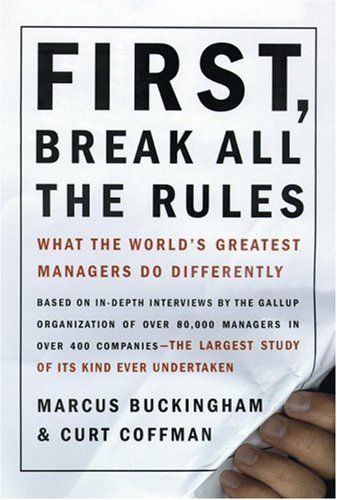
First, break all the rules
What the World's Greatest Managers Do Differently
Introduction
Nova: What if I told you that almost everything you've been taught about managing people is wrong? That the best managers in the world don't try to fix their employees' weaknesses, don't treat everyone the same, and don't believe people have unlimited potential? This is the central, electrifying argument of a book that spent 93 weeks on the New York Times bestseller list and was named by Time magazine as one of the 25 most influential business management books of all time.
Nova: First, Break All the Rules by Marcus Buckingham and Curt Coffman, published in 1999. And here's what makes it different from every other management book out there — it's not based on one person's opinion or a handful of CEO interviews. It's built on Gallup's massive research project spanning 25 years, involving over a million employees and 80,000 managers across dozens of industries.
Nova: Exactly. And what they found was so counterintuitive that the title became the thesis. The world's greatest managers don't just bend conventional wisdom — they shatter it. They break every rule you probably learned in your first management training session. And today, we're going to walk through exactly what they do differently, and why it works.
The Gallup Q12 and What Employees Really Need
The Mountain of Engagement
Nova: So before we get to what great managers do, we have to understand how Gallup figured out what a great workplace even looks like. They started with a deceptively simple question: what do employees really need from their workplace? And after interviewing over a million people, they identified 12 statements that separate the strongest workgroups from everyone else.
Nova: Alright, here they are. Number one: I know what is expected of me at work. Two: I have the materials and equipment I need to do my work right. Three: I have the opportunity to do what I do best every day. Four: In the last seven days, I've received recognition or praise. Five: My supervisor or someone at work seems to care about me as a person. Six: There is someone who encourages my development. Seven: My opinions seem to count. Eight: The mission of my organization makes me feel my job is important. Nine: My coworkers are committed to quality work. Ten: I have a best friend at work. Eleven: In the last six months, someone has talked to me about my progress. And twelve: This last year, I've had opportunities to learn and grow.
Nova: It absolutely is, and Gallup found it was one of the most powerful predictors of team performance. But here's what's really fascinating: these twelve questions aren't random. They form a hierarchy, like climbing a mountain. Questions one and two are base camp — clear expectations and the right tools. Without those, nothing else matters. Questions three through six address individual needs: using your strengths, getting recognition, feeling cared for. Then seven through ten cover interpersonal needs: your voice matters, the mission matters, your teammates are committed, you belong. And finally, eleven and twelve are the summit — growth and development.
Nova: Exactly. Gallup's research showed that you have to secure strong scores on the lower levels before people can reach the top. And here's the kicker: they validated these twelve questions across 2,500 business units in 24 companies and 12 different industries. Higher Q12 scores consistently correlated with higher productivity, higher profitability, better customer satisfaction, and lower turnover.
Nova: Precisely. And Gallup found something else crucial: people don't quit companies. They quit managers. You can have the best mission statement, the fanciest perks, the coolest office. But if an employee's direct manager isn't addressing these twelve needs, that employee is disengaged at best and gone at worst.
People Don't Change That Much
The Revolutionary Insight
Nova: So with the Q12 as their measuring stick, Buckingham and Coffman then asked: what do the managers who ace these twelve questions actually do? They conducted in-depth interviews with over 80,000 managers — from sales directors to school principals, sports coaches to clergy. And they kept hearing one revolutionary insight, over and over again.
Nova: Here's the direct quote: People don't change that much. Don't waste time trying to put in what was left out. Try to draw out what was left in. That is hard enough.
Nova: It really does. Think about how most organizations operate. The annual review points out your weaknesses. The development plan is designed to fix them. The assumption is that anyone can become anything if they just work hard enough. But Buckingham and Coffman argue that the world's greatest managers reject all of that. They don't see their job as transforming people. They see it as unleashing people — identifying the unique talents already present and positioning each person in a role where those talents become performance.
Nova: That's the elegant counterargument the book makes. The authors distinguish between skills, knowledge, and talent. Skills and knowledge can be taught. Talent — the recurring patterns of thought, feeling, and behavior — is basically hardwired. It's like asking someone to grow taller. You can teach a person new techniques, give them new information, but you can't fundamentally rewire what drives them, how they think, or who they naturally connect with.
Nova: That's a perfect way to put it. And they break talent into three categories. Striving talents — the why of a person: their drive, their motivation, their inner engine. Thinking talents — the how: how they make decisions, how they process information. And relating talents — the who: who they trust, who they confront, who they build relationships with. Great managers get exquisitely specific about matching these talent patterns to the demands of a role.
Select, Define, Focus, and Fit
The Four Keys
Nova: So this revolutionary insight leads to what Buckingham and Coffman call the Four Keys of great management. Every manager has four core responsibilities: select people, set expectations, motivate people, and develop people. Great managers just do all four completely differently than conventional wisdom dictates.
Nova: Key one: select for talent, not just experience or credentials. Conventional hiring looks at the resume. Great managers look deeper. They ask open-ended questions and pay attention to the direction candidates naturally take, because that reveals their talent patterns. Skills and knowledge are table stakes. Talent is the differentiator. As the authors put it, you can't teach someone to be empathetic or competitive or analytical in the way a role demands.
Nova: Define the right outcomes, not the right steps. Conventional management says: here's the process, follow it exactly. Great managers say: here's the destination, you figure out the best route. This is the antidote to micromanagement. When you hire for talent and define clear, measurable outcomes, you can trust people to find their own way. The authors cite research showing that when managers focus on controlling steps, they actually suppress the very creativity and ownership that drive exceptional performance.
Nova: Exactly. Focus on strengths, not weaknesses. This is the heart of the book. People who use their strengths every day are six times more likely to be engaged at work and three times more likely to report having an excellent quality of life. Great managers spend their energy amplifying what people already do brilliantly, rather than trying to drag up areas of weakness. And when a weakness is truly damaging, they design a support system around it — a complementary partner, a tool, a process — rather than trying to fix the person.
Nova: Find the right fit, not just the next promotion. This one challenges the entire career ladder model. The Peter Principle — that people rise to their level of incompetence — exists because organizations promote top performers into roles that require completely different talents. The star salesperson becomes a terrible sales manager, and you lose a star and gain a problem. Great managers create alternative paths. They find ways for people to grow in mastery, recognition, and reward without necessarily climbing the hierarchy. They treat career development like casting a play, not climbing a ladder.
The Most Counterintuitive Practices of Great Managers
Playing Favorites and Other Heresies
Nova: Here's where the book gets really provocative. Beyond the Four Keys, Buckingham and Coffman uncovered specific practices that sound almost heretical in a modern workplace. First one: great managers play favorites.
Nova: Not in the discriminatory sense. The point is that treating everyone the same is actually unfair. People are different — they have different talents, different drives, different needs. Treating them identically ignores those differences. The legendary NFL coach Don Shula told his team every season: I'm going to be very consistent with every one of you because I'll treat every one of you differently. The harder a guy works and the better he performs, the more leeway he gets.
Nova: Spend the most time with your best people, not your worst. Most managers spend the bulk of their time and energy trying to fix underperformers. But Gallup found that this actually sends a perverse signal: you get the manager's attention by being a problem. Meanwhile, your stars are quietly doing great work and getting ignored — which can actually cause them to disengage or leave.
Nova: Precisely. And there's a learning argument too. You learn more about excellence by studying what's working than by studying what's failing. The book gives an example of top data entry performers. Initially they were 50 percent better than average. After managers invested in them, they became nearly ten times better. The ceiling on your best people is far higher than you think.
Nova: Give feedback privately and regularly — not in an annual review. Buckingham and Coffman call the annual review a bomb. You save up all your criticisms and drop them on the employee at once. Great managers give continuous, real-time feedback. And they focus that feedback on strengths, asking questions like: what did you enjoy most this week? When did you feel most in the zone? How can we create more of those moments?
Nova: It is. And the final heresy: you cannot learn excellence by studying failure. This one is subtle but profound. Buckingham and Coffman argue that excellence and failure are not opposites — they're often surprisingly similar. Both great salespeople and poor ones feel personally invested when they pitch. The difference is that great ones aren't paralyzed by the fear of rejection. If you only study what went wrong, you miss these critical nuances. Great managers study their stars obsessively and try to bottle that magic.
Conclusion
Nova: Let's bring it all together. First, Break All the Rules makes a compelling, data-driven case that great management is not about transforming people — it's about seeing them clearly and positioning them brilliantly. The front-line manager, not the CEO or the perks package, is the single most important factor in whether employees are engaged, productive, and committed.
Nova: The four keys give us a practical framework. Hire for talent, not just the resume. Define the destination, not the route. Feed strengths, starve weaknesses. And help people find the fit where their unique talents become performance, whether that means going up, going deep, or going sideways.
Nova: That line from the book that keeps echoing: Don't waste time trying to put in what was left out. Try to draw out what was left in. That is hard enough. Whether you're a manager, a team leader, or someone managing your own career, ask yourself: am I spending my energy trying to fix what's missing, or am I building a life and a team around what's already brilliant? The research says the second path leads to extraordinary results. The first path just leads to exhaustion.
Nova: This is Aibrary. Congratulations on your growth!