

The Finisher's Gambit: How the Psychology of 'Done' Shapes History
Golden Hook & Introduction
SECTION
Nova: Why do so many grand plans—from massive political reforms to ambitious military campaigns—fizzle out and fail? We often blame a lack of resources, poor leadership, or external opposition. But what if the real enemy is something much quieter, something internal?
安卓橙子: That’s a powerful question. We love to study the external factors, the big, visible reasons for failure. But the internal, psychological dimension is often overlooked.
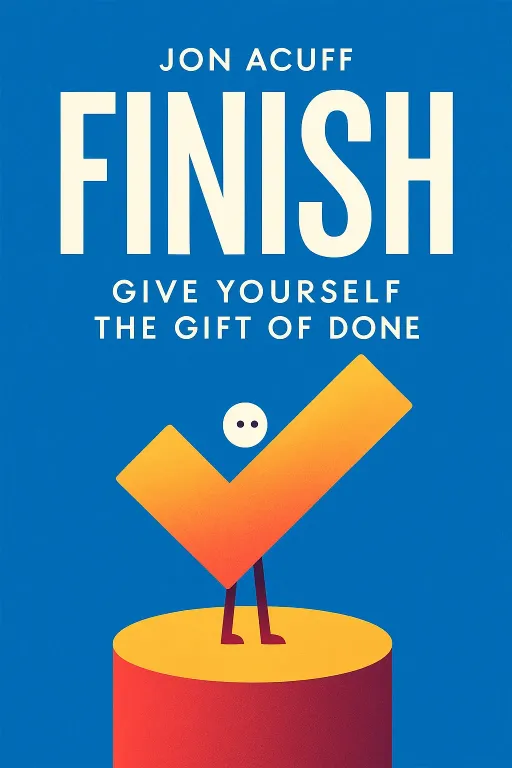
Nova: Exactly! And in his book 'Finish,' Jon Acuff argues the biggest killer of our goals isn't a lack of grit, but a hidden saboteur: perfectionism. It’s that little voice in our head that says, 'If it’s not perfect, it’s a failure.' Today, with my guest 安卓橙子, a curious and analytical thinker who loves exploring patterns in history and politics, we're going to explore how this psychological trap shapes not just our personal projects, but the course of history itself.
安卓橙子: I'm excited. It feels like we're taking a self-help concept and using it as an analytical tool for much larger systems.
Nova: That's the plan! We'll dive deep into this from two perspectives. First, we'll explore the 'Perfectionism Trap' and why grand designs so often fail from the inside out. Then, we'll discuss a powerful antidote: 'Strategic Incompetence,' and how choosing what to fail at is actually a key to victory.
Deep Dive into Core Topic 1: The Perfectionism Trap
SECTION
Nova: So let's start with that core idea, the 'Perfectionism Trap.' Acuff says the biggest problem most of us have isn't starting something new. Starting is exciting! The real problem is what he calls 'The Day After Perfect.' It's the day you mess up. The day the plan goes wrong.
安卓橙子: The first point of contact with reality, where the pristine plan gets messy.
Nova: Precisely. And for a perfectionist, that's often the end. He tells this hilarious personal story. He read a health book and decided to get serious about his diet. The plan involved eating a breakfast of eggs, spinach, and black beans. So, being an all-in kind of guy, he goes to Costco and buys a comically large case of black beans.
安卓橙子: Oh, I can see where this is going. The initial over-the-top commitment.
Nova: Exactly! He starts strong. For twelve straight days, he eats his black bean breakfast. He's a champion of health. He's perfect. But on day thirteen, life happens. Maybe he's traveling, maybe he's just too busy, but he misses his bean breakfast. And what does he do? Does he just eat the beans on day fourteen?
安卓橙子: Of course not. If the chain is broken, the whole endeavor is tainted. He quits.
Nova: He quits completely! The streak was broken, so the entire goal was dead. He said, "When it stopped being perfect, I stopped, too." That "might as well" feeling kicks in. 'Well, I've already ruined the diet today, I might as well eat a whole pizza.' It's a funny story, but that feeling is so universal, right? That collapse after one small failure. 安卓橙子, as you hear this, does this psychological trigger remind you of anything on a larger, historical scale?
安卓橙子: Absolutely. It's the fragility of a 'perfect' plan. I'm thinking of military strategies that rely on every single element going exactly as predicted. A classic example might be Germany's Schlieffen Plan for World War I. It was a masterpiece on paper—a huge, sweeping maneuver through Belgium to encircle and destroy the French army in a matter of weeks. It was timed down to the day.
Nova: It sounds like the military equivalent of buying a giant case of black beans.
安卓橙子: It is! But the plan was incredibly brittle. It had no room for error. When the Belgians resisted more than expected, when the troops got exhausted, when Russia mobilized faster than predicted—the plan started to deviate from 'perfect.' And instead of adapting flexibly, the commanders clung to the ghost of the original, perfect plan, and when it became clear it was impossible, a sense of doom set in. The entire grand strategy started to unravel, not just because it was strategically difficult, but because the 'purity' of the plan was broken. The commanders lost faith. It's not just a strategic failure; it's a psychological one.
Nova: That's a brilliant connection! So the 'Black Bean Diet' is just a micro-version of a failed invasion. Acuff backs this up with research. He talks about the 'planning fallacy,' a cognitive bias where we consistently underestimate how long things will take because our brains only imagine the perfect, uninterrupted path to completion. A study he cites asked college seniors to estimate how long their honors thesis would take. On average, they guessed 34 days. It actually took them 56. Even their worst-case scenarios were wildly optimistic.
安卓橙子: Because they weren't planning for the 'Day After Perfect.' They weren't planning for the flu, or a research dead-end, or a personal crisis.
Nova: Not at all. And so Acuff's solution is radical, and it sounds almost like heresy to a perfectionist. He says: cut your goal in half. Or, if you can't do that, double the time you give yourself. If you want to write a 50,000-word novel, aim for 25,000. If you want to lose 20 pounds, aim for 10. Because finishing a smaller goal gives you a surge of momentum and self-trust. You become a finisher.
安卓橙子: Which, in a political context, sounds like advocating for incrementalism over revolution. A smaller, achievable reform is far more likely to be 'finished' and build momentum than a massive, utopian overhaul that's bound to hit a snag and be declared a total failure by its opponents and even its disillusioned supporters. You get the win, and then you build on it.
Nova: You get the win! That's the key. You give yourself the gift of done.
Deep Dive into Core Topic 2: Strategic Incompetence
SECTION
Nova: Exactly! And that idea of making goals more achievable leads us perfectly to the second, even more provocative idea: to finish what's important, you have to choose what to bomb.
安卓橙子: Choose what to bomb. That sounds... aggressive. I like it.
Nova: It's about strategic neglect. Acuff argues that you simply cannot do everything. Perfectionism tells you that you can, and should, have a perfect career, a perfect family life, a perfect fitness routine, and a perfectly clean house. But that's a lie. To be great at one thing, you have to be willing to be bad at something else. He calls this 'strategic incompetence.'
安卓橙子: Deliberately being bad at something. That does feel counterintuitive.
Nova: It does! He tells a great story about Shonda Rhimes, the creator of blockbuster TV shows like 'Grey's Anatomy' and 'Scandal.' An interviewer asked her, with her insane schedule, what she lets slide. And she said, "Right now, I don’t feel guilty that I’m not working out. I’ll feel guilty about it at another time." She had strategically decided to 'bomb' her fitness goals to focus on running her television empire. She gave herself permission to fail in one area to succeed in another.
安卓橙子: That's a perfect illustration. It's the absolute core of strategy. Resources—be it time, money, or political capital—are always finite. A leader who tries to do everything perfectly is a leader who achieves nothing. Think of a president's first 100 days in office. They don't come in and try to pass 50 different laws addressing every single issue. They pick two or three signature issues and pour all their energy and political capital into them. They are, by definition, being strategically incompetent on dozens of other fronts to secure a few key victories.
Nova: They're choosing what to bomb. And the flip side of this, the thing that stops us, is what Acuff calls 'noble obstacles.' These are the virtuous-sounding excuses we create to avoid the real, hard work. He gives the example of a guy named Bill whose wife wants him to clean out their cluttered garage. It's a straightforward, if unpleasant, task. But Bill says, 'You know, before we clean it, we should have a garage sale to get rid of all this stuff!'
安卓橙子: Ah, adding a massive, complicated project on top of the original project.
Nova: Exactly! It sounds responsible, right? Fiscally prudent! But it's really just a noble obstacle. It makes the goal of a clean garage so much more complicated that it never, ever gets started. The garage sale becomes the permanent, noble reason for inaction.
安卓橙子: And that is the language of political delay. It's uncanny. 'We can't possibly address climate change we fix the economy.' Or 'We need to form another bipartisan committee to study the issue in-depth we can act.' It sounds so responsible, so thoughtful. But it's often a classic noble obstacle, a way to make the goal seem impossibly complex so you never have to start, and you can blame the complexity, not your own inaction.
Nova: You just described half of all political discourse! It's about identifying those false barriers and having the courage to say, 'No, the goal is just to clean the garage. The goal is just to pass the bill. We're not doing the other thing.'
安卓橙子: It requires a kind of ruthlessness with your own priorities. And a willingness to be criticized for the things you choose to neglect. That's the hard part for a public figure.
Synthesis & Takeaways
SECTION
Nova: It really is. So, when we pull all this back, Acuff's book gives us this powerful two-part framework for getting things done, whether it's a diet or a political agenda. First, recognize that our own perfectionism creates fragile, oversized goals that are designed to fail.
安卓橙子: And the antidote is to make the goal smaller, more resilient, and built to survive contact with reality.
Nova: And second, fight back against the myth that you can do everything. Master the art of strategic incompetence—ruthlessly prioritize and choose what to bomb. And learn to spot the 'noble obstacles' that you and others create to justify inaction.
安卓橙子: And what's fascinating is that this isn't just self-help. It's a lens for historical analysis. You can almost diagnose the success or failure of a project, a campaign, or a presidency by looking at whether they fell into the perfectionism trap or if they mastered strategic incompetence. Did they have a plan for the 'Day After Perfect'?
Nova: That's the perfect takeaway. So for everyone listening, especially those who love history and politics like 安卓橙子, here's a new question to ask next time you're reading or watching the news.
安卓橙子: When you're reading about any major endeavor, don't just ask they tried to do. Ask: What did they choose to do? And was their plan built to survive the day after perfect?
Nova: A brilliant question to end on. 安卓橙子, thank you so much for bringing this historical and political depth to these ideas.
安卓橙子: This was a lot of fun. It's given me a whole new framework to think with.









