

Shipping the Code: Overcoming Perfectionism in Tech and Life
Golden Hook & Introduction
SECTION
Dr. Warren Reed: Look at your local drive. How many half-finished side projects, abandoned repositories, and unlaunched ideas are sitting there gathering digital dust? It is not a lack of talent. It is perfectionism. Today, we break down why ninety-two percent of goals fail and how to fix it. Welcome to the show. I am Dr. Warren Reed, and with me is software engineer Jayasree.
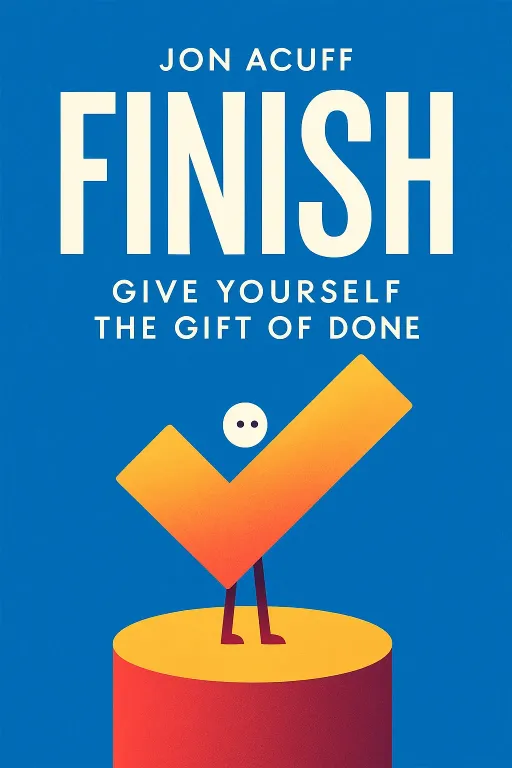
Jayasree: Thanks, Warren. It is great to be here. You know, that hook really hits home for me. In software, we talk a lot about shipping code, but in our personal lives, we often get stuck in endless development cycles. We start with massive enthusiasm, but we rarely hit production. Jon Acuff's book,, offers a really fascinating, analytical look at why this happens. It turns out, our biggest obstacle isn't starting. It is finishing.
Dr. Warren Reed: Correct. Starting is easy. Starting is fun. Finishing is where the real work begins. Acuff's research shows that perfectionism is the silent killer of progress. Today, we are going to tackle this from two distinct angles. First, we will look at the planning fallacy and why you must cut your goals in half. Second, we will discuss strategic incompetence, which means choosing what to bomb so you can win where it matters. Jayasree, let us start with the first big trap. The day after perfect.
Jayasree: Yes, the day after perfect is such a critical concept. Think about it. You set a goal. Maybe it is to write code for an hour every single day, or go to the gym every morning. You do great for a week. Then, on day eight, you miss a session. You sleep in, or you get tired. Perfectionism tells you that because your streak is broken, the entire project is ruined. Acuff calls this the "might as well" mentality. As in, I missed one day, so I might as well quit entirely.
Dr. Warren Reed: It is a binary trap. Zero or one. No middle ground. Acuff shares his own story about the Black Bean Diet. He decided to eat black beans for breakfast every day. He bought a massive quantity from Costco. He made it twelve days. On day thirteen, he missed a day due to travel. What did he do? He quit the entire diet. That is the perfectionism filter in action. If it is not flawless, we delete the whole program.
Jayasree: It is like an all-or-nothing error in code execution. If one test fails, the whole build crashes. But human progress isn't binary. We need to build fault tolerance into our personal operating systems. The day after perfect is actually the most important day of any goal. It is the day you decide to keep going despite a setback. It is the day you accept imperfection and keep moving forward anyway.
Deep Dive into Core Topic 1
SECTION
Dr. Warren Reed: Exactly. To survive the day after perfect, you must change how you set goals. Enter the planning fallacy. We are terrible at estimating time and effort. We overestimate our capacity and underestimate obstacles. Acuff's solution is simple. Cut your goal in half. Or, double your timeline.
Jayasree: That sounds so counterintuitive, doesn't it? As analytical thinkers, we are often trained to push for maximum efficiency and stretch goals. But when you look at the data, the results of cutting your goal in half are staggering. Acuff worked with a researcher from the University of Memphis, Mike Peasley, to study participants in a goal-setting course. They found that those who cut their goals in half increased their performance by an average of sixty-three percent. Sixty-three percent! Plus, ninety percent of them reported an increased desire to keep working on their goal.
Dr. Warren Reed: Numbers do not lie. Why does this work? Three reasons. One: it reduces pressure. Two: it builds early momentum. Three: it defeats the "all-or-nothing" expectation. When a goal is smaller, it feels achievable. You hit the target, you feel successful, and success breeds more success.
Jayasree: It is exactly like the concept of a Minimum Viable Product, or MVP, in software development. You don't try to build the entire, perfect platform on day one. You build the simplest version that works, ship it, get feedback, and iterate. If you try to build the ultimate, feature-rich version right out of the gate, you get bogged down in complexity and never launch.
Dr. Warren Reed: Yes. If you dream too big at the start, you curse your finish. Consider the story of the college seniors working on their honors theses. Researcher Roger Buehler asked them to estimate when they would finish under best-case and worst-case scenarios. On average, they guessed thirty-four days. It actually took them fifty-six days. Their worst-case estimates were still wildly optimistic. That is the planning fallacy in action. We ignore real-world friction.
Jayasree: We really do. We assume we will have perfect energy, zero distractions, and unlimited focus. But in reality, life happens. Servers crash, we get sick, or we just have a bad day. When we don't account for that friction, we set ourselves up for failure. By cutting the goal in half, we are essentially building a buffer into our sprint planning. We are giving ourselves room to navigate the unexpected without throwing in the towel.
Dr. Warren Reed: Let us look at another example from the book. A young man decided to train for a seventy-point-three mile Ironman triathlon with only eight months of training and very little athletic background. He created this massive, intense training schedule. But because the goal was so overwhelming, he couldn't stick to it. Not only did he miss the race, but the pressure actually caused him to stop going to his regular gym altogether. He lost his existing healthy habits because he set a goal that was too big.
Jayasree: That is a classic case of a wrong-sized goal destroying existing positive routines. It is like trying to refactor your entire codebase in one go, getting overwhelmed, and ending up with a system that doesn't compile at all. It is much better to make small, incremental updates that you can actually deploy.
Dr. Warren Reed: Agree. Keep it simple. Keep it manageable. Ship early, ship often.
Deep Dive into Core Topic 2
SECTION
Jayasree: This brings us to the second major concept in the book, which I find incredibly liberating. Choosing what to "bomb." Acuff argues that you cannot do it all. If you are adding a new goal to your life, you have to take something else off your plate. You have to decide, in advance, what you are going to neglect.
Dr. Warren Reed: Strategic incompetence. That is the term. You must proactively decide what to be bad at. If you do not choose, perfectionism will choose for you, and it will choose shame. Let us look at the math. Time is a finite resource. Twenty-four hours in a day. If you dedicate two hours to a new goal, those two hours must come from somewhere. You cannot just grind harder. You must bomb something else.
Jayasree: I love that term, strategic incompetence. It is about managing your cognitive bandwidth. In tech, we talk about technical debt. Sometimes, you intentionally write quick, imperfect code to meet a deadline, knowing you will clean it up later. Choosing what to bomb is like managing life debt. You decide that during this season, your lawn is going to look a bit messy, or you are going to eat simple, repetitive meals, or you are not going to keep up with the latest popular TV shows.
Dr. Warren Reed: Acuff uses the example of Shonda Rhimes, the incredibly successful television producer behind shows like Grey's Anatomy. In an interview, she was asked how she manages to do it all. Her answer was direct. She doesn't. When she is succeeding in one area, another area is sliding. She explicitly stated that she wasn't working out and didn't feel guilty about it because her focus was on running her shows. She chose to bomb fitness for a season to win at her career.
Jayasree: That is so powerful because it removes the shame. Shame is a massive blocker for analytical thinkers. We feel like we should be able to optimize every single variable in our lives. But optimization requires constraints. By consciously choosing what to neglect, we free up the mental RAM we need to focus on our primary objective. Acuff also talks about simplifying tasks you can't completely stop. Like Lisa Scheffler, a busy mom who couldn't stop making dinner or doing laundry, but she simplified them. She made basic meals and stopped folding clothes immediately. It wasn't perfect, but it worked.
Dr. Warren Reed: Yes. If you cannot stop, simplify. Do not apologize. Do not justify. Just say no to the non-essentials. This also applies to what Acuff calls "noble obstacles." These are virtuous-sounding reasons we create to avoid working on our goals. They make the goal seem harder than it needs to be.
Jayasree: Oh, noble obstacles are a huge trap for analytical minds. We love to research and prepare. We tell ourselves, "I can't start writing this application until I have mastered this new framework, set up the perfect development environment, and read three books on software architecture." It sounds responsible, but it is actually just perfectionism in a Halloween costume. It is a hiding place.
Dr. Warren Reed: It is procrastination disguised as preparation. Acuff shares his story of the fantasy basketball newsletter. He wanted to write a book, but that felt daunting and risky. So, instead, he spent hours every week writing a highly detailed, humorous newsletter for an audience of exactly eight people. It felt productive. He was writing, after all. But it was a hiding place to avoid the real, scary goal of writing his book.
Jayasree: I have definitely been there. It is so easy to spend days tweaking your IDE theme or organizing your digital files instead of actually writing the code that matters. It feels like work, but it is low-risk. It protects us from the fear of putting our real work out there and having it judged as imperfect.
Dr. Warren Reed: We must also talk about secret rules. These are subconscious, limiting beliefs that sabotage our progress. Rules like, "For something to count, it has to be difficult," or "If I seek help, it means I am not smart enough."
Jayasree: Those secret rules are like legacy code running in the background of our minds. We don't even realize they are there, but they are constantly affecting our behavior. Acuff tells the story of Rob O'Neill, a high-powered executive who traveled constantly. He used to carry this heavy, uncomfortable leather bag because he believed that suitcases with wheels were "cheating" or looked unprofessional. He had this secret rule that travel had to be difficult to count. One day, he saw a sharply dressed woman effortlessly rolling a wheeled suitcase, and he realized how absurd his rule was. He bought a wheeled bag, and his travel became infinitely easier.
Dr. Warren Reed: Absurd. But we all do it. We create arbitrary rules that make our lives harder. To destroy a secret rule, you must bring it into the light. Ask two questions. One: what does this rule actually mean? Two: who says? Challenge the validity of these assumptions. Replace them with realistic, healthy rules.
Jayasree: It is like refactoring old, inefficient code. You identify the bottleneck, delete the obsolete logic, and replace it with a clean, modern function. For example, replacing the rule "I have to do this all on my own" with "Leveraging existing tools and seeking mentorship is the smartest way to achieve my goal." That is how you stack the odds in your favor.
Synthesis & Takeaways
SECTION
Dr. Warren Reed: Let us bring this home. We have covered a lot of ground. The core message of is simple. Perfectionism is the enemy of done. To defeat it, you must: One: cut your goals in half to beat the planning fallacy. Two: embrace the day after perfect and keep moving. Three: strategically choose what to bomb. Four: identify and destroy your secret rules. Jayasree, what is your main takeaway from this?
Jayasree: For me, it is the shift from a binary mindset to an iterative one. In tech, we know that software is never truly finished; it is just shipped. We need to apply that same grace to our personal goals. It is better to ship an imperfect, half-sized project than to keep a perfect, full-sized project locked away in our minds forever. The future really does belong to finishers, not just starters.
Dr. Warren Reed: Well said. Do not let perfectionism keep you on the couch. Choose your goal. Cut it in half. Decide what to bomb. And go finish. Thank you, Jayasree, and thank you to our listeners. Get out there and get it done.
Jayasree: Thanks, Warren. Happy shipping, everyone.









