

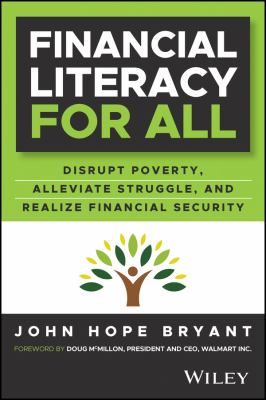
Financial Literacy for All
Disrupting Struggle, Advancing Financial Freedom, and Building a New American Middle Class
Introduction
Nova: What if I told you that a 15-minute drive across town could mean a 20-year difference in how long you live? That's not a metaphor. According to John Hope Bryant, in neighborhoods where the average credit score is 580, life expectancy hovers around 61 years. Drive 15 minutes to a 700 credit score neighborhood, and suddenly people are living to 81. That's the central, startling premise of his book Financial Literacy for All.
Atlas: Wait, hold on. Credit scores and life expectancy? That's a direct connection?
Nova: It is, and it's one of the most striking data points in the entire book. Bryant isn't just talking about balancing a checkbook. He's arguing that financial literacy is literally a matter of life and death, community stability, and access to the American Dream.
Atlas: I have to admit, when I hear "financial literacy book," I think of some dry manual about budgeting spreadsheets. But this sounds different.
Nova: That's exactly what makes Bryant's approach so compelling. He's the founder of Operation HOPE, the largest nonprofit financial literacy provider in the country. He's advised three presidents. He started his first business at age ten with a ten-dollar loan from his mother in Compton, California. This isn't a Wall Street insider telling you how to get rich. It's someone who has seen firsthand what happens when entire communities are locked out of financial knowledge.
Atlas: So what's the big idea? What's the core argument of the book?
Nova: The core argument is deceptively simple: financial illiteracy isn't an individual moral failing. It's a systemic crisis. And the solution isn't just more personal responsibility seminars. It's embedding financial education into every school, every workplace, and every community. Bryant calls it disrupting struggle, advancing financial freedom, and building a new American middle class. Let's dig into what that actually means.
Why Your FICO Score Predicts Your Future
The Credit Score Life Expectancy Gap
Nova: Let's start with the most jaw-dropping data point in the book. Bryant's Operation HOPE developed something called the Financial Wellness Index, and it reveals correlations that are almost hard to believe. In a neighborhood with an average credit score of 580, the life expectancy is around 61 years. In a 700 credit score neighborhood, it jumps to 81.
Atlas: That's a two-decade gap. But is it causal or just correlation? Are people with low credit scores dying earlier because of the credit score itself, or is the credit score a proxy for poverty and lack of access to healthcare?
Nova: That's exactly the right question. Bryant acknowledges that the credit score is a proxy, but it's a remarkably powerful one. It captures income stability, access to capital, housing quality, stress levels, and the ability to weather emergencies. Someone with a low credit score can't get a mortgage, pays higher interest on car loans, might not pass a background check for a job, and lives in a neighborhood with fewer grocery stores and more predatory lenders. All of that compounds.
Atlas: So the credit score becomes this gatekeeper that determines almost every aspect of economic life.
Nova: Precisely. And here's a statistic that really stuck with me: total credit card debt in the U. S. surpassed $1.08 trillion in 2023, with the average household carrying about $6,088. If you're making minimum payments on a $6,000 balance at 23% interest, it takes nearly four years to pay off and you'll pay over $3,000 in interest. That's 50% of the original balance, just vanishing into interest.
Atlas: That's brutal. And that's the average household. For families already struggling, that interest becomes a trap that's nearly impossible to escape.
Nova: Exactly. Bryant's point is that credit is a powerful tool, but it's also a weapon when you don't understand how it works. He calls it a double-edged sword. It can democratize access to education, homes, and business capital. But without financial literacy, it becomes a mechanism for wealth extraction from the very people who can least afford it.
Atlas: And what does Bryant actually propose as the solution to this credit score chasm?
Nova: He's very practical about it. Operation HOPE's programs have helped participants raise their credit scores by an average of 54 points in just six months through one-on-one coaching. That's not magic. It's education about disputing errors, managing utilization ratios, paying down the right debts, and understanding how the system works. Bryant argues that a 120-point credit score increase in a community doesn't just mean better loan rates. It correlates with 15 additional years of life expectancy, lower crime rates, higher college graduation rates, and stronger families.
Atlas: So the argument is: teach people how credit works, and you transform entire communities.
Nova: That's the thesis. Financial literacy is community development.
How Systemic Exclusion Created the Wealth Gap
The History We Were Never Taught
Nova: One of the most powerful sections of the book is where Bryant connects today's financial struggles to historical events that most of us never learned about in school.
Atlas: Like what? Give me an example.
Nova: Take the Freedman's Bank. Established after the Civil War in 1865, it was designed to help newly freed African Americans save money and build wealth. By 1874, it had over 60,000 depositors and held about $57 million in today's dollars. Then it collapsed due to mismanagement and fraud by white trustees. Generations of Black wealth were wiped out overnight. Many depositors received pennies on the dollar, and trust in financial institutions was shattered for decades.
Atlas: That's a wound that echoes across generations. I had no idea about the Freedman's Bank.
Nova: Most people don't. And Bryant connects that to the fact that the Freedman's Bank Building now sits on the White House campus. He's the only private American citizen to have inspired the renaming of a building there. It's now called the Freedman's Bank Building, and Bryant sees it as a symbol of both the tragedy and the potential for redemption.
Atlas: What else does he highlight?
Nova: The G. I. Bill after World War II. It's often celebrated as the engine that built the American middle class. But here's what nobody talks about: African American veterans were systematically excluded from its benefits. They were denied access to the low-cost mortgages and college tuition that helped white families accumulate wealth for generations. Bryant calls this one of the greatest wealth-building programs in American history, and it was largely a whites-only program in practice.
Atlas: So the wealth gap we see today isn't just about individual choices. It's the compound interest of exclusion.
Nova: That's exactly the phrase Bryant uses, actually. He also discusses the destruction of Black Wall Street in Tulsa in 1921, where a thriving Black business district with hundreds of successful enterprises was burned to the ground by a white mob. Generations of economic progress were erased in 48 hours. And then there's redlining, discriminatory lending practices, and the fact that payday lenders and check-cashing stores are disproportionately concentrated in minority neighborhoods.
Atlas: So when Bryant says capitalism is broken, he's not saying capitalism is inherently evil. He's saying it's been weaponized against certain communities.
Nova: Right. He calls himself the "Conscience of Capitalism," a nickname given to him by Fortune 500 CEOs. His argument is that capitalism, in its ideal form, should create opportunity for everyone. But the rules have been rigged, and the only way to fix that is to democratize financial knowledge. As he says, the excluded are the solution, not the problem.
Why Schools Teach Geometry but Not Compound Interest
Financial Education as a Civil Right
Nova: So here's a question Bryant poses that really stopped me in my tracks. Every high school student in America learns geometry. Most will never use it. But almost every single one of them will use a credit card, take out a loan, or need to understand compound interest. And yet, financial literacy is barely taught anywhere.
Atlas: That's a fair point. I remember learning the Pythagorean theorem, but nobody taught me what an APR was.
Nova: Exactly. And Bryant argues that this isn't an accident. He suggests that a financially illiterate population is actually easier to exploit. They're more likely to accept high-interest loans, pay overdraft fees, carry credit card balances, and fall for predatory financial products. The system, as designed, profits from ignorance.
Atlas: That's a pretty provocative claim. Is he saying this is intentional?
Nova: He's nuanced about it. He doesn't claim there's a conspiracy. But he does argue that there's a certain inertia and even a perverse incentive to keep things as they are. Financial institutions make billions from late fees, overdraft charges, and high-interest lending. A financially literate customer is less profitable in the short term, even if they're more stable and valuable in the long term.
Atlas: So what does he propose? What does financial literacy for all actually look like in practice?
Nova: He's launched a 10-year national initiative called Financial Literacy for All, or FL4A, which aims to embed financial education into American culture. The goal is to reach millions of youth and working adults. It's backed by major corporate leaders. Walmart CEO Doug McMillon wrote the foreword to the book. Jamie Dimon of JPMorgan Chase has endorsed it. The U. S. Treasury Secretary recently met with Bryant to discuss rolling this out nationally.
Atlas: So this isn't just a book. It's a movement.
Nova: It really is. Bryant envisions financial literacy taught from kindergarten through 12th grade. He wants it in workplaces. He wants it in community centers. He wants it to be as fundamental as reading and writing. And he's very clear that this isn't about teaching people to be rich. It's about teaching people not to be poor. It's about dignity. It's about understanding the language of money so you're not locked out of the conversation.
Atlas: The language of money. That's a powerful framing.
Nova: It is. And Bryant's own story embodies this. He was a kid in Compton when a banker visited his elementary school to talk about financial education. That one conversation changed his life. He started his first business at ten. He's built over forty organizations and entities. He's directed more than $5 billion in economic activity into underserved communities. All because someone took the time to teach a kid about money.
Practical Takeaways for Building Financial Freedom
From Knowledge to Action
Nova: Let's talk about what readers can actually do with this book. It's not just a manifesto. It's got practical guidance.
Atlas: Good, because I was starting to feel inspired but also a little overwhelmed. Where do you even start?
Nova: Bryant breaks it down into several key areas. First, he says you need to understand your relationship to work and money. What are the conditions under which you should agree to exchange your time and effort for pay? He wants readers to think about work not just as a paycheck but as a wealth-building tool. Are you just earning to spend, or are you earning to invest in your future?
Atlas: That's a mindset shift. Most people, myself included, think of work as trading time for money and then trading money for stuff.
Nova: Right. And Bryant wants to short-circuit that. The second big area is credit management. He teaches that credit is a tool, not a trap. He explains how credit scores work, how to dispute errors on your credit report, and why utilization ratios matter. He emphasizes that a good credit score isn't about being wealthy. It's about being responsible and informed.
Atlas: What about investing? Does he get into that?
Nova: He does, and he makes a crucial distinction between investing and speculation. He explains the principles of responsible long-term investing in plain English. He also addresses newer financial inventions like cryptocurrency, helping readers understand what they actually are and what role they might play in a financial plan versus just being a gamble.
Atlas: So he's not anti-crypto, but he wants people to understand what they're doing?
Nova: Exactly. He's not anti anything except ignorance. The third major area is understanding the broader economic system. He wants readers to know how capitalism works, where it's broken, and how to navigate it. He talks about the racial wealth gap, predatory lending, and how to advocate for systemic change while also taking personal responsibility.
Atlas: That balance between systemic change and personal responsibility seems tricky. How does he thread that needle?
Nova: It's one of the most impressive aspects of the book. He doesn't let anyone off the hook. He acknowledges the systemic barriers in unflinching detail. But he also says, here's what you can do right now. Here's how you can improve your credit score. Here's how you can budget. Here's how you can invest. He refuses to let the enormity of the problem become an excuse for inaction.
Atlas: So it's both: we need to fix the system, and we need to equip individuals to survive and thrive within the system as it currently exists.
Nova: That's it exactly. And he's living proof that it works. The man went from Compton to advising presidents. His message is fundamentally optimistic. He believes the American Dream is still possible, but it requires tearing down the barriers that keep so many people from accessing it.
Conclusion
Nova: So let's bring this together. Financial Literacy for All by John Hope Bryant makes a case that's both deeply personal and sweepingly systemic. Financial illiteracy isn't just about people making bad choices. It's about a system that has historically excluded entire communities from the knowledge and tools needed to build wealth.
Atlas: What struck me most is that 15-minute drive, 20-year life expectancy gap. That's not just a statistic. That's a moral indictment. And Bryant's response isn't just to point fingers. It's to build something. Operation HOPE, the FL4A initiative, the book itself. All of it is designed to close that gap.
Nova: The key takeaways for listeners. One: financial literacy is a lifelong necessity, not a luxury. Understanding credit, interest, budgeting, and investing should be as fundamental as reading. Two: your credit score is more than a number. It's a gatekeeper that determines access to housing, jobs, and even how long you live. Three: the wealth gap we see today is the compound interest of historical exclusion, from the Freedman's Bank to the G. I. Bill to redlining. Four: education is the foundation of empowerment, and it needs to start in kindergarten and continue through adulthood. And five: this is a collective effort. Schools, employers, policymakers, and individuals all have a role to play.
Atlas: I think what I'll carry with me is Bryant's framing of money as a language. If you don't speak the language, you're locked out of the conversation. And learning that language is a form of liberation.
Nova: Beautifully said. Bryant's own words capture it best: the most dangerous person in the world is one with no hope. Financial literacy isn't just about money. It's about restoring hope, dignity, and the belief that a better future is possible.
Atlas: And that's a message worth spreading. This is Aibrary. Congratulations on your growth!