

Borges: The Labyrinth of Reality
Introduction
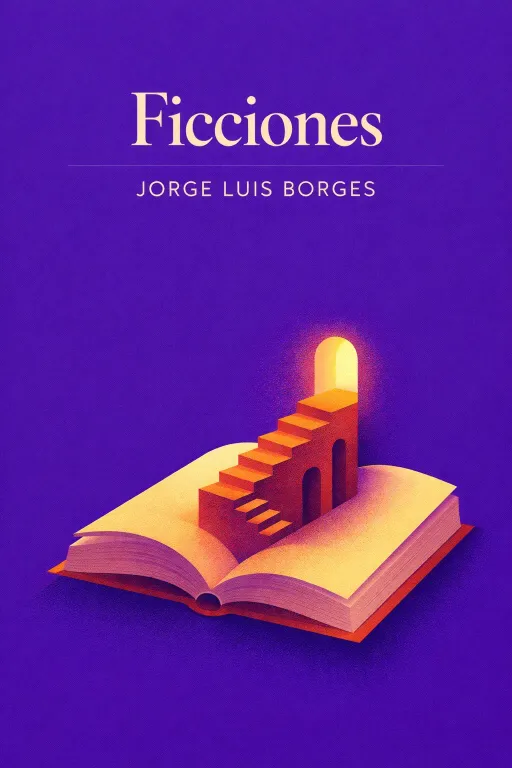
Narrator: What if a secret society spent centuries inventing a fictional planet, complete with its own history, languages, and laws of physics, only for that imaginary world to begin bleeding into our own, slowly replacing reality? What if the universe itself was a colossal library, containing every book ever written and every book that could possibly be written, where the story of your life and the prophecy of your death sit on a shelf, lost among endless volumes of gibberish? These are not just philosophical games; they are the narrative architecture of one of the 20th century's most influential literary collections. In Ficciones, Jorge Luis Borges constructs a series of intellectual labyrinths disguised as short stories, challenging our fundamental understanding of time, reality, identity, and the nature of knowledge itself.
Reality is a Fragile, Fictional Construct
Key Insight 1
Narrator: Borges posits that the line between reality and fiction is not only blurry but permeable. He demonstrates that a sufficiently ordered and attractive fiction can usurp reality, not through force, but through seduction. This idea is most powerfully explored in the story "Tlön, Uqbar, Orbis Tertius."
The narrative begins with a seemingly minor discovery: a single, spurious entry in an encyclopedia describing the mysterious country of Uqbar. This leads the narrator on a years-long investigation that uncovers a vast conspiracy by a secret society to create Tlön, a completely imaginary world. This world is governed by a radical philosophical idealism where objects do not exist unless they are perceived, and where metaphysics is considered a branch of fantastic literature. At first, Tlön is a mere intellectual curiosity. However, the world begins to change when a complete encyclopedia of Tlön mysteriously appears. Humanity, enchanted by the planet’s "minutious and vast evidence of an ordered" existence, starts to embrace it. Tlön’s history, languages, and even its physics begin to infiltrate and replace our own. Borges argues that people prefer Tlön’s "labyrinth urdido por hombres"—a labyrinth devised by men—to the chaotic, divinely ordered labyrinth of reality, which is ultimately incomprehensible. The story concludes with the chilling prediction that the world will become Tlön, demonstrating that a well-crafted fiction can be more powerful than truth.
Time is Not a River, but a Garden of Forking Paths
Key Insight 2
Narrator: Borges dismantles the conventional, linear model of time, proposing instead that time is a web of divergent and convergent possibilities. Every choice creates multiple, simultaneous futures, a concept he visualizes as an infinite, branching labyrinth. This philosophy is the centerpiece of the collection's title story, "The Garden of Forking Paths."
The story is framed as the confession of Yu Tsun, a Chinese spy working for Germany during World War I. Pursued by the relentless Captain Richard Madden, Yu Tsun must communicate a vital piece of intelligence—the location of a new British artillery park named Albert—to his superiors in Berlin. To do this, he devises a desperate and horrifying plan: he will murder a man named Stephen Albert. He travels to Albert's home, where he discovers, in a moment of staggering coincidence, that Albert is a sinologist who has solved the lifelong puzzle of Yu Tsun's own ancestor, Ts'ui Pên. Ts'ui Pên had abandoned his life to write a chaotic, contradictory novel and build a labyrinth, both of which were thought to be failures. Albert reveals that the novel is the labyrinth. Its contradictions, where a character dies in one chapter and is alive in the next, are not errors. They represent the simultaneous existence of all possible outcomes. In Ts'ui Pên's universe, when a character faces a choice, he chooses all options at once, creating "diversos porvenires, diversos tiempos, que también proliferan y se bifurcan" (diverse futures, diverse times, which also proliferate and fork). In one timeline, Yu Tsun is an enemy at Albert's door; in another, he is a friend. In the story's tragic conclusion, Yu Tsun shoots Albert, knowing the news of the murder of a man named Albert will be published in British papers, thus secretly transmitting his message to Berlin. He succeeds in his mission by navigating one path in an infinite garden of possibilities.
The Paradox of Infinite Knowledge is Despair
Key Insight 3
Narrator: In a universe of total information, Borges suggests, meaning becomes impossible to find. If every possible truth exists alongside every possible falsehood, the result is not enlightenment but a profound and crushing despair. This is the central axiom of "The Library of Babel."
The story describes the universe as a library composed of an indefinite, perhaps infinite, number of hexagonal galleries. These galleries contain books of a uniform format, each one a unique permutation of twenty-five basic symbols. Because the Library contains every possible combination of these symbols, it contains everything: the true history of the future, the lost plays of Aeschylus, the catalog of the Library, and a false version of that catalog. Upon this discovery, humanity is first seized by an "extravagant happiness." People believe all problems are solved, as the answers must exist somewhere. This hope quickly curdles into an "excessive depression." Pilgrims set out on futile quests to find their personal "Vindications"—books that justify their lives—but the probability of finding any meaningful text is "computable as zero." The Library, a symbol of ultimate order and knowledge, becomes a testament to meaninglessness. It is a perfect system that contains all truth, but that truth is buried in an infinitely larger quantity of chaos, rendering it inaccessible and therefore useless.
Authorship is an Act of Anachronistic Re-Creation
Key Insight 4
Narrator: Borges challenges the very concept of originality by arguing that the meaning of a text is not inherent in its words alone, but is profoundly shaped by the context and intent of its creation. In "Pierre Menard, Author of the Quixote," he presents the ultimate thought experiment on authorship and interpretation.
The story is a fictional literary review of the work of Pierre Menard, a 20th-century French symbolist. Menard’s greatest, albeit invisible, achievement was not to copy or translate Don Quixote, but to re-create it. His ambition was to produce several chapters of the novel that were verbally identical to Miguel de Cervantes's original, but to arrive at them through the experiences of a 20th-century man. The narrator argues that Menard's Quixote is "casi infinitamente más rico" (almost infinitely richer) than Cervantes's. For example, when Cervantes, a man of his time, writes that history is the "mother of truth," it is a mere rhetorical flourish. But when Menard, a contemporary of pragmatist philosophy, writes the exact same words, it becomes a startling and profound statement on the nature of historical reality. Menard's project demonstrates that the act of writing is an anachronistic dialogue with the past. By re-creating an existing work, he imbues it with new layers of irony, philosophy, and meaning, proving that no text is ever static and that the identity of the author is as crucial as the words on the page.
The Intellect is the Ultimate Labyrinthine Trap
Key Insight 5
Narrator: Borges frequently subverts the classic detective genre, where pure reason triumphs over chaos. Instead, he shows how a brilliant intellect, when driven by pride and a love for esoteric patterns, can become its own worst enemy, leading its owner into a perfectly designed trap. This is the fatal journey of the detective in "Death and the Compass."
The story follows the astute detective Erik Lönnrot as he investigates a series of three murders, each occurring a month apart and in a different cardinal direction of the city. The crimes are accompanied by cryptic clues related to Jewish mysticism, including references to the Tetragrammaton, the four-letter name of God. While his more pragmatic colleague, Treviranus, suggests simple criminal motives, Lönnrot is convinced he is dealing with a "purely rabbinical" explanation. He deduces that the three crime scenes form a perfect equilateral triangle and, using his knowledge of the Tetragrammaton, predicts a fourth and final crime will occur at a location that completes a perfect rhombus. Confident he has outsmarted the killer, he goes to the location alone to intercept him. There, he is met by his nemesis, the gangster Red Scharlach, who reveals the entire series of crimes was a labyrinth constructed specifically for him. Scharlach orchestrated the murders and planted the esoteric clues precisely because he knew Lönnrot’s intellectual vanity would lead him to seek a complex, symmetrical solution. Lönnrot, the master of logic, realizes he has not solved a mystery but merely followed a script written by his enemy, walking willingly into his own death.
Conclusion
Narrator: The single most important takeaway from Ficciones is that the world we perceive as solid and real is, in fact, a story we tell ourselves. Borges demonstrates that systems of thought—be they philosophy, theology, or literature—are not just ways of describing reality, but powerful forces that can actively shape and even create it. His work is a testament to the idea that the universe is not made of atoms, but of narratives, and that the human mind, with its infinite capacity for invention and interpretation, is the ultimate labyrinth.
The enduring challenge Borges leaves us with is to question the very structure of our own reality. Are we living in the one true world, or are we merely inhabitants of one possible fiction among many? By reading Borges, we are invited to become detectives of our own existence, searching for the hidden patterns, the secret symmetries, and the forking paths that lie just beneath the surface of the everyday.