

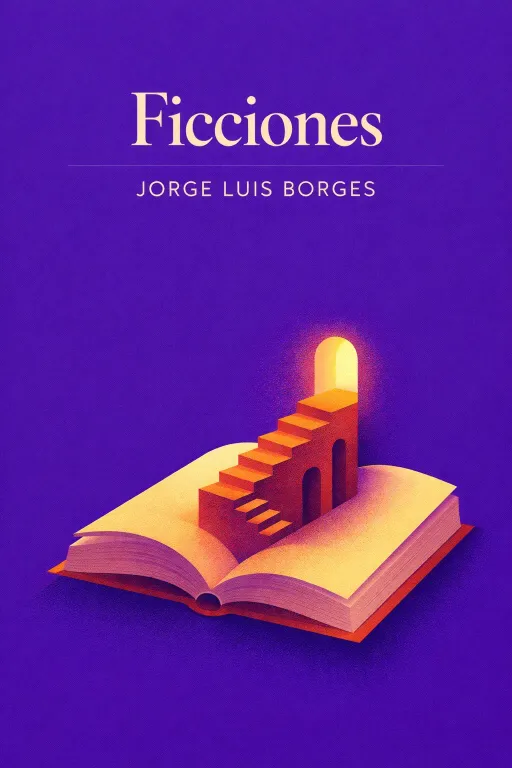
Decoding Borges's Labyrinth
Golden Hook & Introduction
SECTION
Daniel: Okay, Sophia. You've just read Borges. Review The Garden of Forking Paths in exactly five words. Sophia: My brain hurts. Send help. Daniel: Perfect. Mine is: 'Spy thriller, but with metaphysics.' Sophia: That’s a much better summary. I feel like my five words just describe the reader’s experience. It’s exhilarating but also… a lot. It’s like doing sudoku in a hurricane. Daniel: That is an astonishingly accurate description. And it’s why today we are diving into the collection The Garden of Forking Paths by the legendary Argentine writer, Jorge Luis Borges. Sophia: And when you say legendary, you really mean it. This isn't just some dusty classic; his name pops up everywhere. Daniel: Absolutely. Borges is one of those writers' writers. His work is famously praised for its incredible erudition and for elegantly fusing genre plots—like detective stories or spy thrillers—with these massive philosophical ideas. He's a huge influence on everything from literary theory and philosophy to concepts in modern physics and computer science. Sophia: Which explains why my brain hurts. He’s playing 4D chess while I’m still trying to figure out the rules of checkers. Daniel: And that’s the fun of it! The best way to understand Borges is to just jump into one of his intellectual games. And the perfect place to start is with a story that sounds completely absurd on the surface: "Pierre Menard, Author of the Quixote."
The Author is Dead, Long Live the Reader: The Case of Pierre Menard
SECTION
Sophia: Okay, lay it on me. What is so special about this Pierre Menard? Daniel: Well, the story is a fake obituary, a review of the life’s work of a fictional 20th-century French writer. The narrator lists all of Menard's "visible" work—sonnets, monographs on symbolic logic, translations. But he says Menard's true, "subterranean" masterpiece is an invisible one. Sophia: Invisible? Did he write it in invisible ink? Daniel: Close. His masterpiece was… writing several chapters of Don Quixote. Sophia: Writing Don Quixote? But… Cervantes already did that. A few centuries ago. Daniel: Exactly. Menard’s project wasn't to compose another Quixote. His ambition was to compose the Quixote. Word for word, line for line, identical to the original. Sophia: Hold on. He just… copied it? How is that a masterpiece? That sounds like the most elaborate, pretentious act of plagiarism in history. Daniel: That’s the immediate, logical reaction! But Borges's narrator argues that Menard's version is "almost infinitely richer" than Cervantes's. Sophia: How? They're the same words! Daniel: Because of context. Borges gives an example. There's a line in Don Quixote that reads: "...truth, whose mother is history." The narrator says that for Cervantes, a 17th-century man, this is just a "mere rhetorical praise of history." It's a standard, unoriginal thought for his time. Sophia: Right, makes sense. Daniel: But when Pierre Menard, a 20th-century symbolist, writes that exact same phrase, it's mind-blowing. He's a contemporary of philosophers like William James. For him to say history is the mother of truth is a radical, pragmatic statement. He's saying truth isn't some abstract ideal; it's what we piece together from the past. The same words, separated by three centuries, take on a completely different philosophical weight. Sophia: Ah, I see. It's like if someone today re-made a silent film, shot-for-shot, with the same technology. The act of doing it now gives it a totally different, almost ironic meaning. It becomes a commentary on filmmaking, on nostalgia, on technology. Daniel: Precisely! The meaning isn't just in the text; it's in the gap between the author and the text. Menard didn't want to be Cervantes. The story says he rejected that idea as too easy. He wanted to remain Pierre Menard and, through the experiences of a 20th-century man, arrive at the Quixote. It’s an impossible, heroic, and utterly mad intellectual quest. Sophia: So the journey is the point, not the destination, which in this case is a book that already exists. Daniel: Yes! And this is Borges's whole philosophy in a nutshell. In the prologue to this very collection, he gives us his manifesto. He says writing huge, 500-page books to explain a single idea is a "laborious and empoverishing madness." He thinks it's much better to just pretend those books already exist and offer a summary or a commentary on them. Sophia: Which is exactly what "Pierre Menard" is! It's a review of a book that was never really written. He’s playing a game with the reader. Daniel: He's playing a game with the very idea of literature. And that idea of a book being more than just words on a page, of it containing hidden depths and possibilities, gets even wilder in the title story.
Time as a Labyrinth: The Spy Who Found Infinity
SECTION
Sophia: Right, "The Garden of Forking Paths." This one I know is a spy story. How does a World War I spy thriller get tangled up with all this meta-literary philosophy? Daniel: Borges hides the philosophy inside the plot, like a secret message. The story is a confession from a man named Yu Tsun. He's a Chinese professor who has become a spy for the Germans, and he's in deep trouble. He's just discovered that his cover is blown and an implacable Irish agent working for the British, Captain Richard Madden, is closing in on him. Sophia: So it’s a race against time. Classic thriller setup. Daniel: A frantic race. Before Madden catches him, Yu Tsun has to transmit one vital piece of intelligence to his boss in Berlin: the location of a new British artillery park. But all his contacts are gone, and Madden is on his heels. He has the secret, but no way to deliver it. Sophia: Okay, I’m hooked. What does he do? Daniel: He looks in the phone book. He finds the name of the one person who can help him, though not in the way you'd think. A man named Stephen Albert. Yu Tsun travels to his remote house, with Madden always just one step behind. Sophia: And who is this Stephen Albert? Another spy? Daniel: No, he’s a sinologist—an expert in Chinese culture. And by an impossible coincidence, he has spent years studying the work of Yu Tsun’s own great-grandfather, a man named Ts'ui Pên. Sophia: What are the odds? That feels a little convenient. Daniel: In Borges, there are no coincidences. Ts'ui Pên, Yu Tsun's ancestor, was a governor who abandoned his political power to do two things: write an infinitely complex novel and build an infinite labyrinth. He was assassinated, and everyone thought he failed. The novel was a chaotic mess of contradictions, and the labyrinth was never found. Sophia: An infinite labyrinth? What does that even mean? Daniel: That's the secret Stephen Albert has solved. He tells Yu Tsun that the novel and the labyrinth are the same thing. The book is the labyrinth. The reason it seems chaotic is that it’s a model of time. Sophia: A model of time? Daniel: Yes. Albert explains that in most fiction, when a character faces several choices, they pick one and eliminate the others. But in Ts'ui Pên's novel, the character chooses all of them, simultaneously. He creates, as Borges writes, "various futures, various times, which also proliferate and bifurcate." Sophia: Wow. So it's the first multiverse story? Every choice creates a new, branching timeline where a different outcome occurs. That’s why a character can be dead in one chapter and alive in the next—it’s a different path in the garden. Daniel: Exactly. It's a "Garden of Forking Paths" in time, not space. But here's the crucial part. How does this help Yu Tsun? He's about to be captured. Knowing about parallel universes doesn't stop a bullet in this one. Sophia: Right, that’s what I was wondering. It’s a fascinating philosophy lesson, but Madden is still coming for him. Daniel: That's the tragic genius of the story. As Albert is explaining this, Yu Tsun has his terrible epiphany. He finally understands how to send his message. The secret name of the city the Germans need to bomb is "Albert." Sophia: Oh no. Daniel: Oh yes. He pulls out his revolver. By killing Stephen Albert, he knows the murder of a prominent sinologist by a Chinese man will be major news in the British papers. His chief in Berlin will read the story, see the name of the victim—Albert—and understand the message. Yu Tsun has to commit this monstrous act in this timeline to save the German armies. Sophia: That's absolutely brutal. So in one of those forking paths, he and Albert could have been friends, discussing philosophy for years. But in this one, the one we're reading, he has to become his enemy. Daniel: And Borges makes it even more chilling. Just before Yu Tsun shoots him, Albert smiles and says, "In one of my many futures, I am your enemy." He understands. And in that moment, the abstract theory of time becomes a devastating human reality.
The Universe as a Book: Hope and Despair in the Library of Babel
SECTION
Sophia: Okay, so we've gone from a book having infinite meanings in "Pierre Menard," to a book that literally contains infinite timelines in "The Garden of Forking Paths." Where does Borges possibly go from there? Does it get any bigger? Daniel: Oh, it gets infinitely bigger. He takes the idea to its ultimate, cosmic conclusion in one of his most famous stories, "The Library of Babel." In this story, the entire universe is a library. Sophia: The whole universe? Daniel: The whole universe. He describes it with this incredible, haunting precision. It's made of an indefinite, perhaps infinite, number of hexagonal galleries. Each gallery has shelves on five walls, holding 32 identical books. There are sleeping closets, bathrooms, and spiral staircases that stretch up and down into infinity. Sophia: It sounds orderly, but also terrifying. What’s in the books? Daniel: Everything. And nothing. A genius librarian discovered the fundamental law of the Library: all the books are composed of just 25 symbols—22 letters, the comma, the period, and the space. The Library contains every possible combination of those symbols. Sophia: Wait, every possible combination? Daniel: Every single one. This means the Library contains a perfect autobiography of your life, a catalog of all its own books, the cure for every disease, and Shakespeare's greatest plays. But it also contains millions of books that are just the letters "MCV" repeated for 410 pages. It contains every truth, every lie, and an almost infinite amount of gibberish. Sophia: That’s my personal nightmare. It's like the internet before Google, but infinitely worse. It's total information, but also total noise. You have all the answers, but you can't find them. Daniel: Exactly! And Borges describes the human psychological journey perfectly. When this is discovered, the first reaction is "extravagant happiness." Everyone feels they are the "master of an intact and secret treasure." They can find the justification for their life, the history of the future! Sophia: But they can't. The odds are basically zero. Daniel: And so, as he writes, "to this extravagant hope, an excessive depression succeeded." The librarians realize that the probability of finding even one coherent line in a book, let alone a whole meaningful one, is infinitesimal. This leads to madness. People go on violent pilgrimages, they murder each other over books that might be the one, they form cults of "Purifiers" who go around burning what they deem to be useless books. Sophia: Which is futile, because for every book they burn, there are hundreds of thousands of nearly identical copies that differ by just one comma. Daniel: The system is too vast for human intervention. It’s such a powerful and bleak metaphor for the human search for meaning. We are these tiny figures, wandering through this vast, indifferent structure that contains all possibilities, and we are desperate for a coherent story, for a single book that explains it all. We search for the "Man of the Book," a mythical librarian who has read a perfect summary of the entire Library and is like a god. Sophia: But that book probably doesn't exist. Or if it does, it's lost among trillions of false summaries. It's the ultimate existential trap.
Synthesis & Takeaways
SECTION
Daniel: And that's the thread connecting all these stories we've talked about today. Borges is a master of creating these intellectual labyrinths. He's showing us that we are meaning-seeking creatures in a universe that might just be a chaotic, infinite text. Sophia: It's a universe of pure potential. Whether it's Pierre Menard creating new meaning from an old book, or Yu Tsun navigating the forking paths of his own destiny, or the librarians searching for that one true book, we're constantly trying to write a coherent narrative for ourselves out of the noise. Daniel: And what’s so brilliant is that Borges never gives us a final answer. He just builds the labyrinth and invites us in. The Library of Babel might contain a book that explains the Library, but we'll never find it. The meaning has to be created, not found. Sophia: It makes you wonder, are we discovering the meaning that's already out there, or are we the ones creating it by the very act of searching and interpreting? Borges seems to suggest it's the latter. The act of reading, of choosing a path, is the real magic. Daniel: A perfect way to put it. In his world, he hands the power from the author to the reader. He invites us to play in his labyrinth. Sophia: And what a labyrinth it is. For our listeners, which of Borges's ideas sticks with you the most? The infinite library, the forking paths of time, the idea that two identical books can be different? Let us know your thoughts. We'd love to hear them. Daniel: This is Aibrary, signing off.