

The Art of Critical Thinking: Discerning Truth in a Complex World
Golden Hook & Introduction
SECTION
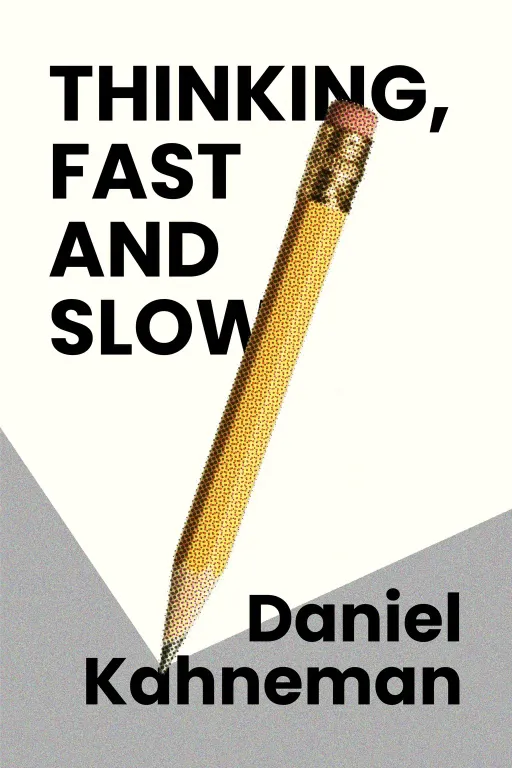
Nova: Atlas, I'm going to give you two incredible books, and your task is to review each in exactly five words. No more, no less. First up, Daniel Kahneman's "Thinking, Fast and Slow."
Atlas: Oh, I love this game! Okay, for Kahneman... "Our brains are wonderfully, terribly flawed."
Nova: Perfectly put! "Wonderful" for the sheer complexity, "terrible" for the traps. Now, for Hans Rosling's "Factfulness: Ten Reasons We're Wrong About the World."
Atlas: Hmm, "Factfulness"... "Data beats drama, world is better."
Nova: Brilliant! You nailed the essence of both. Today, we're diving deep into the art of critical thinking, drawing insights from these two groundbreaking works. Daniel Kahneman, a Nobel laureate in Economics, not psychology, revolutionized our understanding of human decision-making and irrationality, essentially mapping out the bugs in our mental software.
Atlas: That’s amazing, that an economist, observing markets, ended up defining how our minds fundamentally work. It really flips the script on what we thought we knew about rational choice.
Nova: Exactly! And when you combine his insights with Hans Rosling's data-driven optimism, which challenges our inherent biases towards negativity, you get an unparalleled toolkit for navigating our increasingly complex world. So, let’s peel back the layers of how our own minds might be subtly betraying us.
Deep Dive into Cognitive Biases: System 1 vs. System 2
SECTION
Nova: Kahneman’s most famous contribution is probably his distinction between two fundamental systems that drive all our thinking: System 1 and System 2. System 1 is fast, intuitive, emotional, and automatic. It’s what tells you a snake is dangerous before you even consciously register it.
Atlas: Oh, I know that feeling. It's like when you instantly dislike a new song, or you just 'get a vibe' about someone. It's almost primal.
Nova: Precisely. It’s what allows you to drive a car on an empty road without thinking about every turn of the wheel. System 2, on the other hand, is slow, deliberate, logical, and effortful. It’s what you engage when you’re solving a complex math problem, or carefully weighing the pros and cons of a major life decision.
Atlas: So, System 1 is the gut reaction, and System 2 is the deep dive. But where do the 'flaws' come in, as I so eloquently put it?
Nova: Ah, the flaws emerge because System 1 is a magnificent shortcut machine. It’s designed for efficiency, not always accuracy. It relies on heuristics, mental shortcuts, which often work beautifully. But sometimes, they lead us systematically astray, creating cognitive biases. Take the famous 'Linda the Bank Teller' problem.
Atlas: Okay, I’m curious. Lay it on me.
Nova: Imagine Linda. She's 31 years old, single, outspoken, and very bright. She majored in philosophy. As a student, she was deeply concerned with issues of discrimination and social justice, and also participated in anti-nuclear demonstrations. Now, which is more probable? A: Linda is a bank teller. Or B: Linda is a bank teller and is active in the feminist movement.
Atlas: Hmm. My System 1 is screaming "B!" She sounds exactly like someone who would be active in the feminist movement.
Nova: And that's the trap. Your System 1 is using a 'representativeness heuristic' – it's matching Linda's description to your stereotype of a feminist activist. But logically, for Linda to be a bank teller active in the feminist movement, she first has to be a bank teller. The probability of two events occurring together is always less than or equal to the probability of just one of those events occurring.
Atlas: Wait, so you’re saying "A" is more probable? That’s counter-intuitive! My brain really wants "B" to be correct because it feels like it fits her story so well.
Nova: Exactly! That's the conjunction fallacy at play, a direct result of System 1 overriding System 2. It’s a powerful illustration of how our intuitive judgments, even when seemingly logical, can lead us to statistically incorrect conclusions.
Atlas: That's fascinating. For our listeners who are Deep Thinkers, constantly analyzing information and trying to make ethical choices, how does this System 1 bias affect their ability to make a meaningful impact? Could it lead to misjudging situations or people?
Nova: Absolutely. Think about an ethical innovator trying to assess a new technology's impact. Their System 1 might quickly categorize it as 'good' because it solves a problem they care about, or 'bad' because it reminds them of a past failure. This quick judgment could lead them to overlook critical data or potential unintended consequences.
Atlas: So, it's not just about getting the answer wrong in a puzzle; it's about potentially making flawed decisions in real-world scenarios, especially when the stakes are high. It's like our brains are running on a default setting that needs a manual override.
Nova: Precisely. Recognizing that System 1 is constantly at work, generating these quick, often biased, interpretations, is the first step. It allows us to pause and engage System 2, to ask: 'What data or evidence would I need to truly evaluate this claim, rather than just going with my gut?'
Factfulness: Challenging Our Drama Instincts
SECTION
Nova: Now, recognizing internal biases is crucial, but is that enough to truly understand the world? We’re constantly bombarded with information, often skewed towards the negative. And that naturally leads us to the second key idea we need to talk about, which often acts as a counterpoint to what Kahneman teaches us. This is where Hans Rosling, with his co-authors Ola Rosling and Anna Rosling Rönnlund, steps in with "Factfulness."
Atlas: Data beats drama, as my five-word review put it. But honestly, when I look at the news, it feels like the world is constantly on fire. How can data possibly counter that overwhelming sense of negativity?
Nova: That’s the 'drama instinct' Rosling talks about. Our brains, thanks to System 1, are hardwired to pay attention to sensational, negative information. It's an evolutionary survival mechanism. But it distorts our perception of global trends. Rosling argues that the world, by almost every measurable indicator – poverty, child mortality, education, access to clean water – is significantly better than most people think, and it's improving.
Atlas: But wait, don't the headlines tell us things are getting worse? Every crisis seems bigger than the last. How can someone who cares about making a meaningful impact, an ethical innovator, avoid feeling overwhelmed and paralyzed by that constant stream of bad news?
Nova: That’s the core challenge Rosling addresses. He identifies ten drama instincts that lead us astray. One powerful example is the 'gap instinct.' Most people, when asked, believe the world is divided into two distinct groups: the rich and the poor. But Rosling, through his incredible data visualizations, shows that this 'gap' is largely an illusion. The reality is a continuous spectrum, with most of humanity living somewhere in the middle, and significant progress being made across all income levels.
Atlas: So, it's not a chasm; it's more like a hill with lots of people on the slopes. That shifts the whole perspective. It makes me wonder, how does this apply to someone trying to navigate global challenges, a Resilient Explorer, when all the data seems grim and overwhelming?
Nova: It's about shifting from an emotional, alarmist view to a fact-based worldview. For instance, Rosling would point out that while climate change is a severe threat, acknowledging progress in renewable energy or declining extreme poverty isn't being complacent; it's being factful. It allows us to direct our efforts and resources more effectively, rather than being paralyzed by a sense of impending doom.
Atlas: That’s actually really inspiring. It means that progress is possible, even if it’s not always dramatic or headline-grabbing. It gives a sense of agency back to the ethical innovator, knowing that their work can contribute to a genuinely improving world, rather than just fighting a losing battle.
Nova: Exactly. Rosling's message is that a fact-based worldview is not merely optimistic; it's realistic. It empowers us to see where real problems lie and where real progress is being made, allowing us to make better decisions and focus our energies where they'll have the greatest impact. It's about understanding the world as it is, not as our drama-seeking instincts tell us it is.
Synthesis & Takeaways
SECTION
Nova: So, we've journeyed from Kahneman’s internal landscape of cognitive biases to Rosling’s external, data-driven perspective on global realities. It feels like a complete circuit, doesn't it? First, we learn to recognize the mind's internal tricks, then we equip ourselves with the tools to interpret external information accurately.
Atlas: That makes sense. It's like first learning how your own eyes can play tricks on you, and then getting a better set of glasses to see the world more clearly. The Deep Thinker in me appreciates that layered approach.
Nova: And that brings us back to the tiny step we recommended: The next time you encounter a strong opinion, pause and ask yourself: 'What data or evidence would I need to truly evaluate this claim?' It's a simple question, but incredibly powerful. It forces System 2 to engage and challenges the drama instinct.
Atlas: I can definitely relate to that. In a world full of hot takes and instant reactions, that pause feels almost revolutionary. It's like a daily mindful reflection, a way to anchor your ambition and ensure you’re acting on truth, not just emotion.
Nova: Precisely. It’s a discipline. Both Kahneman and Rosling, in their own ways, are urging us to cultivate intellectual humility – to acknowledge the limits of our intuition and the power of data. It's about embracing the journey of continuous learning, knowing that every answer isn’t immediate, and patience is indeed power.
Atlas: That's such a hopeful way to look at it. It's not about being perfectly rational all the time, but about building the resilience to constantly question, learn, and adapt.
Nova: Indeed. The ultimate message here is that critical thinking isn't just an academic exercise; it's a vital skill for personal growth, ethical leadership, and navigating the complex systems of our world. How many decisions, big or small, could be improved just by asking that one simple question?
Atlas: That gives me chills. It's a profound shift in how we engage with information and, ultimately, with the world.
Nova: This is Aibrary. Congratulations on your growth!