

Stop Guessing, Start Measuring: The Guide to Data-Driven Product Success.
Golden Hook & Introduction
SECTION
Nova: Everyone talks about being 'data-driven,' but what if relying on data is actually holding your product back, stifling innovation, and even eroding trust within your team?
Atlas: Whoa, Nova. That's a pretty bold statement. I mean, we're constantly told to 'trust the data,' 'let the numbers speak.' Are you saying we should just… go with our gut? Because for many strategic leaders focused on building resilient structures, that sounds a bit out there, maybe even reckless.
Nova: Not reckless at all, Atlas! It’s about a more nuanced approach. We're not saying abandon data; we're questioning the reliance on it, especially when it becomes a crutch that prevents true understanding or, even worse, masks a lack of clear strategy. And that's precisely the fascinating paradox we're unraveling today, inspired by an incredibly insightful book: "Stop Guessing, Start Measuring: The Guide to Data-Driven Product Success."
Atlas: Oh, I like that title. It hints at a balance.
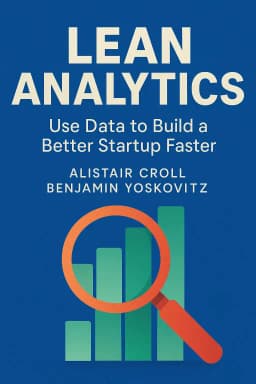
Nova: Exactly! It's a powerful synthesis of ideas, particularly drawing on the groundbreaking work of "Lean Analytics" by Alistair Croll and Benjamin Yoskovitz, and "Experimentation Matters" by Stefan H. Thomke. These aren't just academics; Croll and Yoskovitz are known for their ability to translate complex business models into actionable metric frameworks, while Thomke, a Harvard Business School professor, has spent decades studying how leading companies foster cultures of innovation through systematic testing. They've collectively shaped countless successful ventures by showing how to move beyond guesswork.
Atlas: Okay, so it’s about smart data, not just data. That makes me wonder, how do you even begin to untangle that knot between what your gut tells you and what the spreadsheets are screaming?
The Intuition-Data Paradox: Combining Gut Feel with Hard Evidence
SECTION
Nova: That’s the million-dollar question, Atlas, and it brings us to our first core idea: the intuition-data paradox. Many founders, especially those driven by a powerful vision and a keen eye for potential, feel this intense pull. They've got a brilliant idea, a 'gut feeling' about what people need, but then they're told to 'validate it with data.' The problem, as Croll and Yoskovitz highlight in "Lean Analytics," is that many drown in a sea of metrics, leading to what they call 'analysis paralysis.'
Atlas: I know that feeling. It’s like standing in a grocery store with 50 different types of cereal. You want to make the 'right' choice, but there's just too much information. So how do these authors help you pick the 'one metric that matters'?
Nova: It’s brilliant. They argue that the 'one metric that matters' isn't universal; it depends entirely on your business model and your current stage of growth. Picture this: a brilliant young founder, let's call her Priya, has this intuitive vision for a hyper-niche social network for urban gardeners. Her initial gut feeling is that if she gets a million users, she's won. So she focuses on user acquisition.
Atlas: Right, sounds like a classic startup goal. More users, more success.
Nova: But here's the twist. "Lean Analytics" would guide Priya to understand that for an early-stage social network, raw user numbers can be a vanity metric. What truly matters is. Are people actually connecting? Are they sharing gardening tips? Are they? If she has a million users but only a thousand are active, her product is failing, despite the big number.
Atlas: So you're saying her intuition to build something for urban gardeners was spot on, but her initial metric was off? That’s a great way to put it. It’s like knowing you want to bake a cake, but focusing on how many eggs you’ve bought instead of whether the oven is at the right temperature.
Nova: Precisely! The book shows you how to identify that 'oven temperature' for your specific 'cake.' For Priya, shifting her focus to metrics like 'daily active users' or 'messages exchanged per user' dramatically changed her approach. She realized her intuition was great for the – a community for gardeners. But data, specifically the data, was essential for the – how to make that community vibrant and sticky. This saved her from pouring resources into just acquiring dormant users.
Atlas: That resonates with anyone who struggles with feeling overwhelmed by data dashboards. It clarifies that intuition helps you form the hypothesis, but the right data validates or refines it. But if you’re only looking at one metric, isn't that risky for a strategic leader trying to build trust and sustainable growth? What if you miss something critical?
Nova: That’s a valid concern, and it’s where the balance comes in. The 'one metric that matters' isn't about everything else; it's about for your current challenge. Once you’ve moved that needle, your 'one metric' might evolve. Think of it like a pilot. They have hundreds of gauges, but at takeoff, the 'one metric' is thrust. During cruising, it's fuel efficiency. You don't ignore the other gauges, but you know which one is critical. This approach helps build a culture where clarity triumphs over chaos, allowing teams to trust that their efforts are focused on what truly counts.
Cultivating a Culture of Experimentation: Beyond Metrics to Mindset
SECTION
Atlas: Okay, so once you have that focused metric, what's next? How do you actually move the needle without just guessing? Because even with the right metric, you still have to something to influence it.
Nova: And that naturally leads us to our second core idea, which often acts as the engine driving those metrics: cultivating a culture of experimentation. This is where Stefan Thomke's work in "Experimentation Matters" becomes incredibly powerful. He argues that the most innovative companies don't just experiments; they experimental. It's a deep-seated mindset, not just a tactic.
Atlas: So you're saying it's not enough to just run an A/B test here and there? It needs to be woven into the fabric of the organization?
Nova: Absolutely. Think of it like this: many companies operate like a traditional chef. They follow a recipe, hoping for the best. A company with an experimentation culture operates like a molecular gastronomist. Every ingredient, every temperature, every technique is a hypothesis to be tested and refined. Thomke talks about companies like Amazon, which famously runs millions of experiments a year. It's not about being 'right' initially; it's about systematically learning and iterating.
Atlas: That makes me wonder, isn't that just for tech giants with massive resources? How does a smaller team or a leader focused on building culture, not just features, foster that kind of rigorous testing without becoming a cold, numbers-only operation? I imagine a lot of our listeners are thinking, 'My team isn't Amazon!'
Nova: That’s a critical point, and it’s often a misconception. Thomke's insights are universally applicable. It's not about the scale of the experiment, but the. Imagine an established e-commerce company, let’s call them 'Global Goods,' that for years relied on big, infrequent product launches and design overhauls, all based on executive intuition and market research. These were huge, expensive bets.
Atlas: High stakes, high pressure.
Nova: Exactly. But they started adopting a culture of continuous, small-scale A/B testing. Instead of redesigning their entire checkout flow based on a hunch, they tested tiny changes: the color of the 'buy now' button, the wording of a shipping guarantee, the placement of a review section. Each test was small, low-risk, and quick.
Atlas: And I'm guessing the cumulative effect was significant.
Nova: Massively so. They discovered that a slight tweak to the button text, something their executive team had dismissed as trivial, led to a 3% increase in conversions. That 3%, across millions of transactions, translated into millions in additional revenue. The profound insight here is that the 'big ideas' often come from compounding small, validated learnings. Their culture shifted from 'who has the best idea' to 'who can design the fastest, most insightful experiment.'
Atlas: That’s actually really inspiring. It shows that 'experimentation' isn't about being perfectly scientific from day one, but about embedding curiosity and learning into how you operate. It's about building trust by showing, not just telling, what works. For leaders looking to build resilient, high-performing structures and scale with intention, this sounds like a foundational pillar. It's like building muscle – you don't just lift the heaviest weight once; you consistently train and adapt.
Synthesis & Takeaways
SECTION
Nova: That’s a perfect analogy, Atlas. And it brings us to the core synthesis of these powerful ideas. The most impactful product leaders – the ones who truly stop guessing and start measuring – don't see intuition and data as rivals. They see them as partners. Intuition sets the direction, it sparks the initial hypothesis, it gives you that keen eye for potential. But data, especially the right 'one metric that matters' combined with a relentless culture of experimentation, provides the map and compass to navigate that direction effectively.
Atlas: So it's about empowering your judgment with evidence, not replacing it. It sounds like the ultimate way to build trust and sustainable growth, because you're showing up with both vision validation.
Nova: Absolutely. It fosters a profound understanding of customer needs and market dynamics, leading to products that genuinely resonate. It's about moving from a culture of 'I think so' to 'I know because we've learned.' This foundational shift is what separates good product execution from truly transformative impact. It’s about creating a living, learning organization.
Atlas: That’s such a hopeful way to look at it. For that strategic leader listening, who’s trying to balance their vision with measurable results, what's the very first, tiny step they can take this week to bridge this gap?
Nova: Start small, start now. Identify one key metric for your biggest current challenge – not ten, just one. And then, design a simple, measurable experiment to influence it this week. It could be changing one line of copy, or presenting an option differently. Just one experiment, one metric. Learn from it, and build from there.
Atlas: One metric, one experiment. That’s actionable. It’s about taking that first step towards a culture of intentional learning.
Nova: Exactly. This is Aibrary. Congratulations on your growth!