

Stop Guessing, Start Measuring: The Guide to Data-Driven Product Success.
Golden Hook & Introduction
SECTION
Nova: What if I told you that sometimes, having information can actually be worse than having too little? That your sharpest intuition, when combined with the data, can inadvertently lead you down a very expensive, very confusing rabbit hole?
Atlas: Whoa, that's a bold claim, Nova! I imagine a lot of our listeners, especially those deeply immersed in product development or building innovative cultures, are constantly told to get data, not less. It almost feels counterintuitive to suggest there's a downside to abundance.
Nova: Exactly! And that tension, that subtle but profound pull between trusting your gut and navigating the numbers, is really at the heart of what we're exploring today. We're diving into the principles behind a powerful idea: how to stop guessing and start measuring effectively for true product success. This isn't about ignoring your intuition; it's about validating it with precision.
Atlas: So, you're saying this isn't just another book advocating for data for data's sake? Because honestly, that's a common pitfall. We've all seen projects drown in dashboards and analytics that don't actually tell us anything actionable.
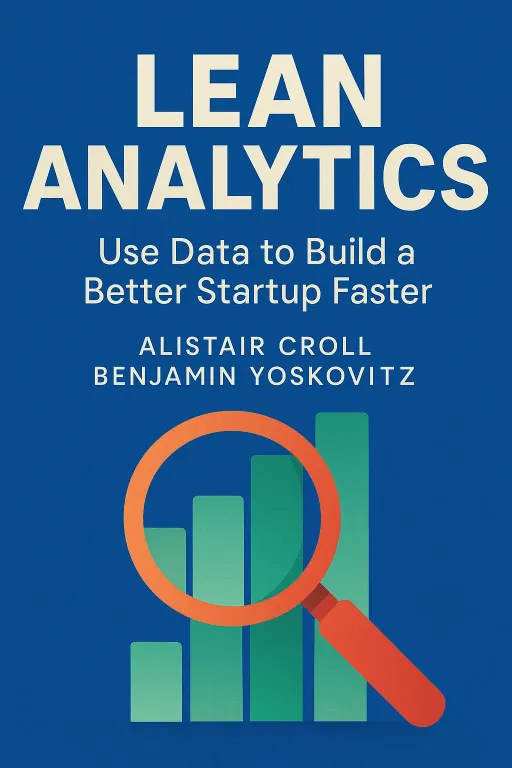
Nova: Absolutely not. This approach is about harnessing data to amplify your strategic vision, not to replace it. A lot of these foundational ideas come from brilliant minds like Alistair Croll and Benjamin Yoskovitz, authors of "Lean Analytics." They really pioneered a practical, no-nonsense approach to metrics, born from years of helping startups and established businesses cut through the noise. They saw firsthand how often teams felt overwhelmed by a deluge of data, leading to analysis paralysis rather than clear decisions. Their work is widely referenced by product leaders precisely because it offers a structured way to make sense of that chaos.
Atlas: That makes sense. It's not just about collecting data, it's about making it for you. So, how do we begin to untangle that knot? How do we move from just collecting information to actually measuring what truly matters?
The 'One Metric That Matters' and Escaping Analysis Paralysis
SECTION
Nova: That's the million-dollar question, and it brings us to our first core idea: the "one metric that matters." The seductive trap for many founders and product leaders is believing that more data is always better. They build intricate dashboards, track dozens of KPIs, and then... they stare at it all, unsure what to do. It’s like trying to navigate a dense jungle with a thousand maps, none of them telling you which path to take.
Atlas: I can definitely relate. For anyone trying to build trust and sustainable growth within a team, presenting a wall of numbers without a clear narrative can be incredibly demotivating. It leaves everyone guessing what the real priority is. So, what exactly is this "one metric that matters," and how does it help cut through that noise?
Nova: It's a single, singular metric that, at your current stage of business, gives you the most accurate read on your progress and whether you're succeeding. And here's the crucial part: it changes. What matters to a brand-new startup trying to find product-market fit is vastly different from what matters to a mature company focused on retention. A few years ago, I was consulting with a SaaS startup, let’s call them "CloudCraft." They had built this incredibly sophisticated project management tool, but they were bleeding users. Their dashboard was a masterpiece of complexity: daily active users, weekly active users, feature usage rates, bounce rates, conversion rates across ten different funnels.
Atlas: Oh, I've seen that movie. Everyone's busy tracking, but nobody knows if they're winning or losing.
Nova: Exactly! The founder, Sarah, was brilliant, but she was drowning. She’d spend hours each day just trying to make sense of the data, feeling like she was always behind. We sat down and asked: at this stage, with users signing up but not sticking around, what is the for CloudCraft to achieve? After a deep dive, we realized their core problem wasn't acquisition, it was and. Their "one metric that mattered" became: "Percentage of new users who complete their first project within 48 hours of signup."
Atlas: That’s a great way to put it. So, instead of gazing at a constellation of stars, they focused on one guiding star. What happened next?
Nova: It was transformative. Suddenly, their entire product team had a crystal-clear North Star. They weren't optimizing for sign-ups anymore; they were optimizing for that first project completion. They simplified the onboarding flow, added in-app nudges specifically for project creation, and even introduced a quick tutorial that walked users through building their first project step-by-step. Within weeks, their activation rate for that metric jumped from 15% to 40%, and their retention numbers started to stabilize. It wasn't about ignoring other metrics, it was about prioritizing.
Atlas: That’s actually really inspiring. For our listeners who are building cultures, this sounds like it creates immense clarity for teams. It gives everyone a shared purpose. But what about different types of businesses? Like, how would an e-commerce store's OMTM differ from a content platform, or even a community-based product? Because that architectural approach to business models sounds vital.
Nova: That's where the nuance comes in. For an e-commerce store, early on, it might be "first-time purchase conversion rate." Later, it could shift to "repeat purchase rate" or "average order value." For a content platform, initially, it might be "time spent on site" or "number of articles read per session," then evolve to "subscriber growth" or "ad revenue per user." And for a community product, it's often "daily active contributors" or "percentage of users who engage in discussions." The key is alignment with your specific business model and current growth stage. It forces you to ask: "What truly defines success for,?" This strategic focus prevents you from chasing vanity metrics that look good on paper but don't move the needle for your actual business goals.
Cultivating a Culture of Experimentation for Continuous Learning
SECTION
Atlas: Okay, so once you have that clarity, once you know what star you're aiming for, how do you actually reach it? Because identifying the metric is one thing, but consistently influencing it, learning from your efforts, and scaling that learning... that feels like a whole different beast.
Nova: It absolutely is, and that leads us to our second core idea: cultivating a culture of systematic experimentation. This isn't just about running A/B tests; it's about embedding learning into the DNA of your organization. Stefan H. Thomke, in his book "Experimentation Matters," really champions this. He shows how leading companies don't just experiment as a tactic; it's their core strategy for learning and growth. Thomke's extensive research highlights that true innovation comes from systematic testing, not just brilliant ideas.
Atlas: I'm curious. For someone who values human connection and is trying to build resilient, high-performing structures, the word "experimentation" can sometimes sound a bit cold or clinical. It might even feel like it removes the human element, the intuition you mentioned earlier. How do you bridge that?
Nova: That's a brilliant question, Atlas, and it's precisely where Thomke's work shines. He argues that a culture of experimentation actually people. Think about a large, established tech company, let's call them "InnovateCorp," known for their groundbreaking products. For years, their product development was driven by a few visionary leaders, almost like a "genius" model. They had big, infrequent launches, and if something didn't land, it was a major setback.
Atlas: High stakes, high pressure... that sounds like a recipe for burnout and risk aversion, not exactly sustainable growth or a thriving culture.
Nova: Exactly. InnovateCorp eventually realized this was unsustainable. Inspired by Thomke's principles, they began to democratize experimentation. Instead of waiting for the "geniuses" to have the next big idea, they empowered smaller cross-functional teams to run tiny, rapid experiments on specific features or user flows. They made it safe to "fail fast" and learn. One team, for example, hypothesised that simplifying a complex settings menu would significantly increase user satisfaction. Instead of a full redesign, they tested a single, small change on 5% of their users.
Atlas: So, it's about breaking down those big, risky bets into smaller, manageable, learnable chunks?
Nova: Precisely. That little experiment with the settings menu didn't just improve user satisfaction; it also revealed an unexpected positive impact on feature discovery. The success wasn't just in the metric, but in the. Their teams started to see experiments not as pass/fail tests, but as questions they were asking the market. This shift fostered a culture where teams felt more autonomous, more trusted, and more engaged. They weren't just executing; they were actively shaping the product's direction through evidence. It built a shared language around learning and reduced the ego associated with big, risky decisions. This is how you build a culture where everyone is a learner, and growth becomes truly sustainable. It's about empowering people to ask questions and find answers, not just follow instructions.
Synthesis & Takeaways
SECTION
Atlas: That makes so much sense. It’s about creating a living, breathing feedback loop. It's not just about data points; it's about enabling a continuous conversation with your market and your team. And that, to me, sounds like the ultimate way to build trust and foster real innovation.
Nova: Absolutely. When you combine the clarity of knowing your 'one metric that matters' with the iterative power of a culture of experimentation, you create an unstoppable engine for growth. You move from intuition alone, which can be prone to bias, to intuition informed and validated by structured learning. It allows you to build products that truly resonate, cultures that are resilient, and achieve impact that is genuinely sustainable. It's about building flexible, high-performing structures that can adapt and thrive, because they are constantly learning.
Atlas: So, for our listeners who are thinking deeply about their next steps, who are driven by impact and care about sustainable growth, what's a tiny step they can take this week to start this journey?
Nova: I love that you asked, because the most powerful insights are always followed by action. So, this week, identify one key challenge you are facing right now – maybe it's user drop-off, or team engagement, or even a personal productivity block. Then, define that would tell you if you're making progress on that challenge. Finally, design a to influence that metric. It doesn't have to be complex; just one small action you can take, and then observe the result.
Atlas: That’s a fantastic, actionable challenge. One metric, one experiment. Simple, powerful. And it really brings together that strategic thinking with the practical application.
Nova: Indeed. And for all of you out there, what might 'one metric that matters' be for your biggest challenge this week? And what's the smallest experiment you could run to move that needle? Think about it.
Atlas: Thank you, Nova, for such an insightful discussion. It's truly inspiring to see how these seemingly abstract concepts can empower us to build better, more human-centric products and cultures.
Nova: My pleasure, Atlas. It's about transforming uncertainty into a structured, learnable path.
Nova: This is Aibrary. Congratulations on your growth!