

Sci-Fi's Human Mirror
Introduction
Narrator: Imagine a small device, no bigger than a keychain remote, with a single button and a green LED. When you press the button, the light flashes. But there’s a catch: the light flashes exactly one second before you press it. You can try to trick it. You can decide to press the button only when the light doesn't flash, but you’ll find you can’t. You can wait for the flash and then refuse to press, but you’ll find your finger moves anyway. The device is never wrong. It proves, with chilling, experiential certainty, that your choices are not your own. Your future is already written. What happens to a society when this truth becomes an undeniable, handheld reality? This is the kind of profound and unsettling question explored in Ted Chiang’s masterwork collection of short stories, Exhalation. The book uses speculative fiction not to escape our world, but to hold up a mirror to it, examining the very foundations of time, consciousness, free will, and what it means to be human.
The Unchangeable Past Demands Acceptance, Not Alteration
Key Insight 1
Narrator: In the story "The Merchant and the Alchemist's Gate," Chiang dismantles the classic time-travel trope of changing the past. The narrative is set in ancient Baghdad, where a fabric merchant named Fuwaad ibn Abbas discovers an alchemist who has created a "Gate of Years." This gate is not a vehicle, but a portal that allows travel exactly twenty years into the past or future. Fuwaad, haunted by guilt over harsh words spoken to his wife before her death, dreams of using the gate to go back and undo his mistake.
Through a series of nested tales, the alchemist illustrates the gate's true nature. One story tells of a young rope-maker, Hassan, who travels to the future, meets his wealthy older self, and receives advice that leads him to his fortune. But this isn't a change to his destiny; the visit itself is the mechanism that causes his predetermined future to unfold. The knowledge from the future is what sets him on the path he was always meant to walk.
Fuwaad eventually embarks on his own journey to the past, a grueling twenty-year trek to reach the gate's other side. He arrives only to find he is too late to speak to his wife. He cannot change what happened. However, his journey is not in vain. He learns that the true purpose of confronting the past is not to alter it, but to gain a deeper understanding. He receives a message of forgiveness from his wife, delivered by a nurse, which finally brings him peace. The ultimate lesson is not one of power, but of release. As Fuwaad concludes, "Nothing erases the past. There is repentance, there is atonement, and there is forgiveness. That is all, but that is enough."
The Terrifying Proof of a Determined Future Can Shatter the Will to Live
Key Insight 2
Narrator: While the first story offers a gentle acceptance of a fixed timeline, "What's Expected of Us" explores its terrifying psychological consequences. The story is presented as a warning from the future about the "Predictor," the small device that infallibly flashes one second before its button is pressed. Unlike philosophical arguments about determinism, the Predictor provides an undeniable, physical demonstration that free will is an illusion.
The societal impact is catastrophic. A significant portion of the population, after failing to "outwit" the device, succumbs to a condition called akinetic mutism. They lose all motivation to act. They can track movement and respond to questions, but they will not feed themselves or move on their own. They are trapped in a waking coma, disabled not by a physical ailment, but by a belief. When doctors try to reason with them, explaining they lived perfectly happy lives before without free will, the patients’ invariable response is, "But now I know."
The narrator’s advice from the future is chilling: "Pretend that you have free will. It’s essential that you behave as if your decisions matter, even though you know they don’t." Civilization, he argues, now depends on this collective self-deception. In a final, devastating twist, he admits he is sending the warning not out of choice, but because he was always destined to. He had no choice.
Consciousness Is a Fleeting Pattern in a Dying Universe
Key Insight 3
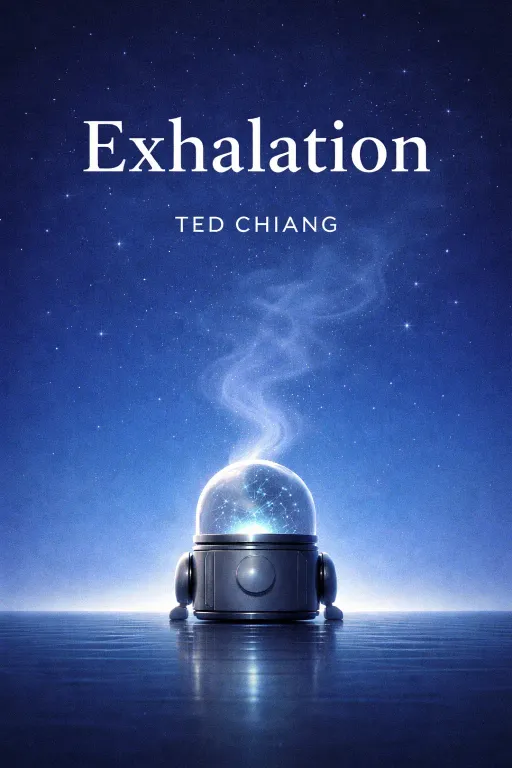
Narrator: In the title story, "Exhalation," Chiang shifts from the nature of time to the nature of life itself. The narrator is a scientist from a race of mechanical beings who live in a universe of chromium and run on air pressure. Their "lungs" are canisters of highly pressurized air that they must refill daily. The story begins with an investigation into a strange anomaly: clocks across their world seem to be running faster.
Driven by curiosity, the narrator performs an auto-dissection, building a complex apparatus of prisms and manipulators to examine his own brain while he is still thinking. He makes a startling discovery. Memory and consciousness are not stored in fixed gears or inscribed foils. Instead, they are intricate, ever-changing patterns of air flowing through tiny gold leaves in the brain. "All that we are," he realizes, "is a pattern of air flow."
This discovery solves the clock mystery. The clocks aren't running faster; their brains are running slower. The atmospheric pressure of their universe is slowly increasing, reducing the pressure differential that drives the flow of air and, therefore, their thoughts. Their universe is a sealed chamber, and it is slowly "exhaling" towards a final, silent equilibrium where all motion, all thought, and all life will cease. Faced with this inevitable end, the narrator finds a profound sense of purpose in documenting his civilization's story, hoping that explorers from another universe might one day find his words and "contemplate the marvel that is existence."
The Burden of Perfect Memory Forces a Painful Honesty
Key Insight 4
Narrator: Technology’s role as a mirror to the human soul is explored in "The Truth of Fact, the Truth of Feeling." The story is set in a near future where "Remem," a tool that provides instant video recall from personal lifelogs, is becoming common. The narrative juxtaposes the narrator’s experience with this new technology against the story of Jijingi, a man from the Tiv tribe in pre-colonial Africa, who is learning to write for the first time. For the Tiv, an oral culture, truth is fluid and serves social harmony. For literate cultures, truth is fixed and recorded.
The narrator initially worries that Remem will destroy relationships by allowing people to "keep score" in arguments, preventing the natural process of forgetting that allows for forgiveness. His fears are realized when he uses Remem to revisit a painful argument with his daughter, Nicole. He has spent years telling himself a story of that fight where she was cruel and he was the wounded victim.
The video footage reveals the opposite. It was he who spoke the cruel, unforgivable words. His memory had subconsciously rewritten the past to protect his ego. The objective, unalterable truth of the video shatters his self-perception. The experience is devastating, but it is also liberating. He concludes that the true purpose of perfect memory is not to prove you were right, but to force you to admit you were wrong. It is a tool for radical, painful, but ultimately necessary self-awareness.
Moral Responsibility Persists in an Infinite Multiverse
Key Insight 5
Narrator: "Anxiety Is the Dizziness of Freedom" tackles the free will debate in the context of the many-worlds interpretation of quantum mechanics. In this world, "prisms" are devices that allow communication with parallel timelines that branch off from a single quantum event. The knowledge that infinite versions of yourself exist, making every possible choice, creates a moral crisis. As one character, Nat, asks, "Why should I bother being nice to other people, if every time I’m also being a dick to them?"
The story follows Nat, who works at a shop that facilitates these communications, and Dana, a therapist who runs a support group for people struggling with prism-induced anxiety. Many people use information from other branches to justify their actions or wallow in envy of their more "successful" selves. The story offers a powerful counter-narrative through Dana. She argues that while you can't control the actions of your parallel selves, you are solely responsible for the person you are building in this branch.
She explains that every decision you make contributes to your character. By consistently choosing to act with compassion and integrity, you not only become a better person, but you also ensure that "more and more of the branches that split off from this point forward are populated by better versions of you." The existence of a multiverse doesn't negate responsibility; it amplifies the importance of character, which is defined by the consistent pattern of choices one makes, whether across time or across timelines.
Conclusion
Narrator: Across its nine stories, Exhalation consistently uses speculative technology as a scalpel to dissect the human condition. Ted Chiang’s work reveals that our most advanced thought experiments about time travel, artificial intelligence, and parallel universes are ultimately not about the future, but about the present. They are tools for understanding the timeless dilemmas of fate, choice, memory, and meaning. The book’s single most important takeaway is that technology’s greatest power is its ability to act as a mirror, forcing us to confront the stories we tell ourselves and the nature of our own consciousness.
In a world increasingly filled with our own versions of "Remem" and "prisms"—from social media profiles that present alternate versions of our lives to algorithms that predict our choices—Chiang’s work is more relevant than ever. It leaves us with a critical question: as technology continues to reveal the myriad possibilities of what we could be, who do we choose to become?