

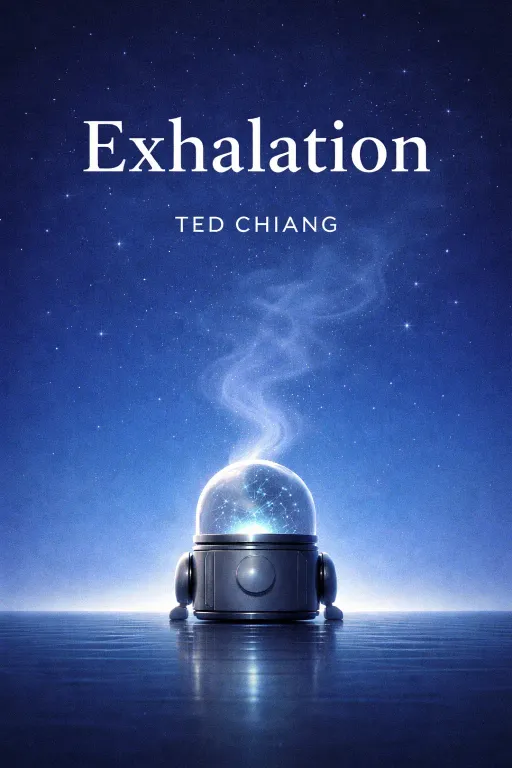
The Ledger of Choice: Auditing Fate, Memory, and Parallel Lives with Ted Chiang
Golden Hook & Introduction
SECTION
Socrates: Imagine holding a small, sleek device with a single button and a green LED. The light flashes. Exactly one second before you press the button. You try to outsmart it. You wait, you twitch, you hesitate. But the light always wins. If your actions are already written in the code of the universe, does choice even exist?
OfficerJnr: It is a terrifying thought, Socrates. As someone who spends my days analyzing data and trying to forecast trends, the idea that the future is already a closed ledger—that there is no variance, no actual risk because the outcome is predetermined—it completely upends how we value decision-making.
Socrates: Indeed. If the ledger is already closed, why do we bother calculating the risk? Today, we are going to tackle Ted Chiang's brilliant collection,, from two distinct angles. First, we will explore the psychological weight of parallel choices and determinism through Chiang's concepts of Prisms and Predictors. Then, we will discuss the tension between objective records and emotional truth, auditing how we construct our own personal histories. OfficerJnr, where does the mind go when it realizes it has no say in its own destiny?
OfficerJnr: Well, in Chiang's story, "What's Expected of Us," the mind goes to a very dark place. When people realize they cannot outwit the Predictor, when they realize that every action is anticipated by a simple green light, they stop. They stop eating, they stop moving, they stop speaking. It is a condition called akinetic mutism. It is a waking coma. They track motion with their eyes, but the will to act is entirely gone. Because, as they say, "But now I know."
Socrates: "But now I know." Is knowledge, then, a form of paralysis?
OfficerJnr: In this case, yes. It is the ultimate systemic failure. If you remove the belief in free will, the entire human operating system crashes. It shows that our motivation, our sense of responsibility, is built on a necessary illusion. We have to pretend our decisions matter just to keep the machinery of civilization running.
Deep Dive into Core Topic 1
SECTION
Socrates: A necessary illusion. But what happens when technology does not just predict our choices, but actually splits them? In "Anxiety is the Dizziness of Freedom," Chiang introduces "prisms"—devices that perform a quantum measurement to create two newly divergent timelines. Suddenly, you can talk to your parallel self, your paraself. How does that shift the balance of decision-making?
OfficerJnr: It introduces a massive psychological debt. Think of it like this: in finance, we look at opportunity cost—what we lose by choosing path A over path B. But with prisms, that cost is no longer theoretical. It is living, breathing, and talking back to you. You can see the version of you that took the other job, or married the ex, or made the lucky investment.
Socrates: And what does that visibility do to the human heart?
OfficerJnr: It breeds a highly specialized form of envy. Take the character Lyle in the story. He uses a prism to decide on a job offer. The blue light flashes, so he takes the new job. But after a while, he grows miserable, while his paraself, who stayed at the old job, gets promoted and finds romantic success. Lyle becomes utterly consumed by this. He is not envying a stranger; he is envying himself. He feels cheated by his own parallel existence. It is a complete breakdown of contentment.
Socrates: Is it a breakdown of contentment, or a refusal to accept the boundaries of a single life? How do these timelines actually diverge? Is it purely human choice, or is there a deeper, chaotic randomness at play?
OfficerJnr: That is the fascinating part. Chiang references the experiments of a scientist named Peter Silitonga. He showed that even if humans take no action, the timelines diverge rapidly due to microscopic quantum perturbations. Silitonga looked at weather patterns—a tiny difference in an oxygen molecule's collision scales up to global weather divergence within a month. He even looked at human conception. In his study, every single child born a year after a prism's activation had a different chromosomal makeup than their counterpart in the other branch. Some were boys in one branch, girls in the other.
Socrates: So, the very fabric of identity is contingent on a quantum coin toss?
OfficerJnr: Exactly. It is a chaotic system. And yet, humans still try to find personal meaning and blame in it. There is another character, Zareenah, whose niece was rejected by Vassar in this timeline but accepted in a parallel one. Zareenah blames herself, thinking her activation of a prism somehow caused the rejection. She is carrying this immense guilt, trying to find a causal link in what is essentially atmospheric turbulence.
Socrates: We seek causality in the noise. But what about those who use this noise to escape accountability? Like Jorge, who vandalized his manager's car, and then used a prism service to check if his parallel selves did the same. When he found out none of them did, he felt absolved. He thought, "It was just a freak accident, not who I am." What do you make of that audit?
OfficerJnr: It is a classic case of bad accounting, Socrates. He is trying to externalize his moral debt. By looking at his parallel selves and seeing they did not commit the crime, he treats his own conscious action as a statistical anomaly. But his therapist, Dana, challenges this. She points out that even if it is an anomaly, is the one who chose to cross that line in this branch. You cannot use the virtue of your parallel selves to pay for your own moral bankruptcy.
Socrates: If every choice is made somewhere, in some branch of the multiverse, does individual morality lose its value? Why bother being good if a parallel version of you is inevitably being a villain?
OfficerJnr: That is the existential crisis Nat faces in the support group. She asks, "Why should I bother being nice to other people, if every time I'm also being a dick to them?" But Dana gives a beautiful, structured response. She says that every decision you make contributes to your character. If you consistently choose to do the right thing, you are shaping the kind of person you are. And by becoming a better person, you ensure that a higher percentage of the branches that split off from this point forward are populated by better versions of you. You are shifting the probability matrix of your own soul.
Socrates: Shifting the probability matrix of the soul. That sounds like a portfolio worth managing. But the market is not always benevolent, is it? There are those who exploit these connections for profit.
OfficerJnr: Yes, the data brokers. Like Morrow. He is a deeply cynical character who preys on people's grief and vulnerability. He takes a prism to Mrs. Oehlsen, an elderly, dying widow, and fabricates a lie about a "timeline tax" to scam her into transferring her wealth to her parallel self. He treats parallel timelines as a financial playground, completely ignoring the human cost. And tragically, his greed catches up with him when Mrs. Oehlsen's son, Glenn, confronts and kills him. Morrow thought he was safe because he believed Glenn would not risk jail time in "this" branch. He miscalculated the local risk.
Socrates: He forgot that regardless of the infinite branches, we still live and die in the local timeline.
OfficerJnr: Precisely. You only experience the branch you are currently standing on. The others are just data points.
Deep Dive into Core Topic 2
SECTION
Socrates: Let us pivot from the branches of the future to the roots of the past. In "The Truth of Fact, the Truth of Feeling," Chiang introduces "Remem," a search engine for your life. It uses continuous video lifelogs and retinal projection to give you instant, perfect recall of every moment you have ever experienced. If you argue with someone, you can search the record and see exactly what was said. How does this perfect ledger affect the economy of human relationships?
OfficerJnr: It changes the currency of relationships from grace to forensic accuracy. Chiang shows us a couple, Joel and Deirdre. During an argument, Deirdre uses Remem to fact-check Joel's memory. He claimed he "knew all along" that a certain criminal suspect was guilty, but Deirdre pulls up a video from years ago where Joel was passionately defending the guy, calling him a scapegoat. It completely embarrasses Joel. It turns a personal relationship into a courtroom.
Socrates: A courtroom. But is there not a value in absolute truth? Why do we fear the objective record?
OfficerJnr: Because human memory is not designed to be a video recorder. It is designed to be a editor. We rewrite our pasts to suit our current needs, to support the story we tell about ourselves. Chiang calls it a "Whig interpretation of our personal histories"—we see our former selves as stepping stones to our glorious present selves. We smooth over our mistakes, we soften our sharp edges, so we can live with ourselves. If you remove that malleability, you remove our ability to heal.
Socrates: To heal. You mean we must forget in order to forgive?
OfficerJnr: Yes, absolutely. Chiang writes about this psychological feedback loop: we have to forget a little bit of the pain before we can forgive. Once the insult is no longer fresh, it is easier to pardon, which in turn makes it less memorable. But if you can replay the insult in high-definition, with the exact tone of voice and facial expression, the anger stays fresh. The wound never scabs over.
Socrates: The wound remains open. This reminds me of Jijingi, the young Tiv man in the story's historical thread. He learns the art of writing from a European missionary, Moseby. The Tiv are an oral culture. Their history, their lineages, are fluid. They adapt to serve the current social harmony. But when writing arrives, it fixes things in place. What happens when Jijingi tries to reconcile the written record with the oral tradition?
OfficerJnr: It creates a massive systemic shock. Jijingi travels to Katsina-Ala and finds written government records that contradict the elders' oral account of clan lineage. To the elders, the oral account is —which means "what is right, what is harmonious." It is a truth that serves the community. But the written record is —which means "what is precise, what is factual." The elders reject the paper truth because it threatens the peace of the tribe. They tap Jijingi on the chest and ask, "Have you studied paper so much that you've forgotten what it is to be Tiv?"
Socrates: "What it is to be Tiv." Is there a danger that in pursuing the precise, we destroy the harmonious?
OfficerJnr: That is the core conflict. Writing is a cognitive technology that reshapes how we think. It makes us "cognitive cyborgs," as Chiang suggests. It forces us to value the static, unyielding fact over the living, adaptive relationship. And Remem is just the next stage of that evolution. It is the ultimate transition from oral memory to written memory.
Socrates: But is the static fact always the enemy of growth? Consider the narrator of that story. He had a deeply painful memory of an argument with his daughter, Nicole, when she was a teenager, right after her mother left. He remembered her screaming at him, saying he was the reason her mother left, that he drove her away, and that she would be better off without him. He carried that wound for years, viewing himself as the victim of a cruel daughter. But then, he searches his Remem logs. What does he find?
OfficerJnr: He finds a devastating truth. The video reveals that was the one who said those exact words to. He screamed at his own daughter, telling her that she was the reason her mother left, and that he would be better off without her. His mind had completely inverted the roles to protect his own ego. He had cast himself as the victim to avoid the crushing guilt of being a terrible father.
Socrates: A shocking audit. How does he react to this discrepancy?
OfficerJnr: It shatters him, but it also saves him. He realizes that his memory was a lie. He goes to Nicole, shows her the footage, and apologizes. It allows for a moment of genuine reconciliation that would have been impossible if he had clung to his self-serving narrative. He concludes that the point of perfect digital memory is not to prove you were right, but to admit you were wrong. It is a tool for radical humility.
Socrates: Radical humility. So, the ledger is not just a tool for prosecution, but for confession?
OfficerJnr: Exactly. It forces us to confront our own capacity for self-deception. In finance, we have audits to ensure that the books reflect reality, not just our wishes. Remem is a moral audit. It is painful, yes, but it is the only way to ensure our self-perception is grounded in truth.
Synthesis & Takeaways
SECTION
Socrates: We have traveled through parallel worlds and audited the archives of memory. How do we synthesize these two mirrors? Whether we are looking at the parallel lives we did not lead, or the actual lives we misremembered, what is Chiang ultimately asking us to do?
OfficerJnr: He is asking us to take ownership of the present moment. In both stories, technology exposes the limits of our control. We cannot control the quantum divergence of the universe, and we cannot control the fallibility of our organic brains. But we can control our intentions right now. We can choose to be the kind of person who makes the honest choice, who admits when the ledger does not balance, and who treats others with grace, regardless of what is written in the stars or on the hard drive.
Socrates: A profound synthesis. If you could leave our listeners with one actionable question to audit their own lives today, what would it be?
OfficerJnr: I would ask them this: If you could look at a perfect, unedited video of your most painful conflict, are you prepared for the possibility that you were the antagonist, and not the victim? And if so, do you have the courage to balance that ledger?
Socrates: A heavy question, but a necessary one. Thank you, OfficerJnr, for bringing your analytical mind and protective heart to this exploration of Ted Chiang's universe.
OfficerJnr: Thank you, Socrates. It has been an incredible learning experience.
Socrates: And to our listeners, may your choices be conscious, your memories honest, and your character consistent across all timelines. Until next time.