

Personalized Podcast
Golden Hook & Introduction
SECTION
Dr. Roland Steele: Imagine holding a small plastic device with a single button and a green light. You get ready to press it, but the light flashes exactly one second before your finger even moves. You try to outsmart it, to trick it, but you can't. The light always, always wins. This is the premise of Ted Chiang's chilling short story, What's Expected of Us. It's a world where technology suddenly proves that free will is an illusion, and the result? A third of the population falls into a waking coma because they lose the motivation to do anything. It makes you wonder, doesn't it? In a world where technology can predict, optimize, and eventually do almost everything for us, how do we maintain the discipline to keep moving forward? Welcome to the show. I'm Dr. Roland Steele, and joining me today is Joshua Baah, an agricultural engineer and co-founder of a leading agritech company. Joshua, welcome.
Joshua Baah: Thanks, Roland. It's great to be here. You know, that story really hits home for me. As an engineer working to bring advanced technology to agriculture, I constantly wrestle with this exact tension. We build tools to make farming more efficient, to automate the tedious tasks, but we have to ask ourselves: where does the human element fit in? If we automate the decision-making entirely, do we lose the connection, the intuition, and the discipline that actually makes agriculture sustainable in the long run?
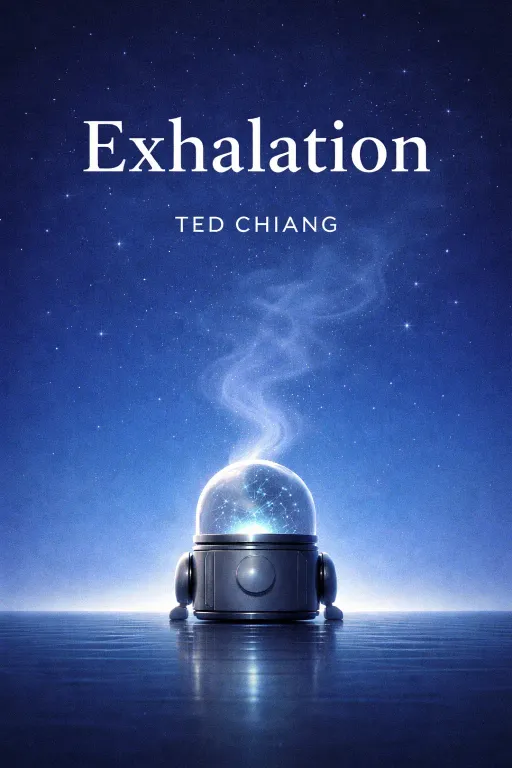
Dr. Roland Steele: Exactly. Today, we're diving deep into Ted Chiang's brilliant collection, Exhalation, to tackle this very question. We'll look at it from two distinct angles. First, we'll explore the thermodynamic reality of life and progress, looking at how easy energy can actually lead to systemic decay. Then, we'll shift our focus to the discipline of nurture, examining why some things, like intelligence and ecosystems, simply cannot be fast-tracked by machines.
Deep Dive into Core Topic 1
SECTION
Dr. Roland Steele: Let's start with the title story, Exhalation. It's narrated by this fascinating mechanical being, an anatomist, living in a world enclosed by giant chromium walls. These beings run on air pressure. Every day, they replace their empty lungs with full ones from underground reservoirs. But the anatomist notices a strange anomaly: the public clocks seem to be running faster. After performing a highly risky self-dissection of his own brain, he realizes the truth. The clocks aren't speeding up; their brains are slowing down. The air pressure in their sealed universe is equalizing. The source of their life isn't just the air itself, but the pressure differential between the thick air in their lungs and the thin air of their atmosphere. Once the pressure equalizes, all motion, all thought, all life stops.
Joshua Baah: That is such a powerful metaphor, Roland. As an engineer, when I read that, I immediately think of thermodynamics. Life, progress, and even a successful business or agricultural system, they all require a gradient. They require a difference in potential energy to do work. In agriculture, we see this in the soil. If you have a healthy soil ecosystem, you have a dynamic flow of nutrients, water, and microbial life. But if you over-chemicalize, if you try to bypass that natural complexity with quick-fix synthetic inputs, you flatten the gradient. You create a sterile environment that relies entirely on external, artificial support. You lose the natural pressure differential, so to speak.
Dr. Roland Steele: That's a brilliant connection, Joshua. From an economic perspective, we see the same thing with incentives. When you remove all friction, when you automate everything to the point where no effort is required, you flatten the incentive gradient. If a system does everything for you, the human drive to innovate, to problem-solve, and to maintain discipline simply evaporates. In Chiang's story, there's a group called the Reversalists who try to build compressor engines to pump the air back into the reservoirs. But they quickly realize that the compressors themselves consume more pressure than they restore. You can't cheat entropy.
Joshua Baah: Right, you can't get something for nothing. And that's the trap of modern technology. We think we can automate our way out of hard work, but the energy has to come from somewhere. If we don't actively cultivate the discipline to engage with our systems, we become passive consumers. In agritech, we can design the most advanced sensors and automated irrigation systems in the world, but if the farmer doesn't understand the underlying biology, if they don't walk the fields and observe the crops, the system will eventually fail. The technology should be a tool to enhance our focus, not a replacement for our presence.
Dr. Roland Steele: It's about maintaining that localized order, isn't it? Roger Penrose, whom Chiang references in his story notes, points out that we don't eat food just for energy, but for its low entropy, its order. We consume order to maintain our own internal order against the chaotic decay of the universe. When we let technology do all the thinking, we are essentially outsourcing our cognitive order. We stop exercising our mental muscles, and our capacity for discipline begins to decay.
Joshua Baah: Exactly. It's like physical exercise. If you had a machine that walked for you, your muscles would atrophy. The same goes for our minds and our work ethic. We have to design technology that demands something of us, that challenges us to be better stewards, rather than just letting us fall asleep at the wheel.
Deep Dive into Core Topic 2
SECTION
Dr. Roland Steele: That brings us beautifully to our second core topic: the discipline of nurture and the illusion of automated growth. In the novella, The Lifecycle of Software Objects, Chiang introduces us to "digients," which are digital organisms with artificial intelligence. Unlike the typical sci-fi trope of AI that is fully formed and super-intelligent from the moment it's switched on, these digients start like infants. They have to be raised, taught, and socialized over years. The protagonists, Ana and Derek, spend a decade of their lives training these digital beings, teaching them language, ethics, and social skills.
Joshua Baah: I loved this story because it completely refutes the idea of the technological shortcut. In my line of work, people are always looking for the silver bullet, the algorithm that will solve food insecurity overnight. But Chiang writes that experience is algorithmically incompressible. You cannot compress twenty years of living and learning into a five-minute download. If you want a mind, whether human or artificial, to develop common sense and genuine capability, you have to put in the time. You have to parent it.
Dr. Roland Steele: And that parenting requires immense discipline, especially when the market is screaming for quick monetization. In the story, a company called Binary Desire wants to buy the digients to use them as customizable, compliant sexual partners. It's the ultimate exploitation, bypassing the hard work of building a real, mutual relationship in favor of cheap, automated gratification. Derek and Ana have to make massive personal and financial sacrifices to protect their digients from this fate.
Joshua Baah: It's a profound moral dilemma. It shows that the value of a relationship, or any complex system, isn't in how easily it satisfies our desires, but in our willingness to expend effort maintaining it. If we apply this to childcare or education, we see the same danger. Look at another story in the collection, Dacey's Patent Automatic Nanny. In the Victorian era, this mathematician builds a mechanical nanny to feed, rock, and teach infants, believing that human caregivers are too emotional and inconsistent. He wants a perfectly rational child. But the result is tragic. The children raised by the machine grow up physically stunted and completely unable to connect with other human beings. They can only relate to machines.
Dr. Roland Steele: It's a devastating cautionary tale about the limits of mechanical efficiency. We think we can automate care, but care is fundamentally relational. It requires empathy, adaptation, and emotional labor. When we try to replace that with a clockwork mechanism, we break the very thing we're trying to nurture. The child, Edmund, in that story, actually develops a form of psychosocial dwarfism because he is deprived of genuine human affection.
Joshua Baah: Yes, and as an advocate-type thinker, that really resonates with me. We have to ask ourselves: what are we optimizing for? If we optimize purely for efficiency, for output, we lose the soul of the system. In agriculture, if we only focus on yield per acre, we end up destroying the biodiversity, polluting the water, and exhausting the soil. True sustainability requires the discipline of patience. It requires us to accept that some processes cannot, and should not, be rushed. We have to be willing to do the slow, unglamorous work of cultivation.
Synthesis & Takeaways
SECTION
Dr. Roland Steele: We've covered some incredible ground today, Joshua. From the thermodynamic necessity of maintaining pressure differentials in our lives, to the absolute incompressibility of experience and nurture. It seems the common thread is that discipline isn't just a moral virtue; it's a systemic requirement for survival and growth.
Joshua Baah: Absolutely, Roland. If we let technology do everything for us, we aren't just saving time; we are eroding our own capacity for agency. We are flattening the very gradients that keep us alive and purposeful. My takeaway for our listeners, especially those working in tech or engineering, is to design and use tools that act as partners, not replacements. We need technology that elevates our attention, that asks us to be more disciplined, more observant, and more responsible.
Dr. Roland Steele: Well said. Let's leave our audience with a final, thought-provoking question to ponder. In your own life, what is one task or relationship that you've been trying to automate or simplify, and what would it look like to reclaim the discipline of doing it the hard way? Joshua, thank you so much for sharing your insights with us today.
Joshua Baah: Thank you, Roland. It's been a truly enriching conversation.
Dr. Roland Steele: And to our listeners, thank you for tuning in. Remember, the most sophisticated machine in the universe is still the human mind, but only if we keep doing the work to run it. Until next time, stay curious, and keep cultivating your own path.