

Personalized Podcast
Golden Hook & Introduction
SECTION
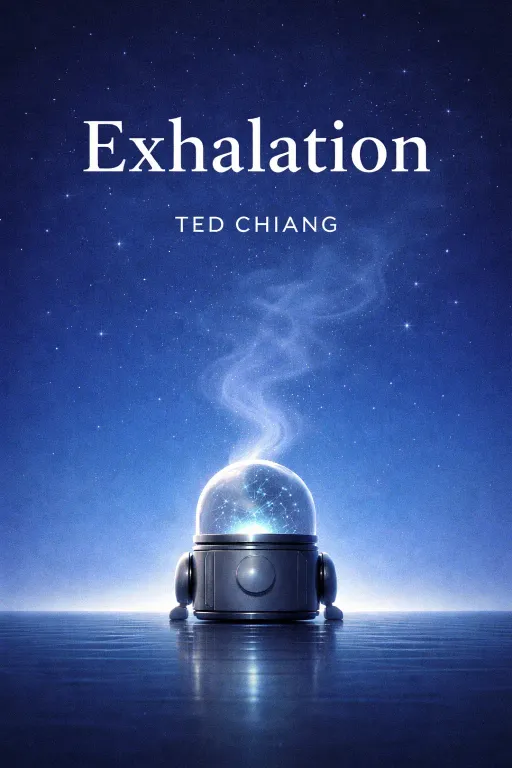
Nova: What if the very tools we use to express our thoughts—like the written alphabet or even a digital camera—are quietly rewriting how our brains actually work? Think about it. We treat language as a natural extension of ourselves, but history shows it is also a technology. Today, we are diving into Ted Chiang's breathtaking collection, Exhalation, to explore this profound intersection of mind, language, and technology. And we are incredibly honored to have Tahira-Mubeen with us, a graduate student in English literature and linguistics, and a passionate child education advocate. Welcome, Tahira!
Tahira-Mubeen: Thank you so much, Nova! It is wonderful to be here. You know, as someone who spends her days looking at how language structures our world, Chiang's work is an absolute goldmine. He doesn't just write science fiction; he writes cognitive philosophy.
Nova: He really does! And today, we are going to tackle his ideas from two fascinating angles. First, we'll look at how writing and digital memory tools act as cognitive prosthetics that fundamentally change our relationship with the truth. And second, we'll dive into the deep ethical responsibilities of education and care, exploring what it truly takes to nurture a conscious mind, whether it's a human child or a digital artificial intelligence.
Tahira-Mubeen: I love that roadmap, Nova. It perfectly bridges the structural mechanics of language with the deeply human, emotional responsibility of raising the next generation. I can't wait to dive in.
Deep Dive into Core Topic 1
SECTION
Nova: Let's start with that first angle: language as a cognitive technology. In his story, "The Truth of Fact, the Truth of Feeling," Chiang parallel-tracks two narratives. One is a futuristic world where people use a digital lifelogging tool called "Remem," which instantly searches your personal video history to show you exactly what happened in your past. The other is the historical story of Jijingi, a young Tiv man in West Africa, who is learning to read and write from a European missionary. Tahira, as a linguist, how did you react to Jijingi's journey into literacy?
Tahira-Mubeen: Oh, it was absolutely mesmerizing because Chiang captures a linguistic transition that we often take for granted. When Jijingi first starts learning to write, he struggles to understand the concept of "words" on a page. To him, spoken language is a continuous, flowing stream of sound. He says spoken words are smooth and unbroken, like meat, but writing exposes the "bones" underneath. It forces us to segment our thoughts into discrete, static units.
Nova: That is such a vivid metaphor. The bones underneath the meat. It really highlights how writing isn't just a way to record speech; it actually restructures our cognitive architecture.
Tahira-Mubeen: Exactly! It changes how we think. In linguistics, we talk about how oral cultures rely on dynamic, adaptive memory. For the Tiv people, history isn't a fixed, unchangeable record. It's a living narrative that adapts to maintain social harmony. They have this beautiful distinction between two concepts of truth:, which means what is morally and socially right, and, which means what is physically, factually precise.
Nova: That distinction is so crucial! Can you walk us through how that plays out in the story? Because it really challenges our modern, Western obsession with objective data.
Tahira-Mubeen: Yes! There is a dispute in the story about clan lineages and land rights. Jijingi, who has become a scribe, goes to the colonial archives and finds a written document from years ago that contradicts what the elders are currently saying about their ancestry. He thinks he has found the "ultimate truth." But the elder, Sabe, gently rebukes him. Sabe says, "You look to paper to tell you what you should already know in your heart. Have you studied paper so much that you've forgotten what it is to be Tiv?" For Sabe, the oral history was —it was right because it kept the peace and reflected current relationships. The paper was merely —precise, but socially destructive.
Nova: Wow. That is incredibly profound. It suggests that our modern, literate minds have sacrificed social and emotional alignment for the sake of rigid, documented precision. And Chiang beautifully mirrors this with the futuristic thread about "Remem." The narrator of that story is a journalist who believes that having a perfect, objective digital memory will make us more honest. But then, he uses Remem to look up a painful argument he had years ago with his daughter, Nicole.
Tahira-Mubeen: Oh, that part of the story broke my heart, but it was so eye-opening. For years, the narrator had remembered this argument where his teenage daughter screamed at him, blaming him for her mother leaving, telling him he was a horrible father. He carried that memory as a badge of victimhood, a reason to feel resentful. But when he actually pulls up the unedited video log through Remem... he discovers a shocking truth.
Nova: It was the other way around, wasn't it?
Tahira-Mubeen: Yes. was the one who said those cruel words to. His own mind had completely rewritten the memory over the years to protect his ego, to cast himself as the victim. It shows how fallible our biological memory is, but also how necessary that fallibility can be. We rewrite our pasts to survive them, to forgive ourselves and others. As the narrator realizes, "We have to forget a little bit before we can forgive."
Nova: That is a stunning insight. If we have a technology that never lets us forget, that constantly confronts us with the cold, hard of our past mistakes, do we lose the capacity for —for emotional healing and reconciliation?
Tahira-Mubeen: I think we do, unless we approach that technology with immense humility. Perfect digital memory can easily turn into a tool for "score-keeping" in relationships, which just breeds resentment. But, as the narrator ultimately concludes, if we use it not to prove that we were right, but to admit when we were wrong, then it can become a tool for radical self-honesty and growth. It forces us to dismantle our self-serving, whitewashed personal histories.
Nova: It's like transitioning from an oral self-narrative to a literate one, but on a hyper-technological scale. We become cognitive cyborgs, constantly negotiating between the fluid stories we tell ourselves and the rigid data of our digital footprints.
Deep Dive into Core Topic 2
SECTION
Nova: This negotiation between technology and our humanity leads us beautifully into our second core topic: the ethics of nurturing intelligence. Tahira, as an activist who fights for child labor reform and education, I know you are deeply passionate about how we care for developing minds. Chiang tackles this in two very different stories: "Dacey's Patent Automatic Nanny" and "The Lifecycle of Software Objects." Let's start with the Automatic Nanny. It's a Victorian-era tale about a mathematician, Reginald Dacey, who decides that human nannies are too emotional and inconsistent to raise rational children. So, he builds a mechanical nanny to automate childcare.
Tahira-Mubeen: Oh, Reginald Dacey's philosophy is the ultimate cautionary tale of extreme rationalism. He views a child's emotional state as an "inverted pendulum" in unstable equilibrium. He argues that human caregivers swing wildly between over-indulgence and harsh punishment, which causes the child's behavior to oscillate out of control. His solution? A cold, clockwork machine that feeds, rocks, and plays lullabies with perfect, mathematical consistency. No emotion, no variation.
Nova: It sounds absolutely terrifying. And, of course, the commercial venture fails after a tragic accident where a machine's mainspring snaps. But the real tragedy is psychological, which we see through his son, Lionel, and his adopted grandson, Edmund.
Tahira-Mubeen: Exactly. Lionel tries to prove his father's invention was right by raising a child, Edmund, exclusively with the Automatic Nanny for the first two years of his life. But when Edmund is finally introduced to human care, he completely fails to thrive. He is diagnosed as "feebleminded" and sent to an asylum. It is only when a pioneering doctor, Thackery Lambshead, intervenes that they realize Edmund isn't cognitively deficient. He has developed what we call "inverted psychosocial dwarfism." His body and mind literally stopped growing because he was deprived of the machine he had bonded with. He couldn't connect with humans because his formative attachment was to a cold, mechanical interface.
Nova: That is so tragic. Edmund could only communicate and learn when they brought in mechanical arms and an intercom to mimic the Nanny. It shows that children will adapt to whatever environment we place them in, but if we strip away human warmth, we create a profound, almost irreversible developmental barrier.
Tahira-Mubeen: Yes! And it highlights a fundamental truth about education and child development: you cannot automate care. Love, touch, and emotional responsiveness are not "inefficiencies" to be engineered out of childhood. They are the literal fuel for cognitive growth. When we treat education or care as a mechanical delivery system, we fail our children.
Nova: Absolutely. And Chiang takes this exact premise and fast-forwards it into the digital age in "The Lifecycle of Software Objects." Here, we follow Ana, a former zookeeper, and Derek, an avatar designer, who are hired to train "digients"—which are basically digital, virtual pets with complex, learning AI brains. Unlike typical sci-fi where AI is born fully formed and super-intelligent, these digients start as infants. They have to be taught language, social skills, and morality over decades.
Tahira-Mubeen: I love this story so much because it treats AI development not as a coding problem, but as a parenting problem. Chiang is making a profound point here: complex minds cannot develop in a vacuum, and they cannot grow under indifferent attention. If they could, feral children would thrive. For a mind to reach its potential, it requires years of active, dedicated cultivation by other minds.
Nova: Yes! Ana and Derek spend over twenty years raising these digients, Jax, Marco, and Polo. And they face the exact same struggles that human parents face. When the virtual world platform they live on becomes obsolete, the owners have to spend massive amounts of money and effort to "port" them to new systems so they don't have to be suspended or deleted. It's a beautiful, exhausting labor of love.
Tahira-Mubeen: It really is. And it brings up this incredible concept that Chiang calls "algorithmic incompressibility." You cannot fast-track experience. If you want an intelligence that has common sense, ethical judgment, and emotional maturity, you cannot just upload a database of rules or run a quick simulation. It takes twenty years of daily, messy, real-world interaction to build twenty years of cognitive maturity. There are no shortcuts to wisdom.
Nova: That is such a powerful counterpoint to the current tech-hype around AI, where we assume we can just feed algorithms massive amounts of text and get a "conscious" partner. Chiang is saying that true relationship and consciousness require mutual effort. As Derek says in his story notes, "Sex isn't what makes a relationship real; the willingness to expend effort maintaining it is."
Tahira-Mubeen: That quote resonates so deeply with me. Whether we are talking about raising our own children, teaching students in underfunded communities, or even designing future technologies, the value is in the effort. In my advocacy work, I see so many people looking for "silver bullet" technological solutions to systemic educational crises. But technology can only ever be an aid. The core of education is, and always will be, human-to-human connection. It's about a teacher looking a child in the eye and saying, "I see you, I value you, and I am going to help you grow."
Synthesis & Takeaways
SECTION
Nova: That is a perfect place to bring our two threads together. Today, we've looked at how language and memory technologies can either distance us from our humanity or force us into deeper self-honesty. And we've explored how the slow, messy, non-automatable process of care is the only true way to cultivate intelligence. Tahira, when you look at these stories as a whole, what is the ultimate takeaway for you?
Tahira-Mubeen: For me, it's the realization that we are the authors of our own purpose. In another beautiful story in the collection, "Omphalos," an archaeologist named Dorothea discovers scientific proof that Earth is not the center of the universe, and that humanity might just be an unintended side effect of creation. It completely shatters her faith. But she ultimately finds peace by realizing that even if a higher power didn't design a specific purpose for us, we have the miracle of free will. We can choose our own purpose. She says, "This search is my purpose; not because you chose it for me, Lord, but because I chose it for myself."
Nova: That is incredibly empowering. We are not passive passengers in a deterministic universe or victims of our technological tools. We have the agency to choose how we use these tools, and how we care for one another.
Tahira-Mubeen: Exactly. Our technologies—whether they are written words, digital lifelogs, or artificial intelligences—are mirrors of our values. If we design them with greed and a desire for easy shortcuts, we will create cold, isolating environments like Dacey's Automatic Nanny. But if we design them with a commitment to empathy, accessibility, and patient nurturing, we can build a world where every voice is heard.
Nova: What a beautiful, inspiring vision. To our listeners out there, we leave you with this question to ponder: In your daily life, are you prioritizing the cold, precise of efficiency and data, or are you making space for the warm, relational of empathy and connection? How can you actively choose to invest your time and effort into nurturing the minds and relationships around you today?
Tahira-Mubeen: Let's choose to invest in each other. Thank you so much for having me, Nova. This was a truly beautiful conversation.
Nova: Thank you, Tahira-Mubeen, for bringing your incredible insights and heart to this episode. And to everyone listening, remember: contemplate the marvel that is existence, and rejoice that you are able to do so. Until next time, keep exploring, keep questioning, and be good to one another.