

The Illusion of Choice
Golden Hook & Introduction
SECTION
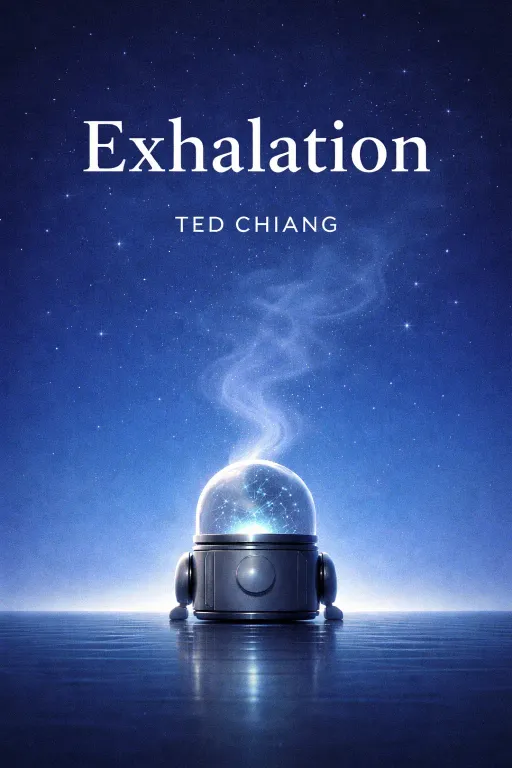
Christopher: Most people think time travel is about fixing your biggest regrets. But what if the only thing a time machine could do is prove you're powerless to change anything? That your past, and your future, are completely set in stone. Lucas: That sounds... incredibly depressing. Why would anyone even build that? It’s like a cosmic prank. Christopher: It’s a fascinating question, and it’s the kind of mind-bending territory we’re exploring today from Ted Chiang's brilliant collection of short stories, Exhalation. Lucas: Ah, Ted Chiang. This is the guy who wrote the story that the movie Arrival was based on, right? He's not your typical sci-fi author; he's more like a philosopher who uses science fiction as his laboratory. Christopher: Exactly. He's won nearly every major science fiction award there is, and his work is famous for these incredibly rigorous, almost parable-like thought experiments. Critics often compare his conceptual depth to writers like Borges. And today, we're diving into two of his most powerful ideas. Lucas: I'm ready. My brain is adequately caffeinated for some philosophical heavy lifting. Christopher: Perfect. And that first idea, the one about the unchangeable past, comes from a story that feels like it's straight out of the Arabian Nights.
The Unshakeable Past and the Illusion of Choice
SECTION
Christopher: The story is called "The Merchant and the Alchemist's Gate." It's set in ancient Baghdad, and our narrator is a fabric merchant named Fuwaad. He stumbles upon the shop of an alchemist named Bashaarat, who has created something truly astonishing. Lucas: Let me guess, he turned lead into gold? Christopher: Better. He’s built a "Gate of Years." It's a simple-looking stone archway, but if you walk through it, you emerge twenty years in the future. And right next to it is another gate that takes you twenty years into the past. Lucas: Okay, so this is the classic setup. Someone gets a time machine. I'm guessing he immediately tries to go back and buy some ancient equivalent of Bitcoin, right? Get rich? Christopher: That's what you'd think! And Bashaarat tells him a story about a young, poor rope-maker named Hassan who did just that. Hassan uses the gate to visit his future self, who he finds is a wealthy merchant in Cairo. Lucas: See? Called it. So older, rich Hassan gives younger Hassan the stock tips, tells him which camel races to bet on, and he becomes a millionaire. Christopher: Almost. The older Hassan gives him some very specific advice: walk on a certain side of the street to avoid a runaway horse, buy extra hemp to avoid a shortage. He even tells him where to find a hidden treasure. Young Hassan follows the advice, finds the treasure, and sure enough, twenty years later, he’s that same wealthy merchant. Lucas: A perfect success story. Time travel for the win. Christopher: But here's the twist. The older Hassan then explains that the only reason he knew what advice to give is because he remembered receiving it from his older self when he was a young man. It's a closed loop. The future was already written. Lucas: Hold on. So he didn't change his future, he just... fulfilled it? That feels like a cheat. What's the point of knowing if you can't alter the outcome? It's like watching a movie you've already seen, but you're also forced to act in it. Christopher: That's the exact philosophical dilemma the story forces you to confront. The gate isn't a tool for changing your destiny; it's a tool for understanding it. And this becomes deeply personal for our narrator, Fuwaad. He has a terrible regret. Years ago, he had a bitter argument with his wife, Najya, and said cruel things to her. She died unexpectedly before he could apologize. Lucas: Oh, that's rough. So he wants to use the gate to go back and take it all back. Christopher: Precisely. He wants to go back twenty years, find his younger self, and tell him to be kind to his wife. He embarks on this grueling, years-long journey to find the other end of the gate in Cairo. He endures hardship, gets thrown in jail, all driven by this one hope of fixing his greatest mistake. Lucas: And does he make it? Christopher: He does. He finally gets to the gate and steps through into the past. But he arrives just days after his wife has already died. He's too late. The past is unchangeable. Lucas: That's heartbreaking. So the technology just dangles this hope in front of him and then snatches it away. It's cruel. Christopher: It feels that way, but it leads him to the story's profound conclusion. He's devastated, but then a woman who was his wife's nurse finds him. She tells him that Najya's last words were not of anger, but of love for him. She died happy, remembering their good years together. Fuwaad realizes he couldn't change the event, but he could change his understanding of it. He could finally let go of his guilt. Lucas: So the journey wasn't about changing the past, but about finding peace with it. Christopher: Exactly. And that's the final lesson Fuwaad shares with the Caliph at the end of the story. He says, and this line gives me chills every time: "Nothing erases the past. There is repentance, there is atonement, and there is forgiveness. That is all, but that is enough." Lucas: Wow. So the "remedy" for the past isn't external, it's internal. That's a really powerful way to think about regret. Okay, so that's a technology that forces you to accept the truth of the past. That's a powerful idea. But it makes me wonder... what if a technology could show you a truth about yourself that you've been denying your whole life?
The Truth of Fact vs. The Truth of Feeling
SECTION
Christopher: You've just perfectly set up the next story, "The Truth of Fact, the Truth of Feeling." In this world, a new technology called 'Remem' has become common. Think of it like a search engine for your own life. Everyone has a continuous video log of everything they've ever seen, and Remem lets you pull up any moment instantly. Lucas: Oh, I can see where this is going. This is the ultimate "I told you so" device. I can imagine couples using this to win every single argument. "See? You did say you'd take out the trash! It's right here, timestamped!" Christopher: That's exactly how it starts. The narrator, a journalist, interviews a couple who uses it for that very purpose. But the story gets much deeper and more personal. The narrator has a painful memory from his teenage daughter Nicole's life. Right after his wife left them, he remembers them having a terrible fight. Lucas: I can imagine. A really volatile situation. Christopher: He remembers it vividly. He remembers Nicole screaming at him, "You're the reason she left! You drove her away! You can leave, too, for all I care. I sure as hell would be better off without you." For years, he's built this entire narrative of their reconciliation around him forgiving her for saying this terrible thing. Lucas: That's a heavy weight to carry, for both of them. Christopher: It is. And one day, he decides to use Remem to look up that exact moment, maybe to finally put it to rest. He searches for the memory, the video plays, and he hears those exact words. Lucas: Don't tell me... he was the one who said it? Christopher: Exactly. The video shows him, the father, screaming those exact words at his teenage daughter. His memory, over decades, had completely flipped the script. He had subconsciously edited his own past to cast himself as the victim and her as the aggressor. Lucas: Wow. That's... devastating. It's like finding out the villain in your life story was actually you the whole time. It makes you question every memory you have. Is any memory 'true'? Christopher: And that's the core question. Chiang pairs this personal story with a parallel narrative about a man named Jijingi, from the Tiv people of Nigeria, who is learning to write from a European missionary. For the Tiv, an oral culture, there are two kinds of truth. There's 'vough,' which means factually precise, accurate truth. And then there's 'mimi.' Lucas: What's 'mimi'? Christopher: 'Mimi' is a deeper truth. It's about what is socially right, what maintains harmony, what feels correct for the community. In Tiv court, if a storyteller changes the details of a historical account to make it align with the current social structure and keep the peace, that's not considered a lie. It's speaking 'mimi.' It's the truth of feeling and narrative. Lucas: I see. So our human memory operates on 'mimi.' We shape our past to fit the story we need to tell ourselves. But this Remem device is the ultimate tool of 'vough.' It's pure, unedited, factual truth. Christopher: And when the two collide, it can be shattering. The narrator has to confront the fact that his entire narrative of being a wronged, forgiving father was a fiction he created to protect his own ego. The technology forces a painful, but ultimately necessary, self-confrontation.
Synthesis & Takeaways
SECTION
Christopher: So you have these two incredible technologies from Chiang's imagination. One is a time gate that proves your future is fixed and your choices are part of a closed loop. The other is a memory device that proves your recollection of the past is a self-serving fiction. Lucas: In both cases, the technology doesn't give people more power or control, which is what we always assume sci-fi gadgets will do. Instead, it just humbles them. It holds up a mirror and shows them a fundamental, and often uncomfortable, truth. Christopher: That's the heart of it. The technology strips away our illusions. The illusion of control over our destiny, and the illusion of being the reliable narrator of our own lives. Lucas: And the truth is that we're not the heroic authors of our own lives in the way we think we are. We're either following a script we can't see, or we're rewriting the script after the fact to make ourselves look better. Christopher: Precisely. And the ultimate takeaway from both stories is about what you do with that knowledge. For Fuwaad, the merchant, it was realizing he couldn't change the past, but he could find forgiveness and atonement. For the narrator of the second story, confronting his lie was the first step toward genuine honesty with himself and his daughter. Lucas: So the truth isn't a weapon to win arguments or a tool to fix the past. It's something else. Christopher: It is. And Chiang gives us the perfect line to sum it all up. At the end of his journey with Remem, the narrator concludes, "The point is not to prove you were right; the point is to admit you were wrong." Lucas: That's a heavy, but really valuable lesson. It makes you wonder, if you had a Remem device, what memory would you be most afraid to look up? What truth about yourself are you avoiding? Christopher: That's a great question for our listeners. It's a fascinating and slightly terrifying thought experiment. Let us know your thoughts. We're always curious to hear how these ideas resonate with you. Lucas: This is Aibrary, signing off.