

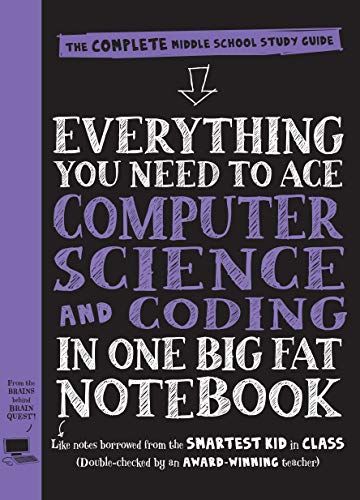
Everything You Need to Ace Computer Science and Coding in One Big Fat Notebook
Introduction
Nova: Hey there, welcome back! Quick question for you: what would you say if I told you there's a single book, aimed at middle schoolers, that covers everything from binary code and algorithms to Python programming and cybersecurity, has sold millions of copies worldwide, and is written to look exactly like the notebook of the smartest kid in class?
Nova: It's called Everything You Need to Ace Computer Science and Coding in One Big Fat Notebook, and it's part of a publishing phenomenon from Workman Publishing — the same editors behind Brain Quest, which is literally America's number one educational bestseller.
Nova: Exactly! The series launched in 2016 and has since sold over five million copies worldwide. It started with five core subjects — Math, Science, English, American History, and World History — and has expanded to 16 titles covering both middle and high school topics. But the computer science and coding edition, which came out in April 2020, is arguably one of the most relevant and timely additions.
Nova: Grant Smith is a computer science education expert. He's taught CS at both elementary and middle school levels, and he's written curricula and standards for computer science education. The book was also vetted by an award-winning computer science teacher named Dawn Dupriest. So this isn't just some publisher throwing content together — it's crafted by real educators who understood how kids learn.
Nova: Let's crack open this Big Fat Notebook!
What Makes This Series Tick
The Secret Sauce of the Big Fat Notebook
Nova: So before we get into the actual content, let's talk about why this book even works. The entire Big Fat Notebook series is built on one irresistible concept: borrowing the notes from the smartest kid in class.
Nova: Yes! The illustrator, Chris Pearce, creates these sketch-like doodles that illuminate tricky concepts. And the formatting is incredibly deliberate. Vocabulary words are highlighted in yellow. Definitions appear in green boxes. Important people, places, dates, and concepts are written in blue. Main ideas get underlined. It's visual learning at its finest.
Nova: And here's a detail I love: there are mnemonic devices sprinkled throughout. These are memory shortcuts that help you remember complex concepts. The whole book feels approachable. One reviewer's son actually giggled while reading it — when's the last time a textbook made a kid laugh?
Nova: Great question. At the end of each chapter, there's a section called Check Your Knowledge — essentially a quiz with answers on the next page. So it's not just passive reading. You're actively testing whether the concepts actually sank in. And the book is 566 pages. At $14.95, that's a lot of carefully structured instruction.
Nova: Exactly. And it's organized into eight units that build on each other logically — from understanding what a computer actually is, all the way to building your own websites with HTML and CSS.
Units 1-3: Computing Systems, Data, and Software Engineering
From Binary to Thinking Like a Computer
Nova: Let's walk through what's actually inside. The first unit is Computing Systems — and this is where the book makes a really smart move. It doesn't assume you know anything.
Nova: Right. It asks the most basic question: what actually is a computer? It covers hardware, software, input and output devices, the operating system, and how all these pieces fit together. And there's this quote from the book that one reviewer highlighted — her son loved it: Computers are powerful but they really aren't that smart.
Nova: Exactly. And that insight sets up everything that follows. Unit 2 is Data and Analysis — this is where binary code comes in. Ones and zeros. The book explains how all information — text, images, sound — gets reduced to binary. It also covers how computers store, organize, and retrieve data.
Nova: Perfect way to put it. And then Unit 3 — Software Engineering — bridges the gap. It covers how software is designed, developed, and tested. It introduces the software development life cycle in a way a twelve-year-old can understand.
Nova: Yes! Computational thinking is a huge theme throughout the book. The idea is breaking down big problems into smaller, manageable pieces — what computer scientists call decomposition. Recognizing patterns. Thinking step by step. These are skills that apply far beyond coding.
Units 4-5: Algorithms, Programming Principles, and Key Concepts
Algorithms, Principles, and Getting Your Hands Dirty
Nova: So this brings us to Units 4 and 5, which are arguably the heart of the book. Unit 4 is Algorithms and Programming. This is where you learn what an algorithm actually is — not just a scary word, but a step-by-step set of instructions for solving a problem.
Nova: Exactly like a recipe! The book does a great job with analogies like that. And it covers loops — which let you repeat actions — events, procedures, Boolean expressions, conditionals. All the foundational building blocks of programming.
Nova: Yes! And the book makes it crystal clear. Then Unit 5 is Universal Programming Principles, which takes a step back and talks about concepts that apply across all programming languages. Things like debugging, writing clean code, commenting your code so other people can understand it, and the importance of testing.
Nova: That's so relevant for kids today. They're online constantly, and understanding cybersecurity basics isn't just academic — it's a life skill. And the book presents it not as a separate intimidating topic, but as a natural part of understanding how computing works.
Units 6-8: Hands-On Programming
Learning to Code: Scratch, Python, and the Web
Nova: This is where we get to the hands-on part that everyone's waiting for. The final three units — Units 6, 7, and 8 — are all about actually writing code. And the book picks three languages that are genuinely perfect starting points.
Nova: You've got it. Unit 6 is Programming with Scratch. Scratch is that visual, block-based language developed by MIT. You drag and drop code blocks like puzzle pieces. It's designed for beginners, and it teaches the logic of programming without the frustration of syntax errors.
Nova: Absolutely. One reviewer actually said their teenager had taken a Scratch course at the local library, and this book served as both a great introduction for the younger sibling and a solid refresher for the older one. Then Unit 7 — Programming in Python.
Nova: Exactly. And the book introduces Python syntax, data types, functions, and basic programs. Now here's a honest note from multiple reviewers: the programming content is basic. If you already know Python, you're not going to learn advanced techniques here. But for someone who has never written a line of code, it's the perfect on-ramp.
Nova: Right. And then Unit 8 — Web Development — covers HTML and CSS. So by the end of the book, a student has gone from understanding what a computer is, to actually building a simple webpage. That's an incredible journey in 566 pages.
Beyond the Middle School Label
Who Is This Book Actually For?
Nova: So here's the fascinating thing about this book. It says it's for middle schoolers, but in practice, it reaches a much wider audience.
Nova: Let me give you some real examples from reviews. One homeschooling mom reviewed it — her high school son devoured it and said it inspired him to get back into coding. Her younger son used it as an introduction. Then there was another family where the oldest daughter, a college graduate with a software engineering degree, took the book and read it for an entire weekend because she found the explanations so clear and enjoyable.
Nova: It does! And another review came from a 14-year-old boy who said — and I'm quoting — the book is for three types of people: someone struggling in a CS class who needs an appealing supplement, someone who wants to learn using a book, and someone who already knows things but wants an easy reference to look back on.
Nova: Right? And here's the other thing: the book has become incredibly popular in the homeschool community. The Homeschool Review Crew had twenty-four families review it, and the consensus was overwhelmingly positive. Parents who admitted they knew nothing about computer science said this book gave their kids an accessible entry point they could work through independently.
Nova: And at $14.95, it's remarkably affordable compared to coding classes or camps, which can run into the hundreds of dollars. Of course, the limitation is that the programming content really is introductory. Multiple reviews noted that if you want to go deep, you'll need additional resources. But for building a foundation? It's exceptional.
CS Education and the Big Fat Notebook Legacy
The Bigger Picture: Why a Book About Coding Still Matters
Nova: Let's zoom out for a moment. There's a reason a book like this exists and why it's sold millions. We're living through a massive push for computer science education. Schools are adding CS to their curricula. Countries are making coding a mandatory subject. And yet, a lot of people still find the topic intimidating.
Nova: Exactly. And that's what makes this book subversive in the best way. It takes those gatekept concepts — algorithms, binary, Boolean logic, cybersecurity — and renders them in colorful notebooks with doodles and mnemonics, as if to say: this belongs to everyone.
Nova: The book's success is also part of a broader publishing story. The Big Fat Notebook series was created by the editors of Brain Quest, which has been America's top-selling educational product for decades. When the series launched in 2016 with the original five titles, it immediately resonated. By 2020, when the computer science edition arrived, the series had already sold millions of copies. Today, that number is over five million and growing.
Nova: It does. And there's something poetic about a physical book — a notebook — being the vehicle that teaches kids about computers. In a world of screens, sometimes the best way to understand the screen is to step away from it and engage with paper and ink.
Conclusion
Nova: So what have we learned? Everything You Need to Ace Computer Science and Coding in One Big Fat Notebook is more than just a study guide — it's a gateway. Across 566 pages and eight carefully structured units, it takes a complete beginner from understanding what a computer is all the way to writing Python programs and building webpages with HTML and CSS.
Nova: The book was written by Grant Smith, a computer science education expert who's taught at elementary and middle school levels, and illustrated by Chris Pearce with those signature doodles that make tricky concepts feel approachable. Published in April 2020, it arrived at exactly the moment when millions of kids were learning from home and parents were looking for reliable resources.
Nova: If you want to take it further, the book gives you the confidence and the vocabulary to seek out more advanced resources. And here's our actionable takeaway: whether you're a parent looking for a resource for your child, a student who wants to supplement a CS class, or an adult who just wants to finally understand how computers work — pick up this book. At $14.95, it's a small investment in digital literacy that could open up an entirely new world.
Nova: This is Aibrary. Congratulations on your growth!