

Unleashing Your Creative Identity and Unstoppable Mindset
Golden Hook & Introduction
SECTION
Nova: Most of us treat our creative projects like fine china. We display them behind glass, terrified of a single scratch, and because we are so afraid of breaking them, we never actually use them. We just let them gather dust.
Atlas: That is a brutal way to look at a hobby, but it is spot on. We treat our potential like a museum exhibit. If it isn't perfect, it isn't worth showing, and if it isn't worth showing, we don't start.
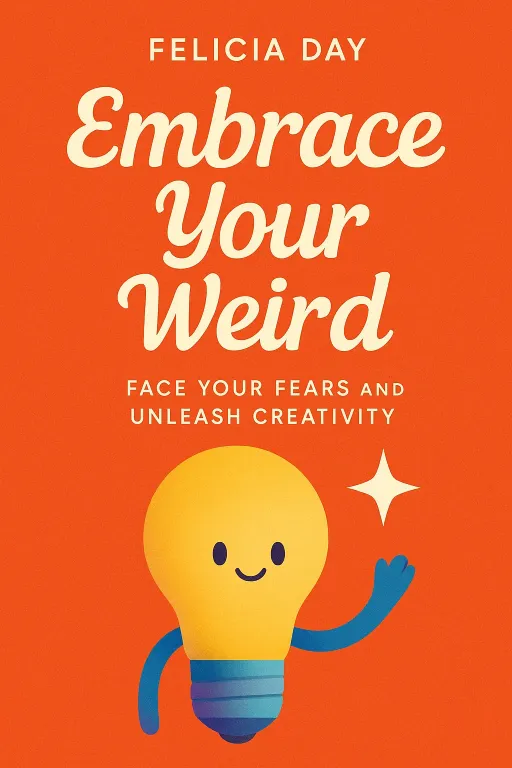
Nova: Exactly. And that is the death of progress. Today, we are dismantling that mindset. We are looking at two powerhouse perspectives on creativity and problem-solving. First, we have Embrace Your Weird by Felicia Day, which is all about slaying the internal villains that keep our quirks hidden. Then, we are pairing that with Everything is Figureoutable by Marie Forleo, which provides the tactical mental framework to solve any problem you encounter.
Atlas: I have heard the title Everything is Figureoutable tossed around a lot. It sounds like one of those catchy motivational phrases, but I am curious if there is actual substance underneath the slogan.
Nova: That is the best part. It is not just a slogan. Marie Forleo built a massive career on this philosophy, and Felicia Day, who you might know as an actress and a pioneer in the early days of web video, wrote her book as a direct response to the anxiety that comes with trying to create original work in a world that demands conformity. Both authors are essentially giving us a permission slip to be messy, human, and ultimately, effective.
The Architecture of Creative Villains
SECTION
Atlas: Let’s start with that messy part. I want to talk about Felicia Day’s concept of these so-called Villains. When I hear the word villain, I think of some external antagonist. But in the context of creativity, you are saying these are internal, right?
Nova: They are entirely internal. Felicia Day identifies these villains as specific manifestations of anxiety and perfectionism. Think of them as the gatekeepers of your own brain. When you decide to start a project, say you want to write a blog post or learn to paint, the Villain of Perfectionism shows up and says, this has to be a masterpiece on the first try, or it is a waste of time.
Atlas: Oh, I know that voice well. It is the voice that says, why bother doing this if you are not going to be good at it? It feels so logical in the moment, doesn't it? Like, I am being efficient by not wasting my time on something I am mediocre at.
Nova: That is the trap. It masquerades as efficiency, but it is actually paralysis. Day argues that these villains thrive on the fear of being seen as weird or incompetent. If you are not perfect, you are vulnerable. If you are vulnerable, you might be judged. So, the Villain convinces you to stay in your comfort zone where everything is predictable and, frankly, boring.
Atlas: So, how do we actually fight back against that? Is it just positive thinking? Because if you tell me to just believe in myself, I am going to have to stop you right there.
Nova: I would never suggest that. Positive thinking is flimsy. Day suggests something much more practical. She encourages a process of naming the villain. When you feel that tightening in your chest, or that urge to close your laptop and walk away, you have to label it. Say, oh, there is my inner perfectionist trying to sabotage my progress. By naming it, you create a tiny gap between the thought and your action. You become the observer of your own anxiety rather than the victim of it.
Atlas: That makes sense from a psychological standpoint. It is like objectifying the problem. Instead of saying, I am a failure, you say, my brain is generating a feeling of failure right now. That is a very different narrative.
Nova: Precisely. And it is about reclaiming your quirks. Day talks a lot about how her own path was unconventional. She leaned into the things that made her different, like her love for gaming and niche internet culture, at a time when that was considered uncool. The Villain wants you to homogenize yourself to fit in, but your creative value actually lies in the specific, weird things that only you care about.
Atlas: I see the value in that. It is like the difference between a mass-produced item and something handcrafted. The imperfections are where the character lives. But let's look at the reality of this. If I am sitting down to write, and the Villain of Perfectionism shows up, and I name it, I still have to write the words. How do I bridge that gap between naming the feeling and actually producing the work?
Nova: You lower the bar. Dramatically. You have to give yourself permission to produce garbage. Day is very clear on this: the goal of the first draft or the first attempt is not quality. It is existence. You just have to make it exist.
Atlas: That is tough for a perfectionist. My brain equates output with identity. If the output is bad, I feel like I am bad.
Nova: That is exactly what you are fighting. Think of it as a systems failure. You are running a program called "Masterpiece" on a processor that is only capable of "First Draft." Of course, it crashes. You need to switch the software. When you start a project, tell yourself, this is going to be the worst version of this thing possible. By aiming for the floor, you make it impossible to fail, because any improvement is a success.
The Mechanics of Figureoutable
SECTION
Atlas: Okay, so I lower the bar, I name my inner villains, and I start creating. But then I hit a wall. Maybe I don't have the technical skills, or I don't have the money, or I don't have the time. This is where I want to bring in Marie Forleo’s concept. Everything is Figureoutable. When I hear that, my skeptical brain immediately goes to: Well, everything is not figureoutable. Some problems are just unsolvable.
Nova: That is the classic pushback. And if you take the statement literally, as a claim that you can solve the laws of physics or reverse time, then yes, it is false. But Forleo is not talking about the universe. She is talking about your brain’s architecture. She argues that the phrase is a tool for your cognitive operating system. It is a way to force your brain to switch from a state of "I can't" to "How can I?"
Atlas: So it is a linguistic hack?
Nova: It is a diagnostic tool. When you say, I can't do this, you are effectively closing the file. Your brain stops looking for solutions because it has accepted the premise that a solution does not exist. But when you ask, how can I figure this out, you are giving your brain a search query.
Atlas: I actually love that analogy. It is like a search engine. If I type in "Why is this impossible," I get a million results confirming why I should quit. If I type in "How to make this work with limited resources," the results change entirely.
Nova: Exactly. Forleo emphasizes that most of our problems are not insurmountable obstacles; they are just puzzles we haven't gathered enough pieces for yet. She shares stories of people who had no experience, no capital, and no connections, yet built incredible things simply because they refused to accept the "I can't" narrative. They treated every roadblock as a piece of data.
Atlas: Give me an example of how that looks in practice. Because I think people struggle with this when the stakes feel high. Like, if my career is on the line, it is hard to just say "everything is figureoutable."
Nova: Imagine you are trying to launch a service, but you don't have the funds to hire a designer or a developer. The "I can't" version of your brain says, I can't launch until I have ten thousand dollars. The "Figureoutable" version asks, how can I launch this with zero dollars? Maybe you learn basic design on a free platform. Maybe you trade services with someone else. Maybe you launch a stripped-down version to test the market. The problem isn't the lack of money; the problem is the assumption that money is the only way to solve it.
Atlas: That is a pivot from passive victimhood to active problem-solving. It reminds me of engineering principles. You define the constraints, and then you optimize within them.
Nova: That is a perfect way to put it. Forleo calls it a "bridge." You are building a bridge between where you are and where you want to be. The materials you have might not be what you want, but you have to build with what is available. The only way you lose is by refusing to start building.
Atlas: I am thinking about how these two books intersect. Felicia Day helps you get over the fear of starting by acknowledging your internal resistance, and Marie Forleo gives you the mindset to navigate the obstacles once you have actually begun.
Nova: You hit the nail on the head. You need both. If you have the mindset but you are paralyzed by the fear of being judged, you won't take the first step. If you are brave enough to start but you lack the resilience to solve problems, you will quit at the first sign of trouble. They are two sides of the same coin.
Synthesis & Takeaways
SECTION
Atlas: We have covered a lot of ground here. We have the "Villains" who want us to be perfect, and we have the "Figureoutable" framework that helps us solve the problems that perfectionism creates. If I am listening to this and I want to apply this right now, what is the most high-leverage thing I can do?
Nova: You go for the "Tiny Step." It is a concept that appears in various forms in both books. Identify one small creative project or hobby you have been putting off. Maybe you want to write, or code, or learn a language. Spend just five minutes on it today.
Atlas: Just five minutes? That feels almost too easy.
Nova: That is the point. The Villain of Perfectionism cannot survive a five-minute window. It needs time to build a case for why you are going to fail. In five minutes, you don't have time to be perfect. You just have time to do. And once you do, you have proof that the world did not end.
Atlas: And once you have that proof, you can apply the Figureoutable mindset to the next five minutes. If you run into a problem, you don't stop. You ask, how do I fix this?
Nova: Precisely. It is a cycle of action and inquiry. You strip away the judgment of the Villain, and you replace it with the curiosity of the problem-solver.
Atlas: I think that is a powerful shift. It moves us from passive consumption of information to active creation of our own lives. We aren't just reading about growth; we are building it.
Nova: And remember, the goal is not to be a finished product. The goal is to be in motion. Every time you push through that fear, you are training your brain to see possibilities instead of walls.
Atlas: I am definitely going to try that. Five minutes, bad quality, zero pressure. It feels manageable, which is exactly why it will work.
Nova: That is the secret. It is not about the grand gesture. It is about the consistency of showing up, even when you are messy, even when you are confused, and trusting that you can figure it out as you go.
Atlas: That is a great note to end on. It is not about talent; it is about persistence.
Nova: Exactly. And the next time you feel that resistance, just remember: name the villain, ask the question, and take the five minutes. You might be surprised at what you can build.
Atlas: I love that. Thank you for breaking this down. I feel like I have a much clearer blueprint for tackling my next project.
Nova: You are very welcome. It is always a pleasure to dissect these ideas with you. This is Aibrary. Congratulations on your growth!









