

The Code of Creation: Hacking Fear and Forging Your Own Path
Golden Hook & Introduction
SECTION
Socrates: Have you ever had that nightmare? The one where the 'Creative Police' show up at your door, slap on the cuffs, and haul you away for fraud? You’re accused of not being original enough, of not being a true expert. It’s a fear that haunts every creator, every innovator, every person who puts something new into the world.
54k9w846jc: I think every developer has felt that. You push some code, and you're just waiting for someone to find the one line you missed and declare you an imposter. It's a very real feeling.
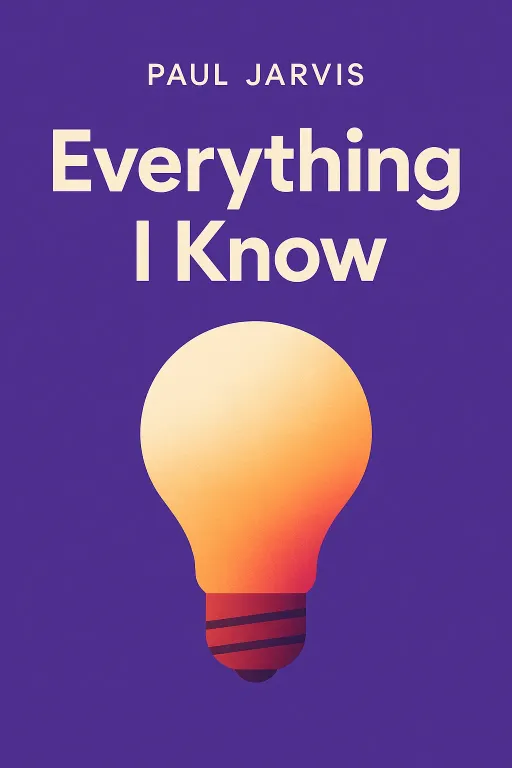
Socrates: Exactly. And that's why today, we're diving into Paul Jarvis's book, 'Everything I Know,' which is a powerful manual for silencing that inner critic and forging your own path. We're going to tackle this from three angles. First, we'll explore how to reframe your life as a 'Choose Your Own Adventure' game.
54k9w846jc: I like that.
Socrates: Then, we'll discuss why embracing imperfection and 'failing fast' is the secret to real innovation. And finally, we'll focus on how your unique, authentic story is your most powerful tool for connection. And I couldn't think of a better person to explore this with than you, 54k9w846jc. With over fifteen years as a software engineer, you live in a world of systems and rules. But what happens when the most important system—your own life—needs a complete refactor?
54k9w846jc: That's the million-dollar question, isn't it? It's easy to optimize code, but optimizing a life is a different kind of problem. I'm curious to see how these ideas connect.
Deep Dive into Core Topic 1: Refactoring Your Life
SECTION
Socrates: Let's start there. In your world, projects are often planned with rigid roadmaps. You have a goal, you have milestones. But Jarvis suggests life is more like a 'Choose Your Own Adventure' book. He literally says, "I’ve always approached my work as if it were a Choose Your Own Adventure book." You remember those? You get to a choice: to fight the dragon, turn to page 13; to run away, turn to page 18.
54k9w846jc: Of course. And you could always stick your finger in the previous page in case you made the wrong choice and got eaten by the dragon.
Socrates: Right! And that's his point. There's no single 'right' path. You make a choice, you see the outcome, and then you make another choice. He argues that you can only live a meaningful life if you keep making choices and moving forward, even if you're scared. You can't know the 'right' path until you're looking back at it. What does that bring to mind for you?
54k9w846jc: It immediately makes me think of the shift in software development from the 'Waterfall' model to 'Agile'. Waterfall was the old way: you'd spend months, even years, planning every single detail of a project. The entire system was designed upfront. And if you were wrong about a fundamental assumption at the beginning... the whole project could collapse. It was catastrophic.
Socrates: So it was like a 'Choose Your Own Adventure' book with no do-overs.
54k9w846jc: Exactly. And it created this immense pressure to be perfect from the start. Agile, on the other hand, is much more like what Jarvis describes. You work in short 'sprints,' maybe two weeks long. You build a small, functional piece of the project, you test it, you get feedback, and then you decide what to do in the next sprint. You're constantly making choices and adapting.
Socrates: So you're pivoting based on new information, not sticking to a rigid plan made a year ago.
54k9w846jc: Precisely. And it's a much more resilient and, frankly, more human way to work. It acknowledges that you don't have all the answers at the start. Applying that to a career path is a powerful idea. Instead of a rigid five-year plan, maybe it's about a series of two-week 'life sprints.' Try something, learn something, and then decide what's next. It takes the pressure off having to know the final destination.
Socrates: I love that framing. A 'life sprint.' It captures the essence of Jarvis's point: "There’s more than one way to reach your goals, and you probably won’t even know you’re on the right path until you’re looking back at it."
54k9w846jc: It's about trusting the process of movement itself, rather than trusting a flawed, static map.
Deep Dive into Core Topic 2: Shipping Imperfect Code
SECTION
Socrates: This idea of adapting and iterating leads perfectly to our next point. Jarvis argues that perfectionism is a trap. He has this fantastic line: "Create as badly as necessary to get things created." That must sound like heresy in a field like software engineering, right? The goal is always bug-free, perfect code.
54k9w846jc: It does sound counter-intuitive, but in reality, it's the secret to all innovation. There's no such thing as perfect, bug-free code on the first try. It doesn't exist. If you wait for it, you'll never ship anything.
Socrates: Jarvis tells this little story about being at a coffee shop and finding one of those wooden puzzles, the kind where you have to fit all the odd-shaped pieces back into a box. He says he tried and failed, over and over. The pieces almost fit, but not quite. He had to take it apart and start again. And his conclusion was, "It didn't work at all, until it did."
54k9w846jc: That's a perfect metaphor. That's debugging. That's product development. You're just trying combinations until one clicks. It reminds me of Thomas Edison, who I've always been fascinated by. When he was inventing the light bulb, he famously said, "I have not failed. I've just found 10,000 ways that won't work." Each failure wasn't a dead end; it was a data point.
Socrates: Jarvis calls this "Failure is an experiment." If you frame your ideas as experiments, you can't technically fail. You just get a result. And if the result isn't what you wanted, you change the variables and run the experiment again.
54k9w846jc: That is 100% the philosophy behind the 'Minimum Viable Product,' or MVP. The idea is to build the most basic, stripped-down version of your product that solves a core problem, and get it into the hands of real users as quickly as possible. It will be buggy. It will be missing features. It will be imperfect.
Socrates: It will be a 'bad first draft.'
54k9w846jc: Exactly. But it's real. And the feedback you get is invaluable. It's so much better to find out your core idea is flawed after three weeks of work than after two years of polishing a 'perfect' product nobody wants. The mantra is 'fail fast, fail cheap.' It's about learning.
Socrates: So the fear of shipping something imperfect is actually more dangerous than the imperfection itself.
54k9w846jc: Absolutely. The fear leads to inaction, and inaction is a guaranteed failure. Shipping something, anything, gives you a chance to learn and iterate. It gives you a path forward.
Deep Dive into Core Topic 3: Finding Your 'True North'
SECTION
Socrates: So if we're iterating and experimenting, constantly changing course, how do we know we're heading in the right direction? Jarvis's answer isn't a goal, like 'make a million dollars.' He says he tried that and it made him miserable. His answer is a 'rallying point'—your authentic self. He tells this incredible story about a health coach named Meg.
54k9w846jc: I'm listening.
Socrates: Meg was trying to build her business, but she had a secret. She had spent two years in federal prison for dealing drugs. She was terrified that if clients found out, they'd run. The health and wellness industry is all about purity and perfection, right? So she tried to sound like every other coach, using the same bland, positive language.
54k9w846jc: Trying to fit the established pattern.
Socrates: Yes. But it felt fake, and she wasn't getting traction. So she faced this 'what if' moment. What if she was just honest? What if she put her whole story out there on her website? It was a huge risk. But she did it. She wrote about her past, about making bad choices, and about how that journey led her to want to help others make healthier choices.
54k9w846jc: Wow. That takes courage.
Socrates: It does. And what happened? She said it was like a filter. The people who would have judged her were repelled, but the people who were drawn to her story—people who had their own struggles and imperfections—they connected with her on a profound level. Her 'flaw' became her greatest strength. Her honesty was her rallying point.
54k9w846jc: That's a powerful story. It makes me think about open-source software projects. The most successful ones have a very clear 'readme' file. It's not just about what the code does; it's about the project's philosophy, its values, its 'why.' That document acts as a rallying point. It attracts developers who believe in the mission, and it filters out those who are just looking for a quick gig.
Socrates: So the authenticity of the mission builds the community.
54k9w846jc: Yes, and it builds trust. As an ESFJ, a 'Caregiver,' that resonates with me. You build stronger teams, stronger communities, when people are connected by shared values, not just a shared task. When you know the 'why' behind a product or a person, you're more forgiving of the 'how' being a little messy sometimes. Meg's story is the ultimate example of a well-defined, human API—an honest interface with the world. It let the right people connect.
Socrates: "Your business is about your people," as Jarvis says. It's not about you, it's about the community your work touches.
Synthesis & Takeaways
SECTION
Socrates: So, when we put it all together, it seems the path Jarvis lays out is about seeing your life as an agile project, shipping your 'MVP' self—imperfections and all—and using your authentic story as your guiding star, your true north.
54k9w846jc: It's a fundamental shift from seeking external validation to trusting an internal compass. It's about being the lead developer of your own life, not just a contributor on someone else's project. It's about being willing to say, "I think I don't know everything," and seeing that as a starting point for discovery, not a weakness.
Socrates: A beautiful synthesis. So, if you were to give one piece of actionable advice to our listeners, inspired by this, what would it be?
54k9w846jc: I'd say, forget the five-year plan for a moment. Instead, start a one-week 'sprint' on a personal project you've been putting off. Maybe it's learning a new programming language, writing the first page of a blog, or even just trying a new recipe. Don't worry about the outcome. Don't worry if it's perfect. The goal is not the finished product. The goal is to start, to experiment, and to see what you learn about the process and about yourself. That's the real win.
Socrates: Start the experiment. I love it. 54k9w846jc, thank you for refactoring these ideas with us today.
54k9w846jc: It was my pleasure. A lot to think about.









