

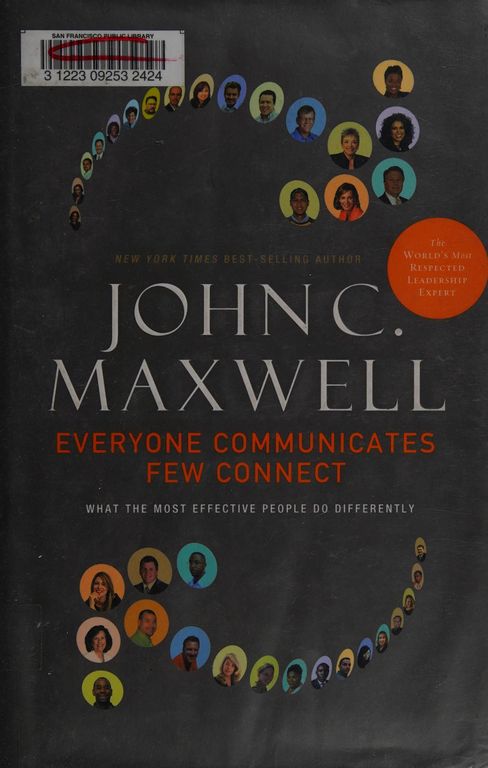
Everyone communicates, few connect
What the Most Effective People Do Differently
Introduction: The Invisible Wall Between Talking and Influence
Introduction: The Invisible Wall Between Talking and Influence
Nova: Welcome back to The Insight Engine, the podcast where we dissect the world's most powerful ideas into actionable wisdom. Today, we are diving deep into a concept that separates the speakers from the leaders, the presenters from the persuaders. We’re talking about John C. Maxwell’s seminal work, Everyone Communicates, Few Connect.
Nova: : That title alone is a punch to the gut, Nova. I mean, we live in the most connected age in human history—smartphones, global video calls, instant messaging—yet Maxwell suggests most of us are just making noise. What’s the core difference he’s drawing here?
Nova: It’s a massive chasm, actually. Maxwell states plainly that everyone communicates, but very few truly connect. Communication is the act of transmitting information. Connection is the act of transmitting and. Think about it: you can deliver a flawless, data-heavy presentation, hitting every bullet point perfectly, but if the audience leaves feeling nothing, you communicated. You didn't connect. And without connection, influence stalls.
Nova: : That makes sense. I’ve sat through countless meetings where the information was clear, but I felt zero motivation to act on it. It was like eating nutritional paste—it filled the requirement but offered no joy or drive. So, is this book just for professional speakers or CEOs? Because I’m just trying to coordinate dinner plans with friends sometimes.
Nova: That’s the beauty of it! Maxwell argues that connection is the foundation of all leadership, and leadership isn't just a title; it’s influence. Whether you’re leading a Fortune 500 company, leading your family, or leading a volunteer committee, connection is the currency. He says, and this is a powerful line, that leaders who connect 'touch a heart before they ask for a hand.' We’re going to break down the five core principles he lays out for moving from mere transmission to true impact.
Nova: : Touching a heart before asking for a hand. That’s a fantastic visual. It implies that the relationship precedes the request. I’m ready to explore how we build that relationship when the world seems to be moving too fast for genuine interaction. Let's start with the mindset shift required to even begin this journey.
Key Insight 1: Connecting is All About Others
The Foundational Shift: From Self-Focus to Other-Focus
Nova: The first major hurdle Maxwell identifies is internal. We naturally default to focusing on ourselves when we communicate. We worry about how we look, how well we articulate, whether we remembered our notes. Maxwell flips this entirely. He says, 'Connecting is never about me. It's about the person with whom I'm communicating.'
Nova: : That sounds simple, but it’s incredibly hard in practice. If I’m giving a presentation, my brain is screaming, 'Don't forget the Q3 projections!' How do I simultaneously focus on the audience's internal state while managing my own performance anxiety?
Nova: You manage it by intentionally setting aside your agenda. Maxwell outlines this as Step One in his practical application: Set Aside Your Agenda. This means recognizing that for the duration of the interaction, their needs, their understanding, and their emotional state are the priority. Think of it like a doctor making rounds. The doctor doesn't walk in thinking, 'I hope I sound smart today.' They walk in thinking, 'What is wrong with this patient, and how can I help them?'
Nova: : That’s a powerful analogy. The patient’s agenda is health; the doctor’s job is to align their communication with that agenda. So, if I’m trying to connect with a team member who is struggling, my agenda might be 'get the report done by Friday,' but their agenda might be 'feel supported and understood.' If I lead with my agenda, I communicate. If I lead with their agenda, I connect.
Nova: Exactly! And this selflessness is what builds trust. Maxwell notes that when you focus on others, you are essentially saying, 'I value you more than I value my own need to be heard or validated.' This is why he emphasizes that maturity is the ability to see and act on behalf of others. It requires stepping outside your own perspective, which is a significant energy drain, by the way. Maxwell mentions that connecting can be emotionally depleting because you are constantly giving energy outward.
Nova: : That explains why great connectors often seem so energized afterward, but also why they need time to recharge. It’s not passive; it’s active empathy. What about the flip side? If I’m connecting, what’s the consequence beyond just a dull meeting?
Nova: The consequence is that your influence shrinks to the size of your message, not the size of your vision. If you’re trying to rally people for a long-term project, and you only communicate the tasks, they might do the tasks, but they won't fight for the vision. Maxwell found that the further along you go in leadership, the more critical this connection skill becomes. It’s the differentiator. He suggests that if you can’t connect, you can’t lead effectively past a certain point, regardless of your technical expertise. It’s the difference between being a manager who directs and a leader who inspires loyalty.
Nova: : So, the first step isn't about learning new vocabulary or better body language; it’s about a radical shift in focus—a conscious decision to prioritize the other person’s reality over your own immediate need to transmit data. It’s a humbling prerequisite for influence.
Nova: Precisely. It’s the prerequisite. And once you’ve made that commitment to focus outward, you can then move into the practical mechanics of how to bridge that gap, which brings us to the second major pillar: finding common ground.
Key Insight 2: Finding Common Ground and Keeping It Simple
The Bridge Builders: Common Ground and Simplicity
Nova: Once we’ve set aside our agenda, the next logical step in bridging the gap is finding the shared space—finding common ground. Maxwell insists that connection happens when people realize, 'This person is like me,' or 'This person understands my world.' How do you find that common ground quickly and authentically?
Nova: : I imagine this is where the active listening you mentioned in the research comes into play. It’s not just waiting for your turn to speak; it’s actively probing to find that shared experience or value. If I’m talking to someone from a completely different industry, what’s the common ground?
Nova: It’s rarely about the industry itself. Maxwell suggests looking for shared values, shared challenges, or shared aspirations. For example, if you’re talking to a software developer and you’re a marketing executive, the common ground isn't code versus campaigns. It’s the shared desire for excellence, the frustration with bureaucracy, or the love of solving complex puzzles. You have to be curious enough to ask those probing questions—Step Two in his practice: Ask Curious Questions.
Nova: : Asking curious questions—that’s the key to unlocking the common ground. It’s about digging past the surface-level job titles. I think many people fear that finding common ground means pandering or being inauthentic, but Maxwell frames it as a necessary step to establish rapport before you can lead them anywhere.
Nova: Absolutely. It’s not about faking a shared interest in stamp collecting if you hate stamps. It’s about respecting their reality enough to see where your paths intersect. And once you’ve found that intersection, the next principle is crucial for ensuring the message lands: Keep Your Communication Simple. This is where many high-level communicators fail.
Nova: : Ah, the curse of knowledge. The expert who can’t explain their expertise to a novice. I see this all the time. They use jargon, complex sentence structures, and assume a baseline level of understanding that simply isn't there.
Nova: Precisely. Maxwell says, 'If you can’t say it simply, you don’t understand it well enough.' Think of it this way: complexity creates distance. Simplicity creates accessibility. When you use overly complicated language, you are subconsciously telling the listener, 'You need to work hard to keep up with me.' That immediately erects a barrier. You are communicating them, not them.
Nova: : So, simplicity isn't about dumbing things down; it’s about elevating the clarity. It’s about respecting the listener’s time and cognitive load. If I can explain the core concept of quantum computing using a metaphor about a coin flip, I’ve connected better than if I use the full mathematical formalism.
Nova: You’ve hit the nail on the head. Simplicity is the ultimate sign of mastery. It allows the audience to focus their mental energy on the of your message, rather than the of your language. When you combine finding common ground—which builds the emotional bridge—with simplicity—which builds the intellectual bridge—you create a pathway where people are actually willing to walk with you.
Nova: : It feels like these first two principles are about preparation and empathy. You prepare by finding where you meet, and you show empathy by speaking their language. What happens once that pathway is clear? Do we just start talking about the main topic now?
Nova: Not quite. Now that they are willing to listen, you have to make sure you them listening. That leads us directly into the third and fourth pillars, which are about engagement and inspiration. We need to capture their interest and then give them something to carry forward.
Key Insight 3 & 4: Interest and Experience
The Engagement Engine: Capturing Interest and Creating Experience
Nova: We’ve established the foundation: focus on them, find common ground, and speak clearly. Now, how do we prevent that hard-won attention from slipping away five minutes in? Maxwell’s third principle is to Capture People’s Interest. This is the hook, the sizzle, the reason they lean forward instead of checking their phone.
Nova: : This is where storytelling must come in, right? Facts tell, but stories sell, as the old adage goes. If I’m presenting data on declining sales, simply showing the downward trend line is communication. Telling the story of the one customer who left and they left—that captures interest.
Nova: Exactly. And Maxwell emphasizes that capturing interest often means using novelty or surprise. He suggests that people are naturally drawn to things that are unexpected or that challenge their current understanding. Think about the opening of our show—we started with a provocative statement about the communication gap. That’s designed to capture interest immediately. In a business context, this might mean starting a strategy meeting with a surprising statistic about your competitor or an anecdote about a failure that taught you everything.
Nova: : So, it’s about injecting a moment of cognitive dissonance or delight early on. But what happens after you capture their interest? You can’t keep shocking them forever. That gets exhausting. That must lead into the fourth principle, which I saw referenced as creating an experience everyone enjoys.
Nova: That’s right. Capturing interest gets them in the door; creating an experience keeps them in the room and makes the message stick. This is where Maxwell moves beyond just and into —not in a theatrical sense, but in creating an environment where engagement is mutual. It’s about making the communication participatory, even if it’s just mentally.
Nova: : How do you create an experience everyone enjoys when the topic is dry? Say, compliance training or budget reviews? That feels like the ultimate test of connection.
Nova: It requires creativity, but it’s possible. If the topic is budget reviews, the experience isn't the spreadsheet; the experience is the the budget review brings. You frame it as: 'Today, we aren't just reviewing numbers; we are collectively deciding how to best invest in our future success.' You turn the review into a collaborative decision-making session. You use visuals that are engaging, you ask for input frequently, and you celebrate small agreements or insights along the way. The enjoyment comes from feeling like a valued contributor to the outcome, not just a recipient of directives.
Nova: : That reframes the entire interaction. It moves from a mandatory lecture to a shared journey. If I’m connecting the dots here, the first two principles get you to speak to them, and these next two ensure they engaged while you speak. It sounds like a very intentional, step-by-step process.
Nova: It is highly intentional. Maxwell is essentially giving us a blueprint for intentional influence. You can’t just wing it and hope connection happens. You have to engineer the environment for it. But all this engineering, all this focus on the audience, all this clever storytelling—it all falls apart if the final principle isn't in place. Because if you aren't genuine, the audience sees right through the technique. That brings us to the capstone principle: Authenticity.
Key Insight 5: Staying Authentic
The Unbreakable Link: Authenticity and Living the Message
Nova: The fifth and final practice Maxwell champions is to Stay Authentic, or as some summaries put it, Live What You Communicate. This is the ultimate multiplier. If you are focusing on others, keeping things simple, capturing interest, and creating a positive experience, but you don't actually believe or live what you are saying, the whole structure collapses.
Nova: : This is where the rubber meets the road, isn't it? Because if I’m preaching work-life balance but I’m sending emails at 2 AM every night, my team knows I’m a fraud. The connection is instantly severed, replaced by cynicism.
Nova: Precisely. Maxwell states that people will not follow someone they don't trust, and trust is built on the alignment between what you say and how you live. He says, 'Leaders touch a heart before they ask for a hand.' That heart-touching requires vulnerability and truth. If you are trying to project an image that isn't yours—maybe you’re trying to be overly charismatic when you’re naturally reserved—people sense the performance.
Nova: : So, authenticity isn't about revealing every single flaw, but it is about ensuring your core message aligns with your core character. It’s about congruence. How does this tie back to the very first principle of setting aside your agenda? Isn't setting aside your agenda sometimes forcing you to adopt agenda?
Nova: That’s a brilliant question that gets to the nuance. Setting aside your agenda means prioritizing in that interaction, but authenticity means ensuring that interaction still serves. You are not abandoning your core self; you are temporarily shifting your focus outward to meet them where they are, while still being fundamentally. If your core value is integrity, you must communicate with integrity, even when discussing a topic you find challenging. The moment you fake a passion you don't possess, you lose the connection.
Nova: : That distinction is vital. It’s not about becoming a chameleon; it’s about being a highly adaptable, self-aware human being who chooses to prioritize the other person’s reality without sacrificing their own truth. It’s the difference between saying, 'I love this new software update' because the CEO told you to, versus saying, 'I see the potential in this new software update, and here is how I believe it will specifically help workflow.' The second statement is authentic to your role as a leader, even if you personally find the software clunky.
Nova: And this authenticity is what allows you to inspire people, the fourth principle we touched on. Inspiration only works when the source is perceived as credible and genuine. People don't follow empty rhetoric; they follow conviction. When you connect authentically, you move from just imparting information to actually transferring energy and vision. You become the kind of leader that, as Maxwell suggests, people to follow, not just to follow.
Nova: : It’s fascinating how these five principles—Focus, Common Ground, Simplicity, Interest, and Authenticity—form a complete loop. You start by looking outward, you build the bridge with shared understanding and clear language, you keep them engaged with novelty, and you seal the deal by being real. It’s a comprehensive system for human influence.
Nova: It truly is. And the research shows that leaders who master this don't just see better compliance; they see better collaboration, higher retention, and ultimately, greater organizational success because relationships are the foundation upon which everything else is built. We’ve covered the theory; now let’s wrap up with what this means for our listeners going forward.
Conclusion: From Noise to Resonance
Conclusion: From Noise to Resonance
Nova: We’ve spent this episode deconstructing John C. Maxwell’s powerful framework for moving beyond mere communication into genuine connection. The takeaway isn't just about being a better speaker; it’s about being a more influential human being.
Nova: : If I had to distill the entire philosophy into one actionable shift, it would be this: Stop preparing what you want to say, and start preparing how you want the. That’s the essence of setting aside your agenda and focusing on them.
Nova: I agree. And for our listeners who feel overwhelmed by the five principles, remember the core message: Connection is not a talent you are born with; it is a skill you develop through intentional practice. Start small. In your next one-on-one conversation, consciously ask one more curious question than you normally would. Try to find one piece of common ground before you dive into the task list. That small act of outward focus is the first step onto the connection highway.
Nova: : And don't forget the power of simplicity. If you can’t explain your most complex idea to a bright ten-year-old, you haven't connected yet. Clarity is kindness, and kindness builds connection.
Nova: Maxwell’s work reminds us that in a world saturated with information, the ability to resonate emotionally and intellectually with another person is the highest form of leadership currency. It’s what turns a crowd into a team, and a directive into a shared mission. It’s the difference between being heard and being followed.
Nova: : It’s a powerful challenge to all of us who rely on influencing others, whether professionally or personally. We must commit to touching hearts before asking for hands.
Nova: Absolutely. Thank you for joining us on this deep dive into connection. We hope this episode helps you move from simply communicating to truly connecting in every interaction you have this week.
Nova: : This is. Congratulations on your growth!