

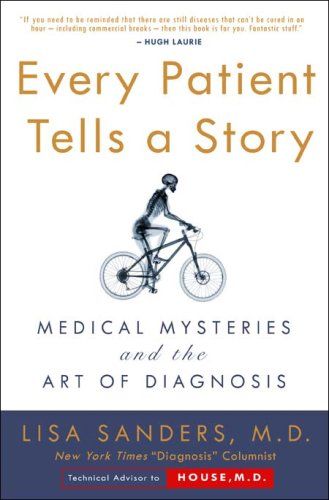
Every patient tells a story
medical mysteries and the art of diagnosis
Introduction
Nova: Have you ever sat in a doctor's office, feeling like you're just a collection of symptoms on a clipboard, while the doctor stares at a computer screen instead of you? It's a common frustration, but today we're diving into a book that argues the most powerful tool in medicine isn't a high-tech scanner or a complex blood test. It's actually your voice.
Nova: Exactly. We're talking about Every Patient Tells a Story by Dr. Lisa Sanders. She's a physician at the Yale School of Medicine, but you might know her better as the inspiration and consultant for the hit TV show House, M. D., or from her long-running Diagnosis column in the New York Times.
Nova: Not quite! But she does share that same relentless detective spirit. Her book is a deep dive into the art and science of diagnosis, which she describes as the most difficult and important thing a doctor does. It's a world where a single missed detail in a patient's story can mean the difference between a cure and a catastrophe.
Nova: It’s a fascinating journey through the history of medicine, the psychology of how doctors think, and the very real dangers of modern technology making us lose sight of the human being in the hospital bed. Let's get into it.
Key Insight 1
The Power of the Narrative
Nova: Let's start with a statistic that blew my mind. Sanders points out that in about eighty percent of cases, the diagnosis is actually found in the patient's history. That means just by listening to the story of how the illness started and progressed, the doctor should have the answer four out of five times.
Nova: That’s the tragedy Sanders highlights. Studies show that on average, a doctor interrupts a patient within eighteen to twenty-three seconds of them starting to speak. Just twenty seconds!
Nova: It's a mix of things—insurance pressures, packed schedules, and a growing belief that the data on the screen is more reliable than the words of the patient. But Sanders argues that the story is where the clues are hidden. She tells this story of a woman with a mysterious, recurring fever that baffled everyone. It wasn't until a doctor really sat down and asked about her life—not just her symptoms—that they found the answer.
Nova: It was actually related to her hobby. She was a bird enthusiast, and she had contracted a rare form of pneumonia from bird droppings. But because no one asked about her pets or hobbies, they kept looking for standard infections. The answer was in her life story, not her white blood cell count.
Nova: Precisely. Sanders calls the medical history the most powerful diagnostic tool ever invented. But it requires two things that are in short supply in modern medicine: time and active listening. She explains that patients often leave out what they think are irrelevant details, but to a trained ear, those are the smoking guns.
Nova: It happens more than we’d like to admit. Sanders notes that when a doctor stops listening, they start making assumptions. They categorize you before you've even finished describing the pain. And once that category is set in their mind, it's very hard to change it.
Key Insight 2
The Dying Art of the Physical Exam
Nova: If the story is eighty percent of the diagnosis, the physical exam is supposed to be another ten to fifteen percent. But Sanders delivers a pretty harsh wake-up call: the physical exam is becoming a dying art.
Nova: Sanders argues that for many doctors, that's just a performance now. It's something they do because they're supposed to, but they aren't actually looking for the subtle signs that older generations of doctors were trained to spot. She uses a term coined by Dr. Abraham Verghese: the iPatient.
Nova: Sort of. It refers to the fact that the patient in the computer—the one made of lab results, CT scans, and digital charts—often gets more attention than the actual human being lying in the hospital bed. Doctors spend hours looking at the iPatient and only minutes looking at the real one.
Nova: Exactly. And the danger is that technology can be misleading. Sanders shares a story about a man who was diagnosed with a serious heart condition based on an ultrasound. They were ready to wheel him into surgery. But a senior doctor decided to actually put a stethoscope to the man's chest and move him around. He realized the sound didn't match the scan.
Nova: The scan showed a shadow that looked like a tumor, but it was actually just a harmless anatomical quirk that only looked scary from one angle. If they had relied solely on the technology, they would have performed an unnecessary, high-risk heart surgery.
Nova: Yes, and Sanders points out that we’re losing specific skills. There are maneuvers with names like the Osler's node or the Janeway lesion—physical signs on the hands or feet that can signal a heart infection. Many young doctors today have never seen them and wouldn't know how to look for them because they're so used to ordering an echo-cardiogram instead.
Nova: That’s her core argument. Technology should be the final confirmation, not the starting point. When you skip the physical exam, you miss the context that the body is trying to provide.
Key Insight 3
The Detective's Toolkit and Cognitive Bias
Nova: One of the most fascinating parts of the book is where Sanders looks at the psychology of the doctor. Why do smart people make mistakes? It turns out, doctors are just as prone to cognitive biases as the rest of us.
Nova: The big one is called anchoring bias. This is when a doctor latches onto the first piece of information they receive and refuses to let go of it, even when new evidence suggests they're wrong.
Nova: Exactly. Sanders tells a story about a young woman who came into the ER with classic symptoms of a drug overdose. The doctors anchored on that because of her age and the situation. They treated her for an overdose for hours, even as she got worse. It turned out she was actually having a massive stroke.
Nova: There's also availability bias, where a doctor diagnoses you with whatever they've seen a lot of lately. If they just saw three cases of Lyme disease, suddenly every rash looks like Lyme disease. Sanders explains that the best diagnosticians are the ones who are constantly trying to prove themselves wrong.
Nova: Right. She calls it the differential diagnosis. It's a list of every possible thing that could be causing the symptoms, ranked from most likely to least likely. A good doctor works through that list methodically. But the pressure of modern medicine often forces doctors to skip the list and go with their gut.
Nova: Intuition is great for quick decisions, but it's dangerous for complex ones. Sanders argues that diagnosis should be a slow, deliberate process. She even talks about how some doctors are starting to use computer programs to help them think—not to replace them, but to suggest possibilities they might have missed.
Nova: Exactly. It's about humility. The best doctors in her book are the ones who aren't afraid to say, I don't know yet, let's keep looking.
Key Insight 4
Zebras and Horses
Nova: There’s a famous saying in medical school: When you hear hoofbeats, think horses, not zebras. It means you should look for the common explanation first, not the rare one.
Nova: Right. But Lisa Sanders' book is essentially a collection of zebras. She’s fascinated by the cases where the hoofbeats actually were zebras. This is where the House, M. D. connection really shines.
Nova: That’s the art. You start with the horses, but you have to be alert for the one detail that doesn't fit the horse narrative. She mentions a case of a man with what looked like a standard case of gout. But the pain didn't respond to the usual meds, and he had this tiny, almost invisible rash.
Nova: Exactly. It turned out to be a very rare autoimmune disorder. Sanders argues that we need to train doctors to be better observers of the unusual. She actually suggests that medical students should study art—like looking at paintings—to improve their observation skills.
Nova: Yes! It teaches you to see what’s actually there, rather than what you expect to see. If you look at a painting of a person, you might notice a slight swelling in their neck or a specific skin tone that an untrained eye would miss. It’s about fighting that urge to generalize.
Nova: And those details are often hidden in plain sight. Sanders talks about how sometimes the zebra is found by the person you'd least expect—a nurse who noticed the patient ate something weird, or a family member who mentioned a trip they took ten years ago. In the world of diagnosis, everyone is a potential source of the missing clue.
Nova: And that information is messy. It’s not always a clean lab result. Sometimes it’s a weird comment made in passing. Sanders shows that the most successful doctors are the ones who treat every case like a fresh mystery, even if it looks like a horse at first glance.
Conclusion
Nova: As we wrap up our look at Every Patient Tells a Story, the biggest takeaway is that the relationship between a doctor and a patient is a partnership in a detective agency. The doctor has the medical knowledge, but you, the patient, are the only one with the evidence.
Nova: That’s exactly what Dr. Sanders would want. Her advice to patients is to be prepared: write down your timeline, don't leave out the weird details, and if you feel like you aren't being heard, speak up. You are the expert on your own body.
Nova: Diagnosis is a beautiful, difficult, and deeply human art. Lisa Sanders reminds us that while technology is a gift, it can never replace the power of a story and the importance of a careful, searching eye. It’s a call to bring the human element back to the center of medicine.
Nova: If you're interested in medical mysteries or just want to be a more empowered patient, I highly recommend picking up Every Patient Tells a Story. It’s a gripping read that might just save your life one day.
Nova: This is Aibrary. Congratulations on your growth!