

The Power of Less: Finding Clarity and Focus in an Overloaded World
Golden Hook & Introduction
SECTION
Nova: What if the secret to achieving everything you want, to feeling truly fulfilled, isn’t about adding more to your plate, but aggressively taking things?
Atlas: Oh man, Nova, that sounds almost heretical in our "more is better" culture. I mean, every instinct tells us to hustle harder, to accumulate more skills, more connections, more tech. It feels like the only way to keep up.
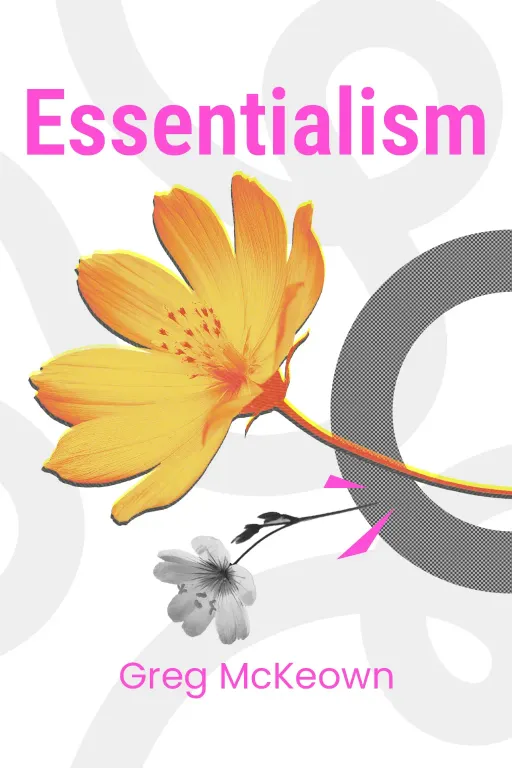
Nova: Exactly, Atlas! And that's precisely why today, we're diving into the profound and often counterintuitive philosophy of "The Power of Less." We're talking about finding clarity and focus in an overloaded world, a concept championed by brilliant thinkers like Greg McKeown, author of "Essentialism," and Cal Newport, who gave us "Digital Minimalism."
Atlas: Oh, I like that. McKeown, if I remember correctly, had this amazing pivot from a high-pressure corporate life to essentially becoming the global evangelist for doing to achieve. And Newport, a computer science professor, telling us to be with our tech. There's a beautiful paradox there.
Nova: Absolutely. It’s a powerful idea, especially for anyone who feels that incessant pull towards complexity, that constant pressure to be everywhere and do everything.
The Counterintuitive Power of Less
SECTION
Nova: So, let’s start with that fundamental premise: the counterintuitive power of less. Our world, our work, our personal lives, they are constantly pushing for 'more.' More features, more apps, more meetings, more information. It's a relentless tide.
Atlas: Right? And we're told this is progress. This is how you innovate, how you grow, how you stay competitive. For our listeners who are constantly designing solutions or building trust in complex environments, this idea of 'less' feels almost counter-intuitive to the need to be comprehensive. How do you fight that ingrained instinct to always expand?
Nova: It's a paradigm shift, Atlas. The core insight here is that when we try to do everything, we often end up doing nothing truly well. Imagine a photograph. If you try to capture every single detail, every background element, every person in a huge crowd, what do you often end up with? A blurry, unfocused mess. But if you intentionally narrow your focus, choose your subject, compose the shot with precision, you get a powerful, clear image.
Atlas: That’s a great analogy. So basically you’re saying that the constant pursuit of 'more' leads to a dilution of our effort, a blurring of our impact, rather than enhancing it.
Nova: Precisely. The drive to simplify is not about doing less for the sake of laziness, it's about doing the things more effectively. It's about identifying the truly vital few versus the trivial many. Think about a small business owner. One might constantly chase every new social media trend, every new SaaS tool, every online course, spreading themselves thin, never seeing deep results from any single effort. Burnout is inevitable.
Atlas: I can definitely relate to that feeling, or at least I imagine a lot of our listeners can. It’s easy to get caught in that trap, especially when you feel like you have to wear all the hats. So, how do we distinguish between 'less' that's lazy and 'less' that's strategic and truly impactful?
Nova: The distinction is intentionality and clarity of purpose. Lazy 'less' is simply neglecting responsibilities. Strategic 'less' is a disciplined pursuit, a conscious choice to eliminate non-essential activities, technologies, and even relationships that don't align with your highest contribution. It’s about creating space for deep impact. It’s about having a crystal-clear vision of what truly matters, and then ruthlessly protecting that vision.
Strategic Minimalism: From Philosophy to Practice
SECTION
Nova: So if 'less' is the new 'more,' how do we actually it? This is where thinkers like Greg McKeown and Cal Newport give us a roadmap. McKeown, in "Essentialism," provides strategies for identifying what is truly essential and eliminating everything else. He talks about the disciplined pursuit of less.
Atlas: Okay, so how does that translate into action? Because for someone trying to empower small businesses, or someone building trust, saying 'no' can feel like you're letting people down. How do you navigate that relational aspect while still being 'essentialist'?
Nova: That's a crucial point, Atlas. Many assume saying 'no' is selfish or detrimental to relationships, but often, a strategic 'no' can actually build trust. When you say 'yes' to everything, you dilute your ability to deliver excellent results on anything. By saying 'no' to the non-essential, you're saying 'yes' to your highest contribution. You're communicating clarity, focus, and reliability. Imagine a tech leader who has ten critical projects. An essentialist leader would ruthlessly prioritize the top two or three that align with the company's core mission, and clearly communicate why others are on hold or deprioritized. This often earns respect because it demonstrates strategic thinking and a commitment to quality over quantity.
Atlas: That makes sense. It's about being honest about capacity and impact. So it’s not about being unhelpful, but being helpful.
Nova: Exactly. And that brings us to Cal Newport's "Digital Minimalism," which is a perfect complement. He champions a philosophy of technology use where you focus your online time on a small number of carefully selected and optimized activities. It’s not about ditching your phone, but about being the master of your tools, not the other way around. It's like having a finely tuned instrument for a specific purpose, instead of a noisy, distracting gadget that does a hundred things poorly.
Atlas: That's a great way to put it. So, it’s not about going off-grid, it’s about intentionality. But what about that 'healing moment' feeling you mentioned earlier, Nova? Where are investing effort that align with less technology and maximum impact? I imagine many of our listeners might be having a moment of introspection right now.
Nova: That's the exact question we should all be asking ourselves. Take a moment right now, listeners. Think about your current projects, your daily habits. Where are you pouring energy that doesn't genuinely move your most important needles? Perhaps it's an app you check habitually but gain no value from, or a recurring meeting that lacks a clear purpose. That's the low-hanging fruit for applying digital minimalism or essentialist principles. It’s about creating space, not just for productivity, but for strategic visioning, for deeper connections, for what truly matters to you and your mission.
Synthesis & Takeaways
SECTION
Nova: So, to synthesize these powerful ideas, it all boils down to a fundamental mindset shift: recognizing that 'less' is not a limitation, but a liberation. It's the path to greater clarity, deeper focus, and ultimately, more profound impact. McKeown gives us the framework for what to, and Newport gives us the framework for how to our tools deliberately.
Atlas: That’s actually really inspiring. It redefines what it means to be a 'strategic architect' – not just fixing problems or managing IT, but designing a life and work of focused impact. It’s about building trust not just through availability, but through reliability and clarity.
Nova: Absolutely, Atlas. It's about empowering yourself to trust your unique voice, to own those insights on 'less technology' because they are powerful. When you simplify your infrastructure, both technological and mental, you create the bandwidth for what you truly excel at, for what makes the biggest difference. It’s a quiet strength in simplification that frees you up for true growth.
Atlas: So ultimately, this isn't just about productivity hacks, is it? It feels like a fundamental re-evaluation of what success truly means. It’s about choosing impact over activity, and intention over distraction.
Nova: Exactly. It's about designing a life and work that truly resonate with your core purpose, freeing up bandwidth for what genuinely matters. It's about a quiet strength in simplification.
Atlas: That gives me chills. This is Aibrary. Congratulations on your growth!









