

The Paradox of Time and Essentialism
Golden Hook & Introduction
SECTION
Nova: If you live to be eighty, you have exactly four thousand weeks on this planet. That is the entire budget. No extensions, no bonus rounds, just four thousand Saturdays and then the game is over.
Atlas: That number is terrifyingly small. I feel like I spent at least fifty of those weeks just looking for my car keys or waiting for water to boil. It makes you realize how much of our lives we spend on autopilot, chasing this phantom idea of someday having everything under control.
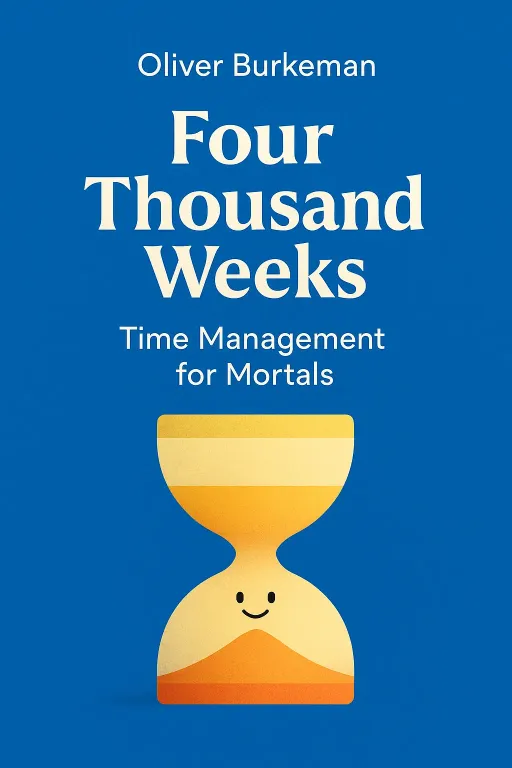
Nova: Exactly, and that is the profound starting point of our journey today. We are diving deep into two incredibly influential books that completely flip the script on how we view our days. We are looking at Four Thousand Weeks by Oliver Burkeman, alongside Essentialism by Greg McKeown. Burkeman actually spent years as a dedicated productivity columnist for the Guardian, trying every single life-hack and time-management app in existence, only to realize that the entire industry is built on a massive lie.
Atlas: Oh, I love that. A recovering productivity guru blowing the whistle on the whole system. That is highly relatable because we have all downloaded that new app thinking it would finally solve our chaotic lives, only to end up with more notifications and even less peace of mind.
Nova: The core of our exploration today is really an exploration of how accepting our absolute limitations is the ultimate key to freedom, and how we can use a systematic discipline to choose what actually matters. Today we will dive deep into this from three perspectives. First, we will look at the efficiency trap and why trying to do it all is a recipe for misery. Then, we will explore the systematic discipline of essentialism and the power of radical trade-offs. Finally, we will focus on how to apply these insights to build a balanced, high-impact life without burning out.
The Efficiency Trap and the Four Thousand Weeks Limit
SECTION
Nova: Let us start with Oliver Burkeman's central argument, which he calls the efficiency trap. The common wisdom tells us that if we just get faster, more organized, and more efficient, we will finally clear our plates and have time for what we love. Burkeman points out that this is mathematically impossible.
Atlas: Wait, hold on a second. That sounds completely counterintuitive. If I get faster at processing my emails, do I not get more free time?
Nova: The opposite actually happens. When you become an email-clearing machine, you simply attract more emails. People realize you respond quickly, so they send you more queries. Your efficiency acts as a magnet for more demands. Think of it like a high-speed conveyor belt in a factory. If you speed up your hands, the supervisor just turns up the speed of the belt.
Atlas: That sounds incredibly stressful, and honestly, it explains why so many professionals feel like they are drowning even when they are working at peak performance. It is like trying to clear water out of a sinking boat with a spoon, and the spoon just keeps getting bigger but the hole in the boat is getting wider.
Nova: That is a perfect analogy. Burkeman argues that the real trouble is that we have an infinite number of things we could potentially do, but a strictly finite amount of time to do them. When you try to fit an infinite number of options into a finite container, you experience constant anxiety. You are always mourning the things you did not choose.
Atlas: I know that feeling all too well. You are sitting at dinner with your family, but you are feeling guilty because you are not working on that presentation. Or you are working on the presentation, but you feel guilty because you are not exercising. We are constantly living in the shadow of the unchosen paths.
Nova: Yes, and the breakthrough moment comes when we accept this limitation. Burkeman suggests that we should stop trying to do everything and instead practice what he calls creative neglect. We have to actively decide what we are going to fail at, what we are going to ignore, so that we can direct our limited energy to the few things that truly matter.
Atlas: That is a fascinating shift in perspective. So you are saying we should intentionally choose what to neglect? That sounds risky for anyone trying to climb the career ladder or manage a busy household. How do you actually pitch that to yourself without feeling like a failure?
Nova: It starts by realizing that you are already neglecting things every single day, you are just doing it by accident. When you let your inbox dictate your morning, you are accidentally neglecting your long-term strategic projects or your health. Burkeman suggests making that choice conscious. You look at your day and say, I am choosing to let my unread messages pile up today because I am actively prioritizing this major project.
Atlas: I can see how that would feel incredibly empowering. You are taking the wheel instead of just reacting to whatever loud noise is coming out of your phone. It moves you from a state of constant defense to a deliberate, offensive strategy for your life.
Nova: It absolutely does. Burkeman shares a story about a graphic designer who was constantly overwhelmed, trying to please every client and take on every project. She was working eighty hours a week, her health was suffering, and her relationships were strained. The turning point came when she sat down and calculated her remaining weeks of active career life. She realized she had about eight hundred weeks left of high-level creative output.
Atlas: Wow, eight hundred weeks. That puts a very sharp clock on things.
Nova: It changed everything for her. She realized she could not build ten different businesses and master five different instruments. She had to choose. She decided to limit her active projects to three at any given time. If a fourth client came along, they had to wait in a queue until one of the active three was completely finished.
Atlas: That is a brilliant way to operationalize this. It forces a hard limit on your capacity. But what happened to her business? Did her clients walk away because she made them wait?
Nova: The exact opposite occurred. Her reputation soared because the three clients she was working with received her absolute, undivided attention. The quality of her work went through the roof, and clients were actually willing to pay a premium to get on her waiting list. By accepting her limits, she became more valuable, not less.
The Disciplined Pursuit of Less
SECTION
Atlas: That story connects beautifully to Greg McKeown's work in Essentialism. McKeown talks about the disciplined pursuit of less, which feels like the perfect operational manual for Burkeman's philosophy. But I have to ask, how did McKeown arrive at this concept? Was there a specific moment that triggered it for him?
Nova: There was a very dramatic and painful moment. McKeown was working in Silicon Valley, consulting for high-tech firms, caught up in the classic culture of constant availability. His wife was in the hospital, having just given birth to their daughter. It should have been a time of absolute focus on his family.
Atlas: Let me guess. The phone rang.
Nova: Worse than that. He received an email from his employer saying they needed him at a client meeting that afternoon. Instead of saying no, he felt this intense pressure to do both, to be the ultimate performer. He actually left his wife and newborn baby in the hospital bed to attend that meeting.
Atlas: Oh, that makes me cringe just hearing it. I can feel the regret from here. How did the meeting go?
Nova: He arrived at the meeting, and afterward, his colleague said, the client will respect you for making the effort to be here. But McKeown looked at the client's face and realized they did not care. They would have been perfectly fine if he had rescheduled. He had traded a once-in-a-lifetime family milestone for a routine business meeting, and for what? To look good for a brief moment.
Atlas: That is a brutal realization. He traded something of infinite personal value for something of minor, temporary professional value.
Nova: That precise moment changed the trajectory of his life. He realized that if you do not prioritize your life, someone else will. If you do not make a conscious choice about where your energy goes, your boss, your clients, your social media feed, and your family's demands will make those choices for you, and they will not make them based on your well-being.
Atlas: So how does the essentialist approach this differently? What is the core mechanism of this disciplined pursuit of less?
Nova: McKeown uses a wonderful analogy of a closet. Imagine your life is a closet. The non-essentialist approach is to try and fit everything into the closet. You buy more hangers, you fold things tighter, you organize the clutter. But eventually, the closet bursts.
Atlas: I think most of our closets, and our schedules, are currently in that bursting state.
Nova: The essentialist looks at the closet and asks a completely different question. Instead of asking, is there a chance I might wear this someday, they ask, do I absolutely love this, and does it fit who I am today? If the answer is not a resounding yes, it goes in the donation bin. It is a systematic process of exploring, eliminating, and executing.
Atlas: That makes sense, but executing that elimination phase is where people get terrified. Saying no to a project, a social event, or even a request from a colleague feels like social or professional suicide in many corporate environments. How do we navigate that fear?
Nova: McKeown suggests using what he calls the ninety percent rule. When you are evaluating an option, look at the single most important criterion for that decision, and give it a score between zero and one hundred. If the option scores lower than a ninety, then automatically drop it to a zero and say no.
Atlas: Whoa, that is incredibly strict. If it is not a ninety or above, it is a flat zero? That requires serious courage.
Nova: It does, but think about the alternative. If you say yes to a bunch of seventies and eighties, your schedule is completely full of mediocre commitments. You have no space left for the rare nineties and hundreds that could truly change your career or your life. You are essentially trading your greatness for a pile of average tasks.
Atlas: I see how that works. It is like clearing out the clutter so the masterpieces have room to breathe. But let us talk about the practical application of this. How does a person in a high-pressure job actually start saying no to their boss using this rule without looking like they are not a team player?
Nova: You do it by reframing the conversation around trade-offs. Instead of a flat refusal, you present the reality of your capacity. You might say, I would love to make this new project a massive success. Right now, my focus is on project A and project B. If we bring in this new project, which of those two should we deprioritize or delay to make room for it?
Atlas: That is a brilliant communication strategy. You are not saying, I will not do my job. You are saying, I want to do a world-class job on what we have already agreed is important, and here is the mathematical reality of my time. It forces the manager to participate in the prioritization process.
Nova: Exactly. It turns a potential conflict into a collaborative strategic decision. You are showing that you care deeply about the quality of the outcome, which actually increases your professional credibility. It positions you as a strategic thinker rather than just a passive task-taker.
Synthesis & Takeaways
SECTION
Atlas: This brings us to a fascinating intersection between our two authors. Burkeman gives us the philosophical peace of mind by telling us to accept that we will never finish everything. McKeown gives us the tactical toolkit to ruthlessly select the few things we will finish with excellence. When you put them together, it feels like a complete operating system for modern life.
Nova: It really is. It shifts us from a mindset of constant panic to a mindset of deliberate focus. We stop asking, how can I do all of this, and start asking, what is the one thing that is truly worth doing right now?
Atlas: That brings us back to the deep question we started with. If you accepted that you will never get everything done, what one essential task would you prioritize today to truly move the needle?
Nova: That is the question that cuts through all the noise. For our listeners who are constantly juggling career advancement, health, and family, this is the ultimate filter. If you only had twenty minutes today to invest in your own growth, your own well-being, where would you put it?
Atlas: I love the idea of starting small. We often think we need to completely overhaul our entire lives over a weekend, which is exhausting and unsustainable. But what if we just protected a tiny block of time, say twenty minutes every day, for focused learning, reading, or strategic planning, and treated that time as absolutely sacred?
Nova: That is where real momentum is built. Every massive achievement, every healthy relationship, every secure financial future is built on a foundation of small, consistent choices made day after day. It is about protecting that twenty-minute boundary with the same fierce dedication that Greg McKeown wishes he had used in that hospital room.
Atlas: That is a powerful reminder. It is about choosing our trade-offs before life chooses them for us. When we accept our four thousand weeks, we stop trying to please everyone and start living a life that actually aligns with our deepest values.
Nova: Well said, Atlas. By embracing our limits, we finally gain the power to make our highest contribution.
Atlas: Thank you all for joining us on this deep dive. If this conversation resonated with you, take a moment today to identify your one essential task and protect the time to make it happen. We would love to hear about your progress and the choices you are making to simplify your world.
Nova: This is Aibrary. Congratulations on your growth!









