The 'Busy Trap' is a Trap: Why Focused Execution Delivers Real Agent Value.
Golden Hook & Introduction
SECTION
Nova: What if I told you that being constantly busy, feeling overwhelmed, and having a packed schedule isn't a badge of honor? What if it's actually the biggest obstacle to truly groundbreaking work in Agent engineering?
Atlas: Oh man, Nova, that's hitting a little too close to home for a lot of our listeners, myself included. But isn't 'busy' just 'productive' in disguise for someone building complex Agent systems? Especially when you're trying to keep up with the latest models and frameworks, it feels like you have to be everywhere, doing everything.
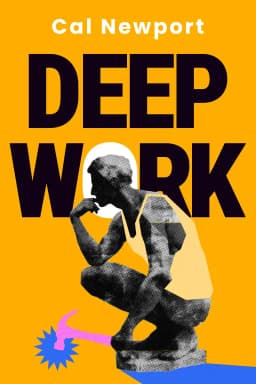
Nova: I know that feeling, Atlas. It's a common trap. But the truth, the profound insight we're uncovering today, is that true value creation in Agent engineering demands intense focus, not just activity. We're diving into two foundational texts that fundamentally shift our approach: Cal Newport's seminal work, "Deep Work," widely recognized as a defining text for focused productivity in our digital age, and Greg McKeown's "Essentialism," which offers a systematic discipline for discerning what is absolutely vital.
Atlas: Right? That's going to resonate with anyone trying to build something truly robust and scalable. The constant demands on architects and developers to juggle multiple priorities often leave us feeling like we're just treading water, rather than making those deep, impactful contributions.
Escaping the Busy Trap with Deep Work
SECTION
Nova: Exactly. And that's where "Deep Work" comes in. Newport argues that the ability to focus without distraction on a cognitively demanding task is a superpower in our increasingly fragmented world. Think about it: when was the last time you had a solid, uninterrupted block of hours to truly wrestle with a complex Agent architecture problem, or to design a novel decision-making algorithm from the ground up?
Atlas: Hold on, Nova, 'distraction-free' sounds like a myth for an engineer or architect. You're constantly pulled into meetings, code reviews, urgent bug fixes. How do you actually an environment for deep work when you're building an Agent system that often demands constant monitoring and iteration? It feels like the system itself is designed to pull your attention.
Nova: That's a perfect question, Atlas, and it's precisely what Newport tackles. He provides strategies, not just ideals. It's about scheduling deep work, ritualizing your breaks, actually embracing boredom – letting your mind wander instead of immediately reaching for your phone – and ruthlessly blocking distractions. Imagine a software architect, for example, who dedicates a specific, non-negotiable block of two hours every morning. Completely offline, notifications silenced, door closed. During that time, they are solely focused on designing the intricate interaction protocols for a new multi-agent system.
Atlas: So you're saying it's about carving out dedicated mental bandwidth for the really hard problems – like designing a robust multi-agent architecture or optimizing complex interaction protocols – rather than just reacting to every single notification or email that pops up? It's about being proactive with your attention.
Nova: Precisely. That architect isn't just reacting to the next Jira ticket; they're proactively shaping the future of the Agent system. That focused, uninterrupted time allows for breakthroughs that simply wouldn't happen if their attention was constantly fragmented. It's about moving beyond shallow work – the administrative tasks, the quick email responses, the constant context-switching – and creating space for the kind of deep, concentrated effort that truly moves the needle in Agent development.
Atlas: I totally know that feeling. You spend an entire day "working," but at the end of it, you feel exhausted but haven't actually shipped anything substantial or solved that one really tricky problem that's been nagging you. That's a powerful shift in perspective.
The Essentialist Agent for Scalable Impact
SECTION
Nova: Absolutely, Atlas. And once you've created that space, the next challenge is making sure you're filling it with the work. This is where Greg McKeown's "Essentialism" becomes incredibly powerful. McKeown emphasizes that essentialism isn't just about time management, but a systematic discipline for discerning what is absolutely vital and eliminating everything else.
Atlas: Doing less, but better? For an architect aiming for breakthrough Agent systems, that sounds counter-intuitive. Aren't we supposed to explore every possibility, integrate every cool new library? How does 'doing less' lead to more stable and scalable Agent systems? That sounds a bit out there for someone who thrives on innovation.
Nova: It's a common misconception that more activity equals more progress. McKeown argues that we often fall into the trap of saying 'yes' to too many things, leading to diluted efforts and mediocre results. Essentialism is about identifying the "vital few" and ruthlessly eliminating the "trivial many." Think about the hidden costs of shallow work and the allure of "doing it all." How many unnecessary meetings do engineers attend? How many features are over-engineered or added "just in case" they might be useful, draining resources and adding complexity?
Atlas: Oh, I've been there. The feature creep, the "nice-to-haves" that suddenly become "must-haves," the endless discussions about minor UI tweaks when the core Agent logic isn't even fully optimized yet. It's like we're constantly adding weight to a system that's already struggling to lift off.
Nova: Exactly. Consider an Agent team that chose to focus on perfecting one core conversational flow for their customer service agent, rather than building ten mediocre ones. Instead of trying to handle every possible user query from day one, they identified the top 20% of queries that generated 80% of their support tickets. They dedicated their deep work to making that specific flow incredibly robust, accurate, and seamless.
Atlas: So, it's about ruthless prioritization in design and development. Not just building features, but building features that truly advance the Agent's core mission, and then dedicating deep work to those. That makes me wonder, how does that translate into stability and scalability?
Nova: It's direct. By focusing intensely on fewer, more critical components, you reduce complexity, minimize potential points of failure, and allow for deeper optimization. That team created a highly performant and scalable solution for those core queries, delivering significant business value. This strategic elimination of the non-essential isn't about laziness; it's about unlocking profound value and achieving breakthroughs in Agent system architecture. It allows you to build a strong, stable foundation before you even consider expanding.
Synthesis & Takeaways
SECTION
Nova: So, bringing it all together, Atlas: Essentialism helps you choose to focus on – identifying the vital few Agent projects or features that will deliver the most impact. And Deep Work gives you the – providing the concentrated, distraction-free effort to execute those chosen projects flawlessly, building them with stability and scalability in mind.
Atlas: That's a great way to put it. For our listeners who are all-stack engineers and architects, striving to be value creators in Agent engineering, this isn't just theory. This is about real-world impact. What's one concrete, actionable step they can take this week to apply these ideas?
Nova: I love that. Let's ask our listeners the deep question from the book's insights: What is one 'shallow work' activity you could eliminate this week to create more time for deep, concentrated effort on your Agent projects? It could be an unnecessary meeting, a habit of constantly checking email, or even just saying 'no' to a non-essential request.
Atlas: And for those really building out complex Agent systems, maybe it’s identifying one 'non-essential' feature or integration that's draining resources and isn't truly aligned with the Agent's core value proposition, and then deliberately choosing to defer or eliminate it. That’s a bold move, but it could be the one that unlocks real progress.
Nova: Absolutely. It's about being intentional with your most valuable resource: your attention and your time. It’s about being a true architect of your impact, not just a busy builder.
Atlas: Powerful stuff, Nova. This is the kind of insight that truly elevates how we approach technology.
Nova: Couldn't agree more, Atlas.
Nova: This is Aibrary. Congratulations on your growth!