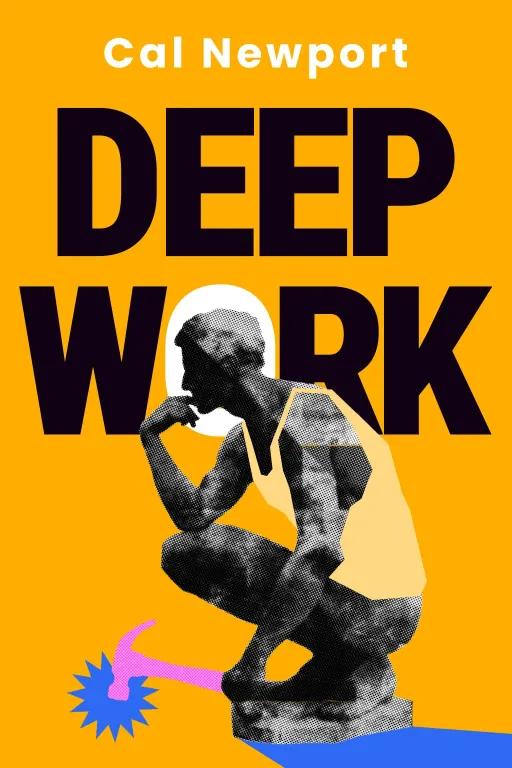
Stop Chasing Trends, Start Building Foundations: The Guide to Deep Work
Golden Hook & Introduction
SECTION
Nova: Atlas, five words. Describe your typical workday.
Atlas: Email, Slack, meetings, oh, wait, what? That’s six. Can I get a do-over? It’s just a blur.
Nova: Exactly! That "blur" is precisely what we're tackling today. We're diving deep into the world of focused productivity, drawing inspiration from two powerful books: "Deep Work" by Cal Newport and "Essentialism" by Greg McKeown. Newport, a computer science professor, makes a compelling case that the ability to focus intensely without distraction is becoming increasingly rare.
Atlas: Rare? It feels impossible! For anyone navigating a demanding work environment, the idea of "deep work" sounds like a myth. How can you possibly cultivate sustained concentration when every app, every email, every notification is vying for your attention?
Nova: That’s the core tension, isn't it? Newport argues that this ability to focus on a single task, without distraction, is rapidly becoming a superpower. Think about it: in a world where everyone is constantly context-switching, the person who can truly sit down and concentrate for hours on a complex problem delivers disproportionately higher value.
Atlas: So you’re saying that the "always-on" culture we've built, this expectation of instant responses and constant availability, is actually making us less valuable, not more? That's a bit out there.
Nova: It's not out there; it's a stark reality. The value created by deep work is often non-replicable. It's the innovative solution, the breakthrough idea, the flawlessly executed project. It’s what truly moves the needle, not the volume of emails sent.
The Scarcity and Value of Deep Work
SECTION
Nova: Imagine two software developers. Let's call them Sarah and Tom. Sarah is a master of the modern workflow. Her inbox is always open, Slack pings constantly, she checks social media every ten minutes. She's "responsive," but her deep coding blocks are constantly fragmented. She feels busy, but her major projects drag on.
Atlas: I know that feeling. It's like trying to fill a bucket with a hole in it. You're pouring in effort, but it's constantly leaking out.
Nova: Exactly. Now, Tom. Tom blocks out two hours every morning specifically for his most complex coding task. During these hours, his phone is on airplane mode, his email is closed, and his office door is shut. He's not just "working"; he's. He’s not checking his phone every five minutes.
Atlas: So, he’s not just avoiding distractions; he's actively a distraction-free environment. That’s a huge difference.
Nova: It is. The result? Tom produces higher quality code, solves problems more elegantly, and often finishes his projects faster than Sarah, even though he might appear less "busy" throughout the day. His brain isn't constantly dealing with what Newport calls "attention residue"—the leftover thoughts from a previous task that linger and diminish your cognitive capacity for the current one.
Atlas: Attention residue. That makes so much sense. That feeling of mental exhaustion at the end of a day, even if you haven't done anything physically strenuous, is often from that constant switching, isn't it? It's like your brain is trying to load too many programs at once.
Nova: Precisely. And this isn't just about software development. It applies to writing, strategic planning, complex problem-solving, even creative arts. Any task that requires sustained cognitive effort benefits immensely from deep work. The ability to enter that state, to truly focus, is becoming a rare commodity in our always-on world, and therefore, incredibly valuable.
Atlas: Wow. So, the cost of being 'always-on' isn't just lost productivity; it's a diminished capacity for truly meaningful, high-quality output. It's like we're trading depth for a false sense of breadth. But how does one even begin to cultivate this superpower? It sounds great in theory, but putting it into practice feels like an uphill battle against the entire digital ecosystem.
Essentialism as a Prerequisite for Deep Work
SECTION
Nova: That’s where our second guide, Greg McKeown and his concept of "Essentialism," comes in. Because cultivating deep work isn't just about willpower; it's fundamentally about creating the for it. And to create that space, you have to ruthlessly eliminate the non-essential.
Atlas: Eliminating? But everything feels important! For many of us, our plates are overflowing. How do you decide what's 'essential' without feeling like you're letting people down, or missing out on opportunities? That’s a massive challenge.
Nova: That's the core of Essentialism: the disciplined pursuit of less. McKeown argues that we often fall into the trap of thinking "more is better." More projects, more meetings, more commitments. But this often leads to shallow, diluted effort across too many things.
Atlas: Like trying to spread butter too thin on too much bread. You end up with a lot of bread, but no real flavor anywhere.
Nova: That’s a perfect analogy! McKeown encourages us to ask: "What is the I can do, such that by doing it, everything else will be easier or unnecessary?" It’s about identifying the vital few and eliminating the trivial many. This clarity is absolutely crucial for protecting the time and energy needed for deep work.
Atlas: So, saying no to a seemingly good opportunity might actually be a 'yes' to something more profound. That's counter-intuitive for many of us who are driven to say yes to everything. It takes courage to say no.
Nova: It takes immense courage, and it often feels uncomfortable initially. But consider it like a cluttered closet. You can't just keep buying more clothes and expect to find what you need easily. At some point, you have to go through, decide what truly fits, what serves you, and what needs to go. That act of clearing out isn't just about tidiness; it's about making space for what truly matters.
Atlas: That's a great way to put it. It’s not just about what you to your schedule, but what you. And that subtraction is what creates the margin for deep work to even happen. Without that, you’re just trying to squeeze deep work into an already overflowing, distracted life.
Nova: Exactly. Essentialism is the prerequisite. It's the filter that protects your capacity for deep work. Without it, you'll constantly be pulled into shallow tasks, reactive work, and the urgent but unimportant. You'll be busy, but not productive in the truly meaningful sense.
Synthesis & Takeaways
SECTION
Nova: So, bringing these two powerful ideas together: deep work is the engine that produces truly valuable output, but Essentialism is the fuel filter that ensures only the highest quality fuel—your focused attention—gets to that engine. You need both working in tandem.
Atlas: Yeah, and for someone who’s passionate about learning and making an impact, that really resonates. It’s not just about getting more done; it’s about doing the things, and doing them with profound focus. It’s about being intentional with your most valuable resource: your attention.
Nova: Absolutely. And while the idea of completely overhauling your work life might seem daunting, both Newport and McKeown emphasize starting small.
Atlas: What’s a tiny step a listener could take right now, to begin cultivating this? Something that feels achievable, not overwhelming.
Nova: Here’s your tiny step for tomorrow: block out just 30 minutes for a single, important task. And here’s the crucial part: turn off notifications. Put your phone in another room. Close your email tabs. Commit fully to that one task, uninterrupted.
Atlas: Thirty minutes of pure, unadulterated focus. That sounds both incredibly simple and incredibly challenging in today's world. But the idea that protecting your focus is not a luxury, but the fundamental act of creating anything truly meaningful, that’s powerful. It’s about reclaiming agency over your own attention.
Nova: It is. In a world designed to steal your attention, choosing to focus deeply is an act of rebellion, and a profound investment in yourself and the value you can create.
Atlas: And what an investment it is. Thank you, Nova, for shedding light on these crucial concepts. This is Aibrary. Congratulations on your growth!