

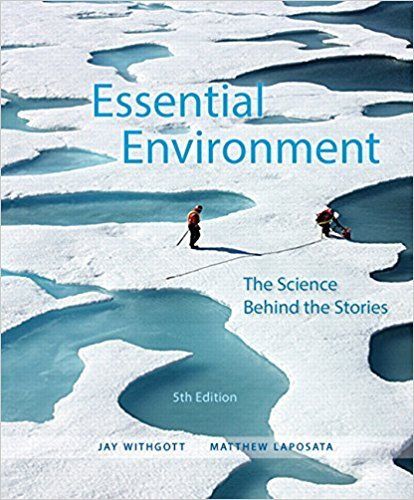
Essential Environment
The Science Behind the Stories
Introduction
Nova: Picture this. A tiny island in the South Pacific, once home to a thriving civilization that raised giant stone statues, suddenly collapses. By the time Europeans arrived in 1722, the island's society had crumbled, its forests were gone, and its people were living in caves. That island is Easter Island, and it opens one of the most widely taught environmental science textbooks in the world. Today we're diving into Essential Environment: The Science Behind the Stories by Jay H. Withgott and Matthew Laposata.
Nova: : Wait, I've heard bits of the Easter Island story before, but I never realized it was the opener for a textbook. That's a pretty dramatic way to kick off a science book. What makes this one so special?
Nova: That's the thing. Essential Environment isn't just any textbook. It's literally the number one book in the introductory environmental science market. And what sets it apart is right there in the subtitle: The Science Behind the Stories. Withgott, who actually began his career as a newspaper reporter and editor before becoming a scientific researcher, uses real-world narratives to make the science stick.
Nova: : So he's blending journalism with science education?
Nova: Exactly. He's published papers in journals like Proceedings of the National Academy of Sciences and Evolution, but he's also written for Smithsonian, New Scientist, and Science magazine. His co-author, Matthew Laposata, is a professor at Kennesaw State University who teaches over five thousand students a year in introductory environmental science courses. Together they've crafted this book — now in its sixth edition, published in 2018 — that spans 496 pages and 18 chapters, covering everything from ecosystems to energy, biodiversity to urban planning.
Nova: : Sounds like a pretty comprehensive tour of the environmental challenges we face. So where do we start?
Nova: Let's follow the book's lead and begin with that story of Easter Island. Because it turns out, that isolated piece of land in the Pacific might just be a miniature version of what we're all living on: an island in space called Earth.
The Book's Signature Approach
Science Through Stories
Nova: Every chapter of Essential Environment opens with what the authors call a Central Case Study. You don't read about abstract ecological concepts first. You read about something real — the vanishing oysters of the Chesapeake Bay, or Asian carp threatening the Great Lakes, or fracking in the Marcellus Shale. Then the science unfolds around that story.
Nova: : So it's like you're walking into a mystery, and the science becomes the detective work that explains what's happening?
Nova: That's a great way to put it. And then partway through each chapter, there's a special section called "The Science Behind the Story," where they zoom in and show you exactly how researchers gathered data and reached their conclusions. For instance, in the Easter Island chapter, the book walks through the archaeological evidence — pollen grains in sediment cores revealing ancient palm forests, carbon dating of rat bones showing when invasive species arrived, and statistical modeling of deforestation rates.
Nova: : I love that. So it's not just "here's what happened" — it's "here's how we know what happened."
Nova: Precisely. And that's Withgott's journalism background at work. He understands that people connect with narrative, with characters, with tension and resolution. So the chapter on climate change opens with rising seas threatening South Florida. The chapter on mining opens with — get this — mining for cell phones. The chapter on environmental health opens with a question: are we being poisoned by our food packaging?
Nova: : Okay, the cell phone mining one got me. I've never thought about where the minerals in my phone come from.
Nova: That's exactly the point. Withgott and Laposata want to take these enormous, sometimes overwhelming global problems and make them feel immediate and personal. They take what could be a dry catalog of environmental woes and turn it into a series of compelling human stories with real stakes. And by the end of each chapter, you understand the science, but you also remember the story.
Sustainability, Interconnectedness, and the Triple Bottom Line
The Big Ideas
Nova: If there's one central theme that runs through every single chapter of Essential Environment, it's sustainability. And the book doesn't treat sustainability as a buzzword. It grounds the concept in something called the triple bottom line — meeting environmental goals, economic goals, and social goals all at once.
Nova: : Break that down for me. What does the triple bottom line actually look like in practice?
Nova: Think of it this way. A solution that saves a forest but puts every logger out of work fails the triple bottom line. A solution that creates jobs but poisons the local water supply fails the triple bottom line. The idea is that truly sustainable solutions have to work on all three fronts: planet, people, and profit.
Nova: : So it's not about choosing between the economy and the environment?
Nova: Right. And the book is very explicit about this. It argues that environmental science isn't about advocating for one particular outcome. It's about understanding how ecological, social, and economic systems are interconnected. Chapter 5 illustrates this beautifully with the case study of Costa Rica, a country that's figured out how to value its ecosystem services — paying landowners to preserve forests because those forests provide clean water, carbon sequestration, and biodiversity that benefit the entire nation.
Nova: : That's a concrete example. The forest gets protection, landowners get income, the country gets clean water. Triple win.
Nova: Exactly. And the book traces how Costa Rica went from having one of the highest deforestation rates in the world in the 1980s to actually reversing that trend and doubling its forest cover within a generation. It wasn't magic. It was policy informed by environmental science.
Nova: : What about the bigger interconnectedness theme? How does the book show that everything is connected to everything else?
Nova: One of the most powerful throughlines is the biogeochemical cycles — the carbon cycle, nitrogen cycle, phosphorus cycle. The book shows how burning fossil fuels doesn't just affect climate. It acidifies the oceans, which kills coral reefs, which destroys fish habitat, which threatens food security for millions of people, which can drive political instability. That's one chain of connections, and the book traces it through multiple chapters — from atmospheric science to marine biology to human population and economics. Nothing happens in isolation.
From Biodiversity to Urban Planning
The Full Spectrum
Nova: One thing that really struck me about Essential Environment is the sheer breadth. It has eighteen chapters, and each one could almost be its own book. You've got evolution and biodiversity, where the Central Case Study is about saving Hawaii's native forest birds — species found nowhere else on Earth that are threatened by introduced diseases and habitat loss.
Nova: : Hawaii is basically a laboratory of evolution, right?
Nova: It is. The book dedicates a whole Science Behind the Story section to how new species form in Hawaii's isolated ecosystems. Honeycreepers — a group of birds — evolved from a single finch ancestor into dozens of species with wildly different beak shapes and lifestyles. But then the book pivots to the conservation crisis: many of these unique birds are now extinct or endangered because of mosquitoes, habitat destruction, and climate change pushing disease-carrying insects to higher elevations.
Nova: : So you see both the wonder and the loss in the same chapter.
Nova: That pattern repeats throughout. Chapter 7 on agriculture uses the case study of a farm-to-table program at Kennesaw State University — Laposata's own campus — to explore the global food system. You learn about soil degradation, water use, fertilizer runoff creating dead zones in the Gulf of Mexico, and then the book poses the question: can we feed a projected nine to ten billion people by 2050 without destroying the planet?
Nova: : That's a terrifying question.
Nova: But the book answers it. It explores sustainable agriculture — no-till farming, organic methods, integrated pest management, and even genetically modified crops as part of the solution. It also highlights a fascinating Science Behind the Story investigation into whether pesticides are contributing to the collapse of bee colonies. Spoiler: it's complicated. It's probably a mix of pesticides, parasites, disease, and habitat loss working together.
Nova: : What about energy? That seems like it would be a huge section.
Nova: Two full chapters. Chapter 15 on nonrenewable energy opens with fracking in the Marcellus Shale formation, then walks through coal, oil, natural gas, and nuclear power. Chapter 16 on renewable energy opens with Germany's ambitious solar program and evaluates wind, solar, geothermal, ocean energy, hydroelectric, bioenergy, and hydrogen. There's a fascinating Science Behind the Story section that asks: can we power the entire world with renewable energy?
Nova: : Can we?
Nova: The book lays out the data. The short answer is technically yes — the sun provides more energy to Earth in an hour than humanity uses in a year. The challenge is infrastructure, storage, politics, and economics. But the book doesn't just present problems. It shows how countries and communities are already making the transition.
The Optimistic Arc of Essential Environment
From Problems to Possibilities
Nova: Here's what I think is the most important thing about this book. It doesn't leave you in despair. After taking you through climate change, deforestation, species extinction, ocean acidification, air pollution, water scarcity, toxic chemicals, and mineral depletion, the final chapters pivot hard toward solutions.
Nova: : I was going to ask about that. How do you cover all those problems and not make students feel hopeless?
Nova: The preface of the book actually addresses this directly. Withgott writes, quote, "We truly feel there are many reasons for optimism." And he means it. Chapter 17 is about waste management with a case study on campus recycling programs. Chapter 18 is about creating sustainable cities, featuring Portland, Oregon — where Withgott himself lives — as a model of urban planning that prioritizes livability, green space, public transit, and growth management.
Nova: : Portland is famous for its urban growth boundary, right?
Nova: Yes. The book explains how Portland drew a line around the city in the 1970s and essentially said: development goes inside this boundary, and farmland and forests stay outside. It was controversial, but it prevented sprawl, preserved green space, and created a more walkable, bikeable, transit-friendly city. The Science Behind the Story section even explores whether cities like Baltimore and Phoenix can function as ecosystems themselves.
Nova: : So the message is: we can design our way out of these problems?
Nova: That's a big part of it. The epilogue is titled "Sustainable Solutions," and it brings everything together. The book argues that we already have most of the technologies and policy tools we need. What's required is political will, public understanding, and the kind of systems thinking that recognizes how everything connects.
Nova: : And that's what the book is trying to build, right? Public understanding?
Nova: Exactly. Withgott writes in the preface, and I'm paraphrasing here: environmental science is more than just a subject you study in college. It provides basic literacy in the foremost issues of the twenty-first century. And the book is designed to make that literacy accessible. It's written for nonscience majors. Laposata teaches thousands of them every year. The goal isn't to create environmental scientists. It's to create environmentally literate citizens.
Conclusion
Nova: So let's bring it all together. Essential Environment: The Science Behind the Stories by Jay Withgott and Matthew Laposata has been the dominant textbook in introductory environmental science for years, and for good reason. It takes a subject that could be abstract and overwhelming and makes it compelling through narrative, rigorous through scientific detail, and ultimately hopeful through a solutions-oriented approach.
Nova: : What I'm taking away is that the book's real innovation is the storytelling. Every chapter starts with something real — a place, a problem, a question — and then uses science to understand it. Easter Island becomes a cautionary tale about resource management. Chesapeake Bay oysters become a window into ecosystem dynamics. A cell phone becomes a lesson in mining and geology.
Nova: And the three big takeaways the book wants every reader to carry forward: First, everything is connected. Ecological systems, economic systems, social systems — they all interact, and you can't solve problems in one without understanding the others. Second, sustainability isn't just about protecting the environment. It's about meeting human needs in a way that doesn't compromise the ability of future generations to meet their own. The triple bottom line — environmental, economic, and social — has to work together.
Nova: : And third?
Nova: Third, there are reasons for optimism. The problems are real and serious — climate change, biodiversity loss, pollution, resource depletion — but solutions exist. Costa Rica doubled its forest cover. Portland redesigned itself as a sustainable city. Germany is powering itself with solar energy. The science is clear, the tools are available, and the stories in this book show that change is possible when we understand the science behind the stories.
Nova: : I started this conversation thinking a textbook would be dry, but I'm genuinely intrigued. I want to read about those Hawaiian honeycreepers now.
Nova: That's exactly the reaction Withgott and Laposata are going for. Science doesn't have to be boring. When you connect it to real places, real stories, and real stakes, it becomes something you can't look away from. And in a world facing serious environmental challenges, that kind of engagement isn't just nice to have. It's essential.
Nova: : This is Aibrary. Congratulations on your growth!
Nova: This is Aibrary. Congratulations on your growth!